
 A SCHOLARLY BOOK REPOSITORY
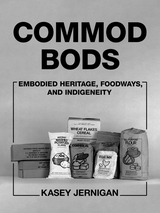
The term “commod bod” is used with humor and affection. It also offers a critical way to describe bodies shaped by long-term reliance on U.S. federal commodity food programs.
In Commod Bods, Kasey Jernigan shares her ongoing collaborative research with Choctaw women and describes the ways that shifting patterns of participation in food and nutrition assistance programs (commodity foods) have shaped foodways; how these foodways are linked to bodies and health, particularly “obesity” and related conditions; and how foodways and bodies are intertwined with settler colonialism and experiences of structural violence, identity making, and heritage in the Choctaw Nation of Oklahoma.
Organized thematically, the book moves from a critical history of obesity and health in Indian Country to narratives of Choctaw women navigating food, memory, and belonging. Chapters such as “Food and Fellowship” and “Heritage, Embodied” center personal stories that show how food is not only sustenance but also a site of connection, resistance, and meaning making.
Food is critical to cultural survival and affirmation. For Choctaw people, the intentional demise of traditional foodways and dependence on federal food programs are specific experiences that inform part of what it means to be Choctaw today.
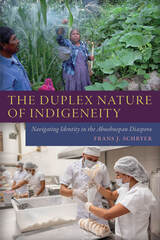
Using a variety of sources, perspectives, and methods, Schryer takes a duplexity approach, which allows understanding the complexity of social reality and its complementary nature—it identifies fields, clusters, and layers as interconnected components of social life. The innovative methods consist of the combination of ethnographic description and an ethnohistorical census that provides information on every person going back to approximately 1850. That census is further examined with the use of inferential and non-inferential statistical techniques, archival research in locations not normally accessible to scholars, Facebook, phone interviews conducted over several years, and help from Nahuatl-speaking people whose perspectives on the findings generate additional information and insights.
Unique in this presentation, which dips into the lives of generations of people to draw insight on those who lay claim to transnational Indigeneity, Schryer’s work contributes to research and theoretical discussion in the field of migration and globalization studies through a close examination of one Indigenous community over the course of many years, utilizing a mix of qualitative and quantitative research methods in anthropology.
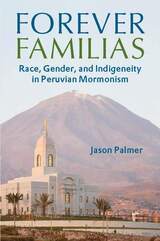
Peruvian members of the Church of Jesus Christ of Latter-day Saints face the dilemma of embracing their faith while finding space to nourish their Peruvianness. Jason Palmer draws on eight years of fieldwork to provide an on-the-ground look at the relationship between Peruvian Saints and the racial and gender complexities of the contemporary Church.
Peruvian Saints discovered that the foundational ideas of kinship and religion ceased being distinct categories in their faith. At the same time, they came to see that LDS rituals and reenactments placed coloniality in opposition to the Peruvians’ indigenous roots and family against the more expansive Peruvian idea of familia. In part one, Palmer explores how Peruvian Saints resolved the first clash by creating the idea of a new pioneer indigeneity that rejected victimhood in favor of subtle engagements with power. Part two illuminates the work performed by Peruvian Saints as they stretched the Anglo Church’s model of the nuclear family to encompass familia.
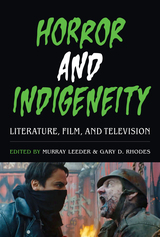
A collection of essays about Indigeneity and horror in cinema, literature, and beyond.
How did Indigeneity come to be horrifying? Think of the “Indian burial ground” trope, a staple of 1970s horror cinema, not to mention decades of western films and fictions that made “savage Indians” the face of fear in popular culture. Can horror do something else in the hands of Indegnous people? Creators such as Eden Robinson and Jeff Barnaby have self-consciously turned to horror to tell new kinds of stories, stories that question who is a monster and what constitutes the monstrous.
Horror and Indigeneity explores representations of Indigenous people in settler horror texts and in the growing corpus of horror by Indigenous writers and filmmakers. Widely spanning time periods and media, the contributors to this edited volume address themes such as cannibalism, eco-horror, historical trauma, and contemporary anti-racism as they relate to classical horror cinema and recent works such as The Dead Can’t Dance, Lovecraft Country, and Stephen Graham Jones’s The Only Good Indians. Also featuring interviews with Jones and director T. J. Cuthand, Horror and Indigeneity rethinks the terror of the Other in potent and provactive terms.


Winner of a NWSA/University of Illinois Press First Book Prize
Nishant Upadhyay unravels Indian diasporic complicity in its ongoing colonialist relationship with Indigenous peoples, lands, and nations in Canada. Upadhyay examines the interwoven and simultaneous areas of dominant Indian caste complicity in processes of settler colonialism, antiblackness, capitalism, brahminical supremacy, Hindu nationalism, and heteropatriarchy. Resource extraction in British Columbia in the 1970s–90s and in present-day Alberta offer examples of spaces that illuminate the dispossession of Indigenous peoples and simultaneously reveal racialized, gendered, and casted labor formations. Upadhyay juxtaposes these extraction sites with examples of anticolonial activism and solidarities from Tkaronto. Analyzing silence on settler colonialism and brahminical caste supremacy, Upadhyay upends the idea of dominant caste Indian diasporas as racially victimized and shows that claiming victimhood denies a very real complicity in enforcing other power structures. Exploring stories of quotidian proximity and intimacy between Indigenous and South Asian communities, Upadhyay offers meditations on anticolonial and anti-casteist ways of knowledge production, ethical relationalities, and solidarities.Groundbreaking and ambitious, Indians on Indian Lands presents the case for holding Indian diasporas accountable for acts of violence within a colonial settler nation.
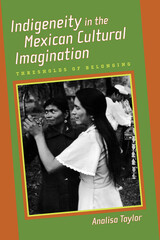
The book focuses on representations of indigenous peoples in post-revolutionary literary and intellectual history by examining key cultural texts. Using these analyses as a foundation, Analisa Taylor links her critique to national Indian policy, rights, and recent social movements in Southern Mexico. In addition, she moves beyond her analysis of indigenous peoples in general to take a gendered look at indigenous women ranging from the villainized Malinche to the highly romanticized and sexualized Zapotec women of the Isthmus of Tehuantepec.
The contradictory treatment of the Indian in Mexico’s cultural imagination is not unique to that country alone. Rather, the situation there is representative of a phenomenon seen throughout the world. Though this book addresses indigeneity in Mexico specifically, it has far-reaching implications for the study of indigenaety across Latin America and beyond. Much like the late Edward Said’s Orientalism, this book provides a glimpse at the very real effects of literary and intellectual discourse on those living in the margins of society.
This book’s interdisciplinary approach makes it an essential foundation for research in the fields of anthropology, history, literary critique, sociology, and cultural studies. While the book is ideal for a scholarly audience, the accessible writing and scope of the analysis make it of interest to lay audiences as well. It is a must-read for anyone seeking a deeper understanding of the politics of indigeneity in Mexico and beyond.

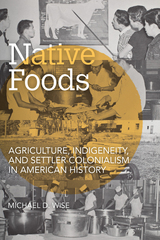
Combining original historical research with interdisciplinary perspectives and informed by the work of Indigenous food sovereignty advocates and activists, this study sheds new light on the historical roles of Native American cuisine in American history and the significance of ongoing colonial processes in present-day discussions about the place of Native foods and Native history in our evolving worlds of taste, justice, and politics.
This volume looks at how metropolitan ideas of nation employed by politicians, the media and education are produced, reproduced, and contested by people of the rural Andes—people who have long been regarded as ethnically and racially distinct from more culturally European urban citizens. Yet these peripheral “natives” are shown to be actively engaged with the idea of the nation in their own communities, forcing us to re-think the ways in which indigeneity is defined by its marginality.
The contributors examine the ways in which numerous identities—racial, generational, ethnic, regional, national, gender, and sexual—are both mutually informing and contradictory among subaltern Andean people who are more likely now to claim an allegiance to a nation than ever before. Although indians are less often confronted with crude assimilationist policies, they continue to face racism and discrimination as they struggle to assert an identity that is more than a mere refraction of the dominant culture. Yet despite the language of multiculturalism employed even in constitutional reform, any assertion of indian identity is likely to be resisted. By exploring topics as varied as nation-building in the 1930s or the chuqila dance, these authors expose a paradox in the relation between indians and the nation: that the nation can be claimed as a source of power and distinct identity while simultaneously making some types of national imaginings unattainable.
Whether dancing together or simply talking to one another, the people described in these essays are shown creating identity through processes that are inherently social and interactive. To sing, to eat, to weave . . . In the performance of these simple acts, bodies move in particular spaces and contexts and do so within certain understandings of gender, race and nation. Through its presentation of this rich variety of ethnographic and historical contexts, Natives Making Nation provides a finely nuanced view of contemporary Andean life.
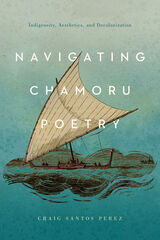
This book shows that CHamoru poetry has been an inspiring and empowering act of protest, resistance, and testimony in the decolonization, demilitarization, and environmental justice movements of Guåhan. Perez roots his intersectional cultural and literary analyses within the fields of CHamoru studies, Pacific Islands studies, Native American studies, and decolonial studies, using his research to assert that new CHamoru literature has been—and continues to be—a crucial vessel for expressing the continuities and resilience of CHamoru identities. This book is a vital contribution that introduces local, national, and international readers and scholars to contemporary CHamoru poetry and poetics.
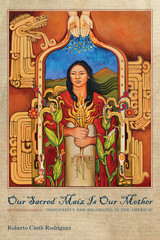
Follow it he did, and his book Our Sacred Maíz Is Our Mother changes the way we look at Mexican Americans. Not so much peoples created as a result of war or invasion, they are people of the corn, connected through a seven-thousand-year old maíz culture to other Indigenous inhabitants of the continent. Using corn as the framework for discussing broader issues of knowledge production and history of belonging, the author looks at how corn was included in codices and Mayan texts, how it was discussed by elders, and how it is represented in theater and stories as a way of illustrating that Mexicans and Mexican Americans share a common culture.
Rodriguez brings together scholarly and traditional (elder) knowledge about the long history of maíz/corn cultivation and culture, its roots in Mesoamerica, and its living relationship to Indigenous peoples throughout the continent, including Mexicans and Central Americans now living in the United States. The author argues that, given the restrictive immigration policies and popular resentment toward migrants, a continued connection to maíz culture challenges the social exclusion and discrimination that frames migrants as outsiders and gives them a sense of belonging not encapsulated in the idea of citizenship. The “hidden transcripts” of corn in everyday culture—art, song, stories, dance, and cuisine (maíz-based foods like the tortilla)—have nurtured, even across centuries of colonialism, the living maíz culture of ancient knowledge.
How were indigenous social practices deemed queer and aberrant by colonial forces?
In Queering Colonial Natal, T.J. Tallie travels to colonial Natalestablished by the British in 1843, today South Africa’s KwaZulu-Natal provinceto show how settler regimes “queered” indigenous practices. Defining them as threats to the normative order they sought to impose, they did so by delimiting Zulu polygamy; restricting alcohol access, clothing, and even friendship; and assigning only Europeans to government schools.
Using queer and critical indigenous theory, this book critically assesses Natal (where settlers were to remain a minority) in the context of the global settler colonial project in the nineteenth century to yield a new and engaging synthesis. Tallie explores the settler colonial history of Natal’s white settlers and how they sought to establish laws and rules for both whites and Africans based on European mores of sexuality and gender. At the same time, colonial archives reveal that many African and Indian people challenged such civilizational claims.
Ultimately Tallie argues that the violent collisions between Africans, Indians, and Europeans in Natal shaped the conceptions of race and gender that bolstered each group’s claim to authority.
Klopotek describes the varied effects of the recognition process on the social and political structures, community cohesion, cultural revitalization projects, identity, and economic health of each tribe. He emphasizes that recognition policy is not the only racial project affecting Louisiana tribes. For the Tunica-Biloxis, the Jena Band of Choctaws, and the Clifton-Choctaws, discourses around blackness and whiteness have shaped the boundaries of Indian identity in ways that have only begun to be explored. Klopotek urges scholars and officials from the Bureau of Indian Affairs (BIA) to acknowledge the multiple discourses and viewpoints influencing tribal identities. At the same time, he puts tribal recognition in broader perspective. Indigenous struggles began long before the BIA existed, and they will continue long after it renders any particular recognition decision.
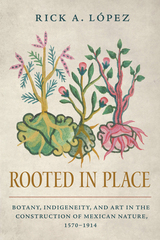
Focusing on the ways people, environment, and policies have been affected by political boundaries, historian Rick A. López explores the historical connections between political identities and the natural world. López analyzes how scientific intellectuals laid claim to nature within Mexico, first on behalf of the Spanish Empire and then in the name of the republic, during three transformative moments: the Hernández expedition of the late sixteenth century; the Royal Botanical Expedition of the late eighteenth century; and the heyday of scientific societies such as the Sociedad Mexicana de Historia Natural of the late nineteenth century.
This work traces how scientific intellectuals studied and debated what it meant to know and claim the flora that sprang from Mexican soil—ranging from individual plants to forests and vegetated landscapes—and the importance they placed on indigeneity. It also points to the short- and long-term consequences of these efforts. López draws on archival and published sources produced from the sixteenth century through the start of the twentieth century and gives special attention to the use of visual images such as scientific illustrations and landscape art. López employs the term “visualization” in recognition of the degree to which officials, botanists, and draftsmen produced imagery and also how they and others viewed nature.
Rooted in Place reveals how scientific endeavors were not just about cataloging flora but were deeply intertwined with the construction of identity and the political landscape at three pivotal moments in Mexican history.
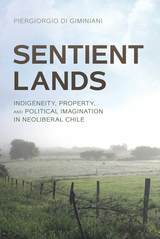
Sentient Lands is a historically grounded ethnography of the Mapuche people’s engagement with state-run reconciliation and land-restitution efforts. Piergiorgio Di Giminiani analyzes environmental relations, property, state power, market forces, and indigeneity to illustrate how land connections are articulated, in both landscape experiences and land claims. Rather than viewing land claims as simply bureaucratic procedures imposed on local understandings and experiences of land connections, Di Giminiani reveals these processes to be disputed practices of world making.
Ancestral land formation is set in motion by the entangled principles of Indigenous and legal land ontologies, two very different and sometimes conflicting processes. Indigenous land ontologies are based on a relation between two subjects—land and people—both endowed with sentient abilities. By contrast, legal land ontologies are founded on the principles of property theory, wherein land is an object of possession that can be standardized within a regime of value. Governments also use land claims to domesticate Indigenous geographies into spatial constructs consistent with political and market configurations.
Exploring the unexpected effects on political activism and state reparation policies caused by this entanglement of Indigenous and legal land ontologies, Di Giminiani offers a new analytical angle on Indigenous land politics.
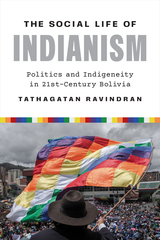
A sophisticated analysis of an influential Indigenous political ideology.
When the political ideology known as “Indianism” developed in Bolivia in the 1960s, it was premised on a rejection of Bolivian nationalism. Over the ensuing decades, however, it underwent several mutations as it moved out of a close circle of intellectuals to grip the urban masses that brought Evo Morales—the first Indigenous president—to power in 2006.
The Social Life of Indianism offers a fresh perspective by examining Bolivian Indigenous politics through the lens of political ideology. Through an ethnographic study of Indianism in the city of El Alto, Tathagatan Ravindran shows how canonical Indianism—the original ideology that rejects Bolivia as enslaver of the Indian nation—provided philosophical ballast for exponents of a more popular folk Indianism that accommodates the Bolivian state and pursues Indigenous empowerment within it. Synthesizing approaches from several disciplines, Ravindran demonstrates how canonical Indianism was not refuted or supplanted; it refracted, in the broader public, into a new common sense. A sophisticated analysis of a complex political landscape, The Social Life of Indianism brings much-needed nuance to one of the most prominent forms of Indigenous ideology and offers a unique framework for analyzing political ideologies across the contemporary world.

This wide-ranging collection addresses the political possibilities of Western law and the international meanings of sovereignty and Indigeneity. One essay analyzes the autonomous government through which local citizens in Indigenous Zapatista communities in Mexico hope to dissolve systems of top-down sovereignty altogether. Another explores narratives of Native American law and the treatment of sovereignty in contemporary Mohawk visual culture. Several essays discuss the legal and political implications of the field’s pivotal public documents, including the 2007 U.N. Declaration on the Rights of Indigenous Peoples.
Eric Cheyfitz is the Ernest I. White Professor of American Studies and Humane Letters in the Department of English at Cornell University. N. Bruce Duthu is the Samson Occom Professor of Native American Studies and Chair of the Native American Studies Program at Dartmouth College. Shari M. Huhndorf is Associate Professor of English at the University of Oregon.
Contributors: Christine Black, Eric Cheyfitz, Gordon Christie, Chris Cunneen, Jonathan Goldberg-Hiller, Lorie M. Graham, Roy M. Huhndorf, Shari M. Huhndorf, Forrest Hylton, Mara Kaufman, Alvaro Reyes, Jolene Rickard, Carlos Salinas, Noenoe K. Silva, Cheryl Suzack, Siegfried Wiessner
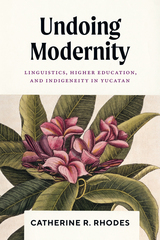
An ethnography of the decolonization of Maya-ness.
On the Yucatan Peninsula today, undergraduates are inventing a new sense of being Maya by studying linguistics and culture in their own language: Maya. In this bold theoretical intervention informed by ethnographic research, Catherine Rhodes argues that these students are undoing the category of modernity itself. Created through colonization of the Americas, modernity is the counterpart to coloniality; the students, Rhodes suggests, are creating decoloniality’s companion: “demodernity.”
Disciplines like linguistics, anthropology, history, and archaeology invented “the Maya” as an essentialized ethnos in a colonial, modern mold. Undoing Modernity follows students and their teachers as they upset the seemingly stable ethnic definition of Maya, with its reliance on a firm dichotomy of Maya and modern. Maya linguistics does not prove that Maya is modern but instead rejects the Maya-ness that modernity built, while also fostering within the university an intellectual space in which students articulate identity on their own terms. An erudite and ultimately hopeful work of interdisciplinary scholarship that brings linguistic anthropology, Mesoamerican studies, and critical Indigenous studies into the conversation, Undoing Modernity dares to imagine the world on the other side of colonial/modern ideals of Indigeneity.
READERS
Browse our collection.
PUBLISHERS
See BiblioVault's publisher services.
STUDENT SERVICES
Files for college accessibility offices.
RECENTLY PUBLISHED






UChicago Accessibility Resources
home | accessibility | search | about | contact us
BiblioVault ® 2001 - 2025
The University of Chicago Press