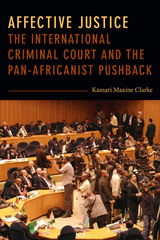
front cover of Affective Justice
Affective Justice
The International Criminal Court and the Pan-Africanist Pushback
Kamari Maxine Clarke
Duke University Press, 2019
Since its inception in 2001, the International Criminal Court (ICC) has been met with resistance by various African states and their leaders, who see the court as a new iteration of colonial violence and control. In Affective Justice Kamari Maxine Clarke explores the African Union's pushback against the ICC in order to theorize affect's role in shaping forms of justice in the contemporary period. Drawing on fieldwork in The Hague, the African Union in Addis Ababa, sites of postelection violence in Kenya, and Boko Haram's circuits in Northern Nigeria, Clarke formulates the concept of affective justice—an emotional response to competing interpretations of justice—to trace how affect becomes manifest in judicial practices. By detailing the effects of the ICC’s all-African indictments, she outlines how affective responses to these call into question the "objectivity" of the ICC’s mission to protect those victimized by violence and prosecute perpetrators of those crimes. In analyzing the effects of such cases, Clarke provides a fuller theorization of how people articulate what justice is and the mechanisms through which they do so.
[more]

logo for Rutgers University Press
The Dilemma of Dominic Ongwen
From Child Soldier to the International Criminal Court
Kjell Anderson
Rutgers University Press, 2027

Dominic Ongwen was abducted by Joseph Kony's Lord's Resistance Army while walking to school at the age of nine. He later rose through its ranks committing, and ultimately being convicted by the International Criminal Court (ICC) of, many of the same crimes of which he was once a victim. The Dilemma of Dominic Ongwen tells this extraordinary story through the voices of those who knew him best: family members, fighters, commanders, “wives,” victims, and trial participants. Their testimonies, gathered in Uganda and The Hague, form the backbone of a narrative that interlaces survivor accounts with legal analysis and vivid excerpts from the ICC trial. The book offers a rare, human-centered lens on international justice, illuminating the dilemmas of prosecuting a former child soldier for mass atrocities. It provides indispensable insights for scholars of international criminal law, transitional justice, political violence, trauma, and human rights. 

[more]


Send via email Share on Facebook Share on Twitter