
 A SCHOLARLY BOOK REPOSITORY
14 start with C start with C

Rudolphina Menzel (née Waltuch, 1891–1973), was a Viennese-born, Jewish scientist whose pioneering research on canine psychology, development, and behavior fundamentally shaped the ways dogs came to be trained, cared for, and understood. Between the two world wars, Menzel was known throughout Europe as one of the foremost breeders and trainers of police dogs and served as a sought-after consultant at Kummersdorf, the German military dog training institute in Berlin. She was also a fervent Zionist who was responsible for inventing the canine infrastructure in what came to be the State of Israel and for training hundreds of dogs to protect Jewish lives and property in pre-state Palestine. Teaching Jews to like dogs and training dogs to serve Jews became Menzel’s unique kind of Zionist mission. Detailed and insightful, Canine Pioneer: The Extraordinary Life of Rudolphina Menzel brings to light an important piece of history.
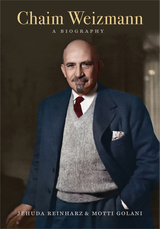
In Chaim Weizmann: A Biography, Jehuda Reinharz and Motti Golani show how Weizmann, a leader of the World Zionist Organization who became the first president of Israel, advocated for a Jewish state by gaining the support of influential politicians and statesmen as well as Jews around the world. Beginning with his childhood in Belorussia and concluding with his tenure as president, Reinharz and Golani describe how a Russian Jew, who immigrated to the United Kingdom in the early twentieth century, was able to advance the goals of Theodor Herzl, the founder of the Zionist Organization. Weizmann is also shown as a man of human foibles—his infatuations, political machinations, and elitism—as well as a man of admirable qualities—intelligence, wit, charisma, and dedication.
Weizmann, who came to the UK to work as a biochemist, was in regular communication with British political figures, including prime ministers Arthur James Balfour, David Lloyd George, Winston Churchill, and Ramsay MacDonald. He also met presidents of the United States from Woodrow Wilson to Harry Truman. His success in earning the support of British political figures helped lead to the Balfour Declaration, which advocated for a “national home” for the Jewish people in Palestine.
As the authors show in this authoritative account of Weizmann’s life, Weizmann was guided by the belief that “Zion shall be redeemed in justice,” a phrase that recurs often in his writings.
Drawing on a newly developed theoretical definition of “missed opportunity,” Chances for Peace uses extensive sources in English, Hebrew, and Arabic to systematically measure the potentiality levels of opportunity across some ninety years of attempted negotiations in the Arab-Israeli conflict. With enlightening revelations that defy conventional wisdom, this study provides a balanced account of the most significant attempts to forge peace, initiated by the world’s superpowers, the Arabs (including the Palestinians), and Israel. From Arab-Zionist negotiations at the end of World War I to the subsequent partition, the aftermath of the 1967 War and the Sadat Initiative, and numerous agreements throughout the 1980s and 1990s, concluding with the Annapolis Conference in 2007 and the Abu Mazen-Olmert talks in 2008, pioneering scholar Elie Podeh uses empirical criteria and diverse secondary sources to assess the protagonists’ roles at more than two dozen key junctures.
A resource that brings together historiography, political science, and the practice of peace negotiation, Podeh’s insightful exploration also showcases opportunities that were not missed. Three agreements in particular (Israeli-Egyptian, 1979; Israeli-Lebanese, 1983; and Israeli-Jordanian, 1994) illuminate important variables for forging new paths to successful negotiation. By applying his framework to a broad range of power brokers and time periods, Podeh also sheds light on numerous incidents that contradict official narratives. This unique approach is poised to reshape the realm of conflict resolution.
By delving into the history of American Jews’ philanthropic giving to Israelis, Fleisch assesses the core nature of power sharing between both sides of the Jewish diaspora to the United States through in-depth contemporary case studies of the relationship between sixteen non-governmental organizations and their American Jewish donors. Field observation, document analysis, and interviews with leaders, activists, and select donors alike serve a critical role here, as Fleisch assesses whether these contemporary philanthropic associations repeat classic dynamics of power-sharing or whether they represent a marked departure from the Checkbook Zionism of old. The result is a new paradigm for evaluating power sharing that can be applied to future considerations of development in the Israel-Diaspora relationship.

With majestic sweep and sparkling detail, this magnificent volume brings to life the great and ancient drama of the world's holiest city on the eve of a new millennium. Some three thousand years ago King David captured Jerusalem from the Jebusites and made the city his capital. There Solomon built the Temple and the Jewish people found their spiritual center. From its glory under the House of David to its emergence a thousand years later as the birthplace of Christianity, from its destruction by the Romans to its conquest by the forces of Islam and its Crusader and Ottoman periods, Jerusalem has been endlessly revered and warred over, passionately celebrated and desecrated. Mining the rich evidence of this remarkable history, the world-renowned authors gathered here conjure the Holy City as it has appeared in antique Hebrew texts; in the testimony of Jewish and Christian pilgrims and in art; in medieval Islamic literature and in western nineteenth-century accounts; in maps and mosaics and architecture through the ages.
Here is Jerusalem in its physical splendor, the sun rising over the Mount of Olives to touch the golden crown of the Dome of the Rock and warm the crenelated walls of the Old City, with its foundations from the days of the Hasmoneans and Herod the Great, its seven gates and Jewish, Christian, Armenian, and Muslim quarters marked out by the Roman decumanus and the Byzantine cardo. Above the Ramban Synagogue, established by Nachmanides in 1267, looms the minaret of the fifteenth-century Sidi Umar Mosque. Nearby are the foundations and apses of the Crusader Church of St. Mary of the German Knights, which in turn abuts the underground Herodian Quarter, with its fresco-covered walls, mosaic floors, and opulent baths. Remnants of the Nea Church erected by Justinian in 543 and of the Ayyubid tower from the thirteenth century stand within the Garden of Redemption, a memorial to the six million Jews exterminated by the Nazis.
Amid these marvels of geography and architecture, the authors evoke Jerusalem's spiritual history, the events and legends that have made the city the touching point between the divine and the earthly for Jews, Christians, and Muslims alike. They trace Jerusalem's fortunes as the City of David, as the site of the Crucifixion and Resurrection of Jesus, as the "Furthest Shrine" from which the Prophet Mohammed ascended to heaven. Writing from an enlightening variety of backgrounds and perspectives, the authors share a depth of feeling for their subject that imparts a warmth and immediacy to their depiction of the city in all its historic grandeur and religious complexity. An Armenian Jerusalemite once wrote that in the Holy City each person carries a mirror, but each holds it in only one direction. This book brings all these reflections together to create a living picture of Jerusalem not only in history but also in the hearts of those who call it home and those who revere it as a Holy City.
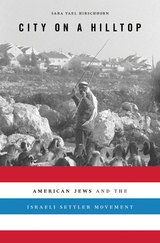
Since 1967, more than 60,000 Jewish-Americans have settled in the territories captured by the State of Israel during the Six Day War. Comprising 15 percent of the settler population today, these immigrants have established major communities, transformed domestic politics and international relations, and committed shocking acts of terrorism. They demand attention in both Israel and the United States, but little is known about who they are and why they chose to leave America to live at the center of the Israeli-Palestinian conflict.
In this deeply researched, engaging work, Sara Yael Hirschhorn unsettles stereotypes, showing that the 1960s generation who moved to the occupied territories were not messianic zealots or right-wing extremists but idealists engaged in liberal causes. They did not abandon their progressive heritage when they crossed the Green Line. Rather, they saw a historic opportunity to create new communities to serve as a beacon—a “city on a hilltop”—to Jews across the globe. This pioneering vision was realized in their ventures at Yamit in the Sinai and Efrat and Tekoa in the West Bank. Later, the movement mobilized the rhetoric of civil rights to rebrand itself, especially in the wake of the 1994 Hebron massacre perpetrated by Baruch Goldstein, one of their own.
On the fiftieth anniversary of the 1967 war, Hirschhorn illuminates the changing face of the settlements and the clash between liberal values and political realities at the heart of the Israeli-Palestinian conflict.
Described by the New York Times as one of two American journals in which public intellectuals and other scholars prefer to publish, the highly acclaimed Common Knowledge has returned to publication after a two-year hiatus. In an effort to place itself in the ferment of intellectual life and broaden its geographical range, the journal has moved to the Middle East, to Israel. Born in an attempt to moderate and get past the "culture wars" of the 90s, Common Knowledge has moved, literally, to a war zone, and accordingly its editorial interests have broadened to include culture wars of a less metaphorical kind.
Its mission is both incredibly ambitious and shockingly simple: to open up lines of communication between the academy and the community of thoughtful people outside its walls. Common Knowledge was created to form a new intellectual model, one based on conversation or cooperation rather than on metaphors adopted from sports and war, of "sides" that one must "take." The journal will collect work from a variety of fields and specialties, including philosophy, religion, psychology, literary criticism, cultural studies, art history, political science, and social, cultural, and intellectual history.
Scholars such as Richard Rorty, Bruno Latour, Clifford Geertz, Julia Kristeva, Karma Nabulsi, and J. G. A. Pocock will cross paths with political figures like Prince Hassan of Jordan and President Arpad Goncz of Hungary, novelists like Susan Sontag, poets like Yves Bonnefoy, composers like Alexander Goehr, and journalists like Adam Michnik. The pages of Common Knowledge are sure to challenge the ways we think about theory and its relevance to humanity. The first volume will feature the beginning of a Seriatim Symposium, “Disagreement, Enmity, and Dispute,” which will include discussions of the title concepts from a variety of theoretical perspectives. The Symposium asks why, in an intellectual context in which “true” and “real” are words that can be used only in condescending scare quotes, there is so much absolute conflict. If truth and reality are constructions, then why aren’t we constructing consensual orders (metaphysical and social) that are conducive to peace, calm, and cooperation?
Contributors for forthcoming issues include: Manfred Frank, Jacques Le Goff, Vicki Hearne, Sissela Bok, Edward Cardinal Cassidy, Linda Hutcheon, G. Thomas Tanselle, Arlette Farge, Marcel Detienne, Caryl Emerson, Stanley Katz, and Peter Laslett.
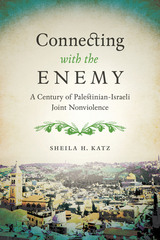
Thousands of ordinary people in Israel and Palestine have engaged in a dazzling array of daring and visionary joint nonviolent initiatives for more than a century. They have endured despite condemnation by their own societies, repetitive failures of diplomacy, harsh inequalities, and endemic cycles of violence.
Connecting with the Enemy presents the first comprehensive history of unprecedented grassroots efforts to forge nonviolent alternatives to the lethal collision of the two national movements. Bringing to light the work of over five hundred groups, Sheila H. Katz describes how Arabs and Jews, children and elders, artists and activists, educators and students, garage mechanics and physicists, and lawyers and prisoners have spoken truth to power, protected the environment, demonstrated peacefully, mourned together, stood in resistance and solidarity, and advocated for justice and security. She also critiques and assesses the significance of their work and explores why these good-will efforts have not yet managed to end the conflict or occupation. This previously untold story of Palestinian-Israeli joint nonviolence will challenge the mainstream narratives of terror and despair, monsters and heroes, that help to perpetuate the conflict. It will also inspire and encourage anyone grappling with social change, peace and war, oppression and inequality, and grassroots activism anywhere in the world.
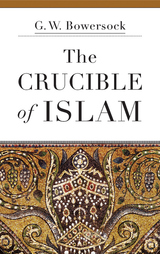
Little is known about Arabia in the sixth century, yet from this distant time and place emerged a faith and an empire that stretched from the Iberian peninsula to India. Today, Muslims account for nearly a quarter of the global population. A renowned classicist, G. W. Bowersock seeks to illuminate this obscure and dynamic period in the history of Islam—exploring why arid Arabia proved to be such fertile ground for Muhammad’s prophetic message, and why that message spread so quickly to the wider world. The Crucible of Islam offers a compelling explanation of how one of the world’s great religions took shape.
“A remarkable work of scholarship.”
—Wall Street Journal
“A little book of explosive originality and penetrating judgment… The joy of reading this account of the background and emergence of early Islam is the knowledge that Bowersock has built it from solid stones… A masterpiece of the historian’s craft.”
—Peter Brown, New York Review of Books
READERS
Browse our collection.
PUBLISHERS
See BiblioVault's publisher services.
STUDENT SERVICES
Files for college accessibility offices.
RECENTLY PUBLISHED


UChicago Accessibility Resources
home | accessibility | search | about | contact us
BiblioVault ® 2001 - 2024
The University of Chicago Press