
 A SCHOLARLY BOOK REPOSITORY
5 start with J start with J
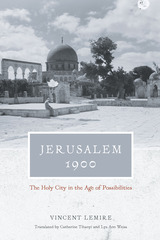
In this masterly history, Lemire uses newly opened archives to explore how Jerusalem’s elite residents of differing faiths cooperated through an intercommunity municipal council they created in the mid-1860s to administer the affairs of all inhabitants and improve their shared city. These residents embraced a spirit of modern urbanism and cultivated a civic identity that transcended religion and reflected the relatively secular and cosmopolitan way of life of Jerusalem at the time. These few years would turn out to be a tipping point in the city’s history—a pivotal moment when the horizon of possibility was still open, before the council broke up in 1934, under British rule, into separate Jewish and Arab factions. Uncovering this often overlooked diplomatic period, Lemire reveals that the struggle over Jerusalem was not historically inevitable—and therefore is not necessarily intractable. Jerusalem 1900 sheds light on how the Holy City once functioned peacefully and illustrates how it might one day do so again.
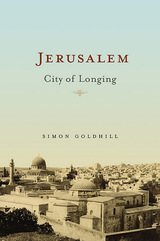
Jerusalem is the site of some of the most famous religious monuments in the world, from the Dome of the Rock to the Church of the Holy Sepulchre to the Western Wall of the Temple. Since the nineteenth century, the city has been a premier tourist destination, not least because of the countless religious pilgrims from the three Abrahamic faiths.
But Jerusalem is more than a tourist site—it is a city where every square mile is layered with historical significance, religious intensity, and extraordinary stories. It is a city rebuilt by each ruling Empire in its own way: the Jews, the Romans, the Christians, the Muslims, and for the past sixty years, the modern Israelis. What makes Jerusalem so unique is the heady mix, in one place, of centuries of passion and scandal, kingdom-threatening wars and petty squabbles, architectural magnificence and bizarre relics, spiritual longing and political cruelty. It is a history marked by three great forces: religion, war, and monumentality.
In this book, Simon Goldhill takes on this peculiar archaeology of human imagination, hope, and disaster to provide a tour through the history of this most image-filled and ideology-laden city—from the bedrock of the Old City to the towering roofs of the Holy Sepulchre. Along the way, we discover through layers of buried and exposed memories—the long history, the forgotten stories, and the lesser-known aspects of contemporary politics that continue to make Jerusalem one of the most embattled cities in the world.
Jewish Self-Determination beyond Zionism also engages a Humanist Zionist vision to confront the Zionist movement’s foundational sins and demands a full reckoning with the Palestinians. Graubart focuses on two of Humanist Zionism’s most insightful thinkers, Martin Buber and Hannah Arendt, putting them “in conversation” with each other, and synthesizing their collective insights and critical Jewish perspectives alongside the ideas of Noam Chomsky, Judith Butler, Ella Shohat, Edward Said, and other philosophers and academics. Jewish Self-Determination beyond Zionism concludes that an updated, binational program is the best path forward.
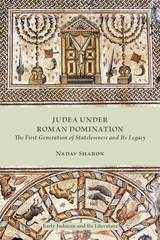
Investigate a relatively neglected but momentous period in Judean history
Nadav Sharon closely examines a critical period in Judean history, which saw the end of the Hasmonean dynasty and the beginning of Roman domination of Judea leading up to the kingship of Herod (67-37 BCE). In this period renowned Roman figures such as Pompey the Great, Julius Caesar, Gaius Cassius (a conspirator against Caesar), and Mark Anthony, led the Roman Republic on the eve of its transformation into an Empire, each having his own dealings with—and holding sway over—Judea at different times. This volume explores the impact of the Roman conquest on the authors of the Dead Sea Scrolls, enhances the understanding of later Judean-Roman relations and the roots of the Great Revolt, and examines how this early period of Roman domination had on impact on later developments in Judean society and religion.
Features:
- Part one dedicating to reconstructing Judean history from the death of Alexander to the reign of King Herod
- Part two examining the effects of Roman domination on Judean society
- Maps, illustrations, and appendices
READERS
Browse our collection.
PUBLISHERS
See BiblioVault's publisher services.
STUDENT SERVICES
Files for college accessibility offices.
RECENTLY PUBLISHED






UChicago Accessibility Resources
home | accessibility | search | about | contact us
BiblioVault ® 2001 - 2024
The University of Chicago Press