
 A SCHOLARLY BOOK REPOSITORY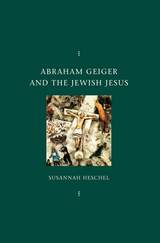
Geiger, a pioneer of Reform Judaism and a founder of Jewish studies, developed a Jewish version of Christian origins. He contended that Jesus was a member of the Pharisees, a progressive and liberalizing group within first-century Judaism, and that he taught nothing new or original. This argument enraged German Protestant theologians, some of whom produced a tragic counterargument based on racial theory.
In this fascinating book, Susannah Heschel traces the genesis of Geiger's argument and examines the reaction to it within Christian theology. She concludes that Geiger initiated an intellectual revolt by the colonized against the colonizer, an attempt not to assimilate into Christianity by adopting Jesus as a Jew, but to overthrow Christian intellectual hegemony by claiming that Christianity—and all of Western civilization—was the product of Judaism.
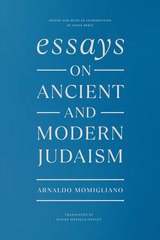
Momigliano acknowledged that his Judaism was the most fundamental inspiration for his scholarship, and the writings in this collection demonstrate how the ethical experience of the Hebraic tradition informed his other works. Part 1 is devoted entirely to writings on ancient and medieval Judaism. In these essays, Momigliano ranges over such subjects as the stages of rapport between Hellenism and Judaism, the figure of Flavius Josephus, and the salient moments of Maccabean history. Part 2 comprises Momigliano's writings on modern subjects. Here are profiles of Jewish scholars of the classical world (Bernays, Bickerman, and Finley) together with those of eminent representatives of contemporary Jewish thought (Strauss, Scholem, and Benjamin). These essays gain special significance alongside Momigliano's reflections on Italian Jewry and the Weberian interpretation of Judaism.
Silvia Berti's Introduction discusses Momigliano's religious and intellectual formation, the key events of his life, and the influence of Judaism on his mature scholarship. In his Preface, Momigliano offers a personal meditation on his own Judaism and that of his family.
By the time of his death, Momigliano had acquired an international following. This volume will at last give his admirers in the English-speaking world easy access to an important body of his work.
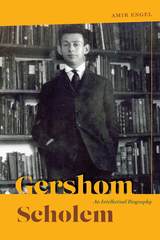
As Engel shows, in his search for the truth of Jewish mysticism Scholem molded the vast literature of Jewish mystical lore into a rich assortment of stories that unveiled new truths about the modern condition. Positioning Scholem’s work and life within early twentieth-century Germany, Palestine, and later the state of Israel, Engel intertwines Scholem’s biography with his historiographical work, which stretches back to the Spanish expulsion of Jews in 1492, through the lives of Rabbi Isaac Luria and Sabbatai Zevi, and up to Hasidism and the dawn of the Zionist movement. Through parallel narratives, Engel touches on a wide array of important topics including immigration, exile, Zionism, World War One, and the creation of the state of Israel, ultimately telling the story of the realizations—and failures—of a dream for a modern Jewish existence.
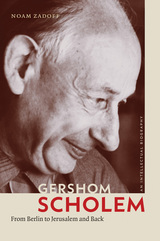
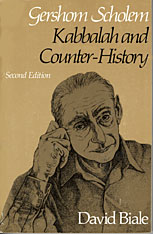
Through a lifetime of passionate scholarship, Gershom Scholem (1897–1982) uncovered the “domains of tradition hidden under the debris of centuries” and made the history of Jewish mysticism and messianism comprehensible and relevant to current Jewish thought.
In this paperback edition of his definitive book on Scholem’s work, David Biale has shortened and rearranged his study for the benefit of the general reader and the student. A new introduction and new passages in the main text highlight the pluralistic character of Jewish theology as seen by Scholem, the place of the Kabbalah in debates over Zionism versus assimilation, and the interpretation of Kafka as a Jewish writer.

In describing the career of Abraham Yagel, a Jewish physician, kabbalist, and naturalist who lived in northern Italy from 1553 to about 1623, David Ruderman observes the remarkable interplay between early modern scientific thought and religious and occult traditions from a wholly new perspective: that of Jewish intellectual life.
Whether he was writing about astronomical discoveries, demons, marvelous creatures and prodigies of nature, the uses of magic, or reincarnation, Yagel made a consistent effort to integrate empirical study of nature with kabbalistic and rabbinic learning. Yagel's several interests were united in his belief in the interconnectedness of all thing—a belief, shared by many Renaissance thinkers, that turns natural phenomena into “signatures” of the divine unity of all things. Ruderman argues that Yagel and his coreligionists were predisposed to this prevalent view because of occult strains in traditional Jewish thought He also suggests that underlying Yagel's passion for integrating and correlating all knowledge was a powerful psychological need to gain cultural respect and acceptance for himself and for his entire community, especially in a period of increased anti-Semitic agitation in Italy.
Yagel proposed a bold new agenda for Jewish culture that underscored the religious value of the study of nature, reformulated kabbalist traditions in the language of scientific discourse so as to promote them as the highest form of human knowledge, and advocated the legitimate role of the magical arts as the ultimate expression of human creativity in Judaism. This portrait of Yagel and his intellectual world will well serve all students of late Renaissance and early modern Europe.
For decades, Gershom Scholem kept these diaries locked away, returning to them only to refresh his memory of past events and eloquent observations. They remained unread by others until the meticulously edited German edition of this book appeared in 2002.
Lamentations of Youth gives insight into a crucial stage in Scholem's life, beginning when he was a student in Berlin during the First World War, a time of incubation and growth for his later ideas. Much of the journal writing, however, took place in Switzerland, a magnet for radical artists, socialist intellectuals, and revolutionaries fleeing war. The diaries are where Scholem forges his anarchic orthodoxy, and where he chronicles his intense relationship with Walter Benjamin. Many entries have the crisp quality of literary aphorisms crafted in the great German tradition of Kafka and Canetti.
For Scholem and Benjamin, the time they spent together in Switzerland spawned an astoundingly original view of literary criticism, interpretation, and cultural transmission. More personally, the themes of friendship, love, and heartbreak that dominate these pages later reemerge in Scholem's scholarship. No longer is the inner life of the critic seen as distinct from his textual criticism--they are deeply and esoterically intertwined.
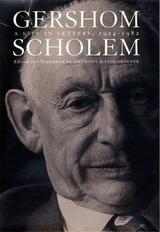
Perhaps the greatest scholar of Jewish mysticism in the twentieth century, Gershom Scholem (1897–1982) once said of himself, “I have no biography, only a bibliography.” Yet, in thousands of letters written over his lifetime, his biography does unfold, inscribing a life that epitomized the intellectual ferment and political drama of an era. This selection of the best and most representative letters—drawn from the 3000 page German edition—gives readers an intimate view of this remarkable man, from his troubled family life in Germany to his emergence as one of the leading lights of Israel during its founding and formative years.
In the letters, we witness the travails and vicissitudes of the Scholem family, a drama in which Gershom is banished by his father for his anti-kaiser Zionist sentiments; his antiwar, socialist brother is hounded and murdered; and his mother and remaining brothers are forced to emigrate. We see Scholem’s friendships with some of the most intriguing intellectuals of the twentieth century—such as Hannah Arendt, Walter Benjamin, and Theodor Adorno—blossom and, on occasion, wither. And we learn firsthand about his Zionist commitment and his scholarly career, from his move to Palestine in the 1920s to his work as Professor of Jewish Mysticism at the Hebrew University. Over the course of seven decades that comprised the most significant events of the twentieth century, these letters reveal how Scholem’s scholarship is informed by the experiences he so eloquently described.
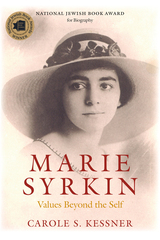
Marie Syrkin’s life spanned ninety years of the twentieth century, 1899–1989. As a polemical journalist, socialist Zionist, poet, educator, literary critic, translator, and idiosyncratic feminist, she was an eyewitness to and reporter on most of the major events in America, Israel, and Europe. Beautiful as well as brilliant, she had a rich personal life as a lover, wife, mother, and friend. During her lifetime Syrkin’s name was widely recognized in the world of Jewish life and letters. Yet, since Syrkin’s death, recognition of her name is no longer quite so immediate. Carole S. Kessner’s biography restores Syrkin’s fascinating life and legacy for a new generation.
READERS
Browse our collection.
PUBLISHERS
See BiblioVault's publisher services.
STUDENT SERVICES
Files for college accessibility offices.
RECENTLY PUBLISHED


UChicago Accessibility Resources
home | accessibility | search | about | contact us
BiblioVault ® 2001 - 2025
The University of Chicago Press