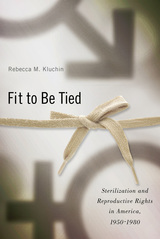
front cover of Fit to Be Tied
Fit to Be Tied
Sterilization and Reproductive Rights in America, 1950-1980
Kluchin, Rebecca M
Rutgers University Press, 2011
The 1960s revolutionized American contraceptive practice. Diaphragms, jellies, and condoms with high failure rates gave way to newer choices of the Pill, IUD, and sterilization. Fit to Be Tied provides a history of sterilization and what would prove to become, at once, socially divisive and a popular form of birth control.

During the first half of the twentieth century, sterilization (tubal ligation and vasectomy) was a tool of eugenics. Individuals who endorsed crude notions of biological determinism sought to control the reproductive decisions of women they considered "unfit" by nature of race or class, and used surgery to do so. Incorporating first-person narratives, court cases, and official records, Rebecca M. Kluchin examines the evolution of forced sterilization of poor women, especially women of color, in the second half of the century and contrasts it with demands for contraceptive sterilization made by white women and men. She chronicles public acceptance during an era of reproductive and sexual freedom, and the subsequent replacement of the eugenics movement with "neo-eugenic" standards that continued to influence American medical practice, family planning, public policy, and popular sentiment.


[more]

front cover of The Nursing Clio Reader
The Nursing Clio Reader
Histories of Sex, Reproduction, and Justice
Jacqueline D. The Nursing Clio Editorial Collective
Rutgers University Press, 2025
On June 24, 2022, the Supreme Court’s Dobbs v. Jackson Women’s Health Organization decision overturned Roe v. Wade, stripping federal protection for abortion rights and placing control in the hands of individual states. This monumental shift in policy underscores the need for deeper historical perspectives on reproductive rights.
 
The Nursing Clio Reader answers that call, bringing together essays that examine reproductive health through historical research and personal experience. Featuring both new and classic pieces from the Nursing Clio blog, leading historians of reproductive health provide insights that connect past struggles with today’s ongoing battles over bodies, reproductive rights, and health care. This collection offers intimate, urgent scholarship that speaks to the present moment.
 
A powerful resource for classrooms and individual readers alike, The Nursing Clio Reader invites reflection on how the past informs current debates, urging us to engage deeply with the history of reproductive justice in a time of unprecedented change, underscoring that indeed "the personal is historical." 
 
[more]


Send via email Share on Facebook Share on Twitter