
 A SCHOLARLY BOOK REPOSITORY
In 1968 Margaret K. Omar (Nydell) spent four months in a small Egyptian village called Sheikh Mubarak. Located in Middle Egypt near Al-Minya, residents of Sheik Mubarak speak in a dialect closer to Sa'eedi, not the dialect spoken in Cairo. Omar spent time there conducting interviews, examinations, and taping sessions with children and families to study primary language acquisition in non-Western languages.
Based on her fieldwork, Omar describes the physical and social environment in which the native language was learned, the development of early communication and speech, and when and how children learn the phonology, vocabulary, morphology, and syntactical patterns of Egyptian Arabic. Omar makes comparisons with aspects of language acquisition of other languages, primarily English, and explores implications for the theory of language acquisition.
Originally published in 1973, this book is the most thorough and complete analysis of the stages in which children learn Arabic as a first language. The Arabic in this book is presented in transcription, making the information accessible to all linguists interested in language acquisition.

Amy, Wendy, and Beth, the 1980 recipient of the New York Academy of Sciences Edward Sapir Award, is a lively in-depth study of how three young children from an urban working-class community learned language under everyday conditions. It is a sensitive portrayal of the children and their families and offers an innovative approach to the study of language development and social class.
A major conclusion of the study is that the linguistic abilities of working-class children are consistent with previous cross-cultural accounts of the development of communicational skills and, as such, lend no support to past claims that children from the lower classes are linguistically deprived. Instead, Amy, Wendy, and Beth emerge as able and enthusiastic language learners; their families, as caring and competent partners in the language socialization process.
Sound scholarship and original findings about a hitherto neglected population of children lend special value to this work not only for scholars in psychology, linguistics, and anthropology, but for educators and policymakers as well.

How do children learn the intangible rules of conversation? How do they make talk “work”? Adults usually regard talk as a simple means of conveying information. Catherine Garvey’s examination of children’s talk reveals, however, that much more than this goes on in any conversational exchange.
Talk always takes place in a particular situation or context: the speakers are continuously interpreting what is going on, and they adjust their responses accordingly. To be sure that the message is received, children must learn to engage the attention of the other person, to take turns at talking, and to set up signals for the beginning and end of conversation. They learn to confirm that the intended meaning is understood and to evaluate the acceptability of the message, and they acquire an understanding of the ritual aspects of talk, including marks of courtesy such as “please” and “thank you,” displays of attentiveness, and an awareness of interpersonal status. Children must also learn to say “no,” to use talk to reach a goal, and to interpret the differences in the ways other people talk.
Garvey explains the importance of talk to children’s socialization and development and shows why talk is an integral and revealing part of the child’s life that reflects important changes in thinking and social interaction.
Community-based Language Learning offers a new framework for world language educators interested in integrating community-based language learning (CBLL) into their teaching and curricula. CBLL connects academic learning objectives with experiential learning, ranging from reciprocal partnerships with the community (e.g., community engagement, service learning) to one-directional learning situations such as community service and site visits.
This resource prepares teachers to implement CBLL by offering solid theoretical frameworks alongside real-world case studies and engaging exercises, all designed to help students build both language skills and authentic relationships as they engage with world language communities in the US. Making the case that language learning can be a tool for social change as well, Community-based Language Learning serves as a valuable resource for language educators at all levels, as well as students of language teaching methodology and community organizations working with immigrant populations.
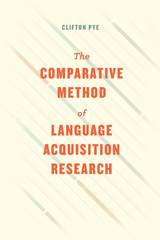
Pye here applies the comparative method to three Mayan languages—K’iche’, Mam, and Ch’ol—showing how differences in the use of verbs are connected to differences in the subject markers and pronouns used by children and adults. His holistic approach allows him to observe how small differences between the languages lead to significant differences in the structure of the children’s lexicon and grammar, and to learn why that is so. More than this, he expects that such careful scrutiny of related languages’ variable solutions to specific problems will yield new insights into how children acquire complex grammars. Studying such an array of related languages, he argues, is a necessary condition for understanding how any particular language is used; studying languages in isolation, comparing them only to one’s native tongue, is merely collecting linguistic curiosities.


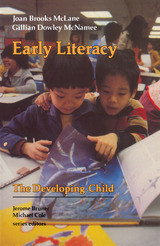
Four-year-old Joshua challenges his father to a game: Can he come downstairs before Joshua writes the word to? Rachel, two and a half, makes a series of wavy lines on a piece of paper and calls it a “thank-you letter to Grandma.” In Early Literacy Joan McLane and Gillian McNamee explore the ways young children like Joshua and Rachel begin to learn about written language. Becoming literate requires mastering a complex set of skills, behaviors, and attitudes that makes it possible to receive and communicate meaning through the written word. McLane and McNamee provide a fresh examination of this process in light of recent research.
The authors look closely at what young children do with writing and reading. As children play with making marks on paper and listen to stories being read aloud, they begin to discover uses and purposes for written language. They learn that they can use writing to communicate with people they care about and that reading story books opens up new ideas and experiences. As children experiment with writing and reading in their talking, drawing, and pretend play, they can build “bridges to literacy.”
The authors emphasize the importance of children's relationships with significant adults and peers for growth in literacy. They also devote chapters to early literacy development at home and in the neighborhood, and in preschool and kindergarten settings. In one daycare center for inner-city children, for example, where a favorite activity is dictating and acting out stories, children become active participants in a community of readers and writers—a literate culture.
Through its clear and concise discussion of young children's growth toward literacy, and its examples of the contexts that encourage and enrich that growth, Early Literacy will serve as a valuable resource for parents, teachers, and others who work or play with young children.

For many years, Roger Brown and his colleagues have studied the developing language of pre-school children--the language that ultimately will permit them to understand themselves and the world around them. This longitudinal research project records the conversational performances of three children, studying both semantic and grammatical aspects of their language development.
These core findings are related to recent work in psychology and linguistics--and especially to studies of the acquisition of languages other than English, including Finnish, German, Korean, and Samoan. Roger Brown has written the most exhaustive and searching analysis yet undertaken of the early stages of grammatical constructions and the meanings they convey.
The five stages of linguistic development Brown establishes are measured not by chronological age-since children vary greatly in the speed at which their speech develops--but by mean length of utterance. This volume treats the first two stages.
Stage I is the threshold of syntax, when children begin to combine words to make sentences. These sentences, Brown shows, are always limited to the same small set of semantic relations: nomination, recurrence, disappearance, attribution, possession, agency, and a few others.
Stage II is concerned with the modulations of basic structural meanings--modulations for number, time, aspect, specificity--through the gradual acquisition of grammatical morphemes such as inflections, prepositions, articles, and case markers. Fourteen morphemes are studied in depth and it is shown that the order of their acquisition is almost identical across children and is predicted by their relative semantic and grammatical complexity.
It is, ultimately, the intent of this work to focus on the nature and development of knowledge: knowledge concerning grammar and the meanings coded by grammar; knowledge inferred from performance, from sentences and the settings in which they are spoken, and from signs of comprehension or incomprehension of sentences.
Renowned scholars contributing to this volume include Ursula Bellugi, Judy Snitzer Reilly, Susan Goldwin-Meadow, Andrew Lock, M. Chiara Levorato, and many others.
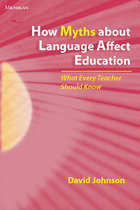
How Myths about Language Affect Education: What Every Teacher Should Know clarifies some of the most common misconceptions about language, particularly those that affect teachers and the decisions they make when they teach English language learners. The chapters in this book address myths about language in general, about first and second language acquisition, about language and society, and about language and thinking. Each chapter concludes with activities for teachers that give examples, exercises, or simple questions that relate directly to teachers' everyday dealings with ELLs and language.
How Myths about Language Affect Education is not intended to be a complete introduction to linguistics; it does not contain information on phonetics or complex syntactic explanations, and technical jargon is kept to a minimum. The aim of this book is not to settle language issues but rather to highlight popular misconceptions and the ways that they influence debates regarding language and affect language policies in and out of the classroom.
In this book, a philosopher combines these famous cases with a lifetime of study to examine the threshold of language--that point "between speech and not quite speech." He provides fascinating accounts of the deaf and blind Helen Keller, of chimpanzees like Washoe, and of feral children such as Victor, the "wild boy of Aveyron," putting a new spin on their stories. When does it start, he asks, that miracle most of us take for granted? Where does it come from, that uniquely human power to transform perception and action into thought and the singular activity we call speech?
Here is evidence that, for chimp or child, the crucial factors in acquiring language have less to do with intellect and everything to do with social interaction. Here is confirmation that the "give-and-take, push-and-pull" of daily life forces virtually all of us to acquire language simply to live and work together. Author Jerry Gill offers no pat answers. Rather, he emphasizes imitation and reciprocity—for example, playing pat-a-cake with a baby—as essential to becoming part of a speaking community "and thereby becoming a human being." In addition, Gill gives dozens of examples to show how gesture and facial expression both create and change the meaning of language. In compelling fashion, he underscores the point that language acquisition can be fully understood only in terms of such physical and social activity. The author exposes the flaws of research focused mainly on mental processes and gives little credit to findings based upon artificially contrived experiments.
With vigor, compassion, and a broad-minded humanism, these pages invite the reader to think again about how we say what we mean, how we mean what we say, and where it all starts in the first place. Valuable to students of psychology, linguistics, philosophy, and anthropology, the book will also appeal to general readers who welcome an opportunity to explore familiar things in a new and entirely enjoyable way.
Bridging the gap between theoretical linguistics and language teaching, Judith R. Strozer explores what recent theoretical advances suggest about learning a language after childhood and the implications for the design and execution of a foreign language program. Strozer outlines clearly, in nontechnical language, the major concepts of modern language theory, from Chomsky's theory of language through the most recent discoveries about the abstract foundations of language. She explains ideas about the evolution of a cognitive structure for language in the human brain, a "language faculty" or Universal Grammar that gives humans alone the creative ability to generate the infinite expressions of language. This innate universal schema for language endows humankind with a number a very broad principles applicable to all languages.
Turning to current advances in the theory of phrase structure, which has replaced our 2,000-year-old rules of grammar with highly abstract universal principles of language structure, she relates the latest discoveries about the foundations of language to ideas about how children learn languages. A child hearing a specific language can automatically set the parameters for the rules governing that particular language, much like setting a binary switch. But our ability to access this innate language mechanism automatically seems limited to childhood, until physical maturity somehow changes this brain function.
Arguing that adults need to learn consciously the systems and structures of another language that children acquire unconsciously, Strozer applies these latest theories about the nature of language and how we learn it to the design of foreign language programs for adults. She concludes with recommendations for developing a new kind of teaching program that would draw on comparative language research and include new pedagogic approaches.
Presenting state-of-the-art language theory in easily readable terms and illustrative examples, this book will be of interest to everyone interested in the latest understanding of the relationship between the brain and language, as well as to all professionals in linguistics and language education.
Language in Use creatively brings together, for the first time, perspectives from cognitive linguistics, language acquisition, discourse analysis, and linguistic anthropology. The physical distance between nations and continents, and the boundaries between different theories and subfields within linguistics have made it difficult to recognize the possibilities of how research from each of these fields can challenge, inform, and enrich the others. This book aims to make those boundaries more transparent and encourages more collaborative research.
The unifying theme is studying how language is used in context and explores how language is shaped by the nature of human cognition and social-cultural activity. Language in Use examines language processing and first language learning and illuminates the insights that discourse and usage-based models provide in issues of second language learning. Using a diverse array of methodologies, it examines how speakers employ various discourse-level resources to structure interaction and create meaning. Finally, it addresses issues of language use and creation of social identity.
Unique in approach and wide-ranging in application, the contributions in this volume place emphasis on the analysis of actual discourse and the insights that analyses of such data bring to language learning as well as how language shapes and reflects social identity—making it an invaluable addition to the library of anyone interested in cutting-edge linguistics.
Language, Mind and Brain is a delightfully readable, yet erudite exploration of how the human mind processes and orders sounds and words into meaning. It explores how properties of the human mind/brain constrain linguistic structure and how linguistics can benefit by combining traditional linguistic methodologies with insights from research on language acquisition, processing, and impairment. The first part of the book offers a useful introduction to the relevant issues for readers with little prior knowledge of these disciplines; part two addresses such key issues as the status of rules, the relationship between grammar and the lexicon, and the relationship between innate structure and acquired knowledge. Fascinating for anyone interested in the intricacies of how language is acquired and how the brain sorts sounds into communication.
The only way we can convey our thoughts in detail to another person is through verbal language. Does this imply that our thoughts ultimately rely on words? Is there only one way in which thoughts can occur? This ambitious book takes the contrary position, arguing that many possible "languages of thought" play different roles in the life of the mind.
"Language" is more than communication. It is also a means of representing information in both working and long-term memory. It provides a set of rules for combining and manipulating those representations.
A stellar lineup of international cognitive scientists, philosophers, and artists make the book's case that the brain is multilingual. Among topics discussed in the section on verbal languages are the learning of second languages, recovering language after brain damage, and sign language, and in the section on nonverbal languages, mental imagery, representations of motor activity, and the perception and representation of space.
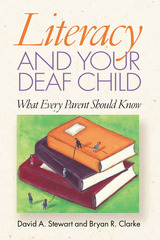
In the modern world, success depends upon literacy, a fact especially true for deaf children who, if they read and write well, can take full advantage of e-mail, the Internet, and other communication innovations. Literacy and Your Deaf Child: What Every Parent Should Know provides parents with the means to ensure that their deaf or hard of hearing child becomes a proficient reader and writer. In nine chapters, parents will learn about the relationship of language to reading and writing, including the associated terminology, the challenges that deaf children face, and the role of schools. They’ll also learn activities that they can engage in at home that will strengthen their children’s reading and writing capabilities.
Literacy and Your Deaf Child begins by introducing some common concepts, among them the importance of parental involvement in a deaf child’s education. It outlines how children acquire language and describes the auditory and visual links to literacy. With this information, parents can make informed decisions regarding hearing aids, cochlear implants, speechreading, and sign communication, all of which can have a marked influence on their child’s language development. Parents will discover how to create environments at home and in their community for fostering their child’s literacy, especially in school by learning how to work closely with their child’s teachers. The book also refers throughout to the developmental link between American Sign Language and English literacy for children who use sign communication, making it the best guide available for all deaf children and their parents.

language correctly. Later comes the precocious ability to
“reflect” upon and deliberately control its use.
Metalinguistic development, or the emergence of a reflective
attitude to the comprehension and production of oral and
written language, must be distinguished from that of ordinary
verbal communication.
This is the first book to review and analyze what is
known about metacognitive processes in relation to language.
Each of its seven chapters deals systematically with the
relationship between the comprehension and production of the
phonetic, syntactic, semantic, pragmatic, and textual aspects
of language. This material is then related to the
metacognitive principles which govern reflective awareness.
A concluding chapter deals with written language and
metalinguistics.
Jean Émile Gombert's novel description of processes such
as the understanding of metaphor and humor in relation to
pragmatics and his suggestion that metalinguistic knowledge
is intimately connected with literacy contribute to a fuller
understanding of the stages of language acquisition and
mastery. With clarity and insight, Metalinguistic
Development reveals how the capacity for reflection gives
rise to emergent properties of the language system.
“A clear, critical, and interesting book about
an important topic which has not been reviewed properly
before. I particularly like the way that Jean Eacute;mile Gombert
combines a comprehensive account of American work with a very
impressive knowledge of European work.”—Peter Bryant,
University of Oxford
Jean Émile Gombert teaches genetic psychology at the
University of Dijon.
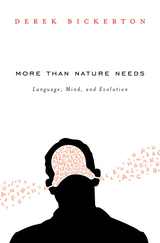
The human mind is an unlikely evolutionary adaptation. How did humans acquire cognitive capacities far more powerful than anything a hunting-and-gathering primate needed to survive? Alfred Russel Wallace, co-founder with Darwin of evolutionary theory, saw humans as "divine exceptions" to natural selection. Darwin thought use of language might have shaped our sophisticated brains, but his hypothesis remained an intriguing guess--until now. Combining state-of-the-art research with forty years of writing and thinking about language evolution, Derek Bickerton convincingly resolves a crucial problem that both biology and the cognitive sciences have hitherto ignored or evaded.
What evolved first was neither language nor intelligence--merely normal animal communication plus displacement. That was enough to break restrictions on both thought and communication that bound all other animals. The brain self-organized to store and automatically process its new input, words. But words, which are inextricably linked to the concepts they represent, had to be accessible to consciousness. The inevitable consequence was a cognitive engine able to voluntarily merge both thoughts and words into meaningful combinations. Only in a third phase could language emerge, as humans began to tinker with a medium that, when used for communication, was adequate for speakers but suboptimal for hearers.
Starting from humankind's remotest past, More than Nature Needs transcends nativist thesis and empiricist antithesis by presenting a revolutionary synthesis--one that instead of merely repeating "nature and nurture" clichés shows specifically and in a principled manner how and why the synthesis came about.
A new approach to training and evaluating world languages online instructors
The rapid growth in online world language programs in the United States coupled with the widespread implementation of virtual teaching in response to COVID-19 have pushed the field to reconceive instruction. Virtual learning creates unique challenges for instructors, who need to ensure that their students have adequate interaction with their peers, their professor, and native speakers of the language. Even with a growing demand for online language courses, there are few tools that evaluate the training and assessment of online language instructors.
In Online World Language Instruction Training and Assessment, authors Carmen King Ramírez, Barbara A. Lafford, and James E. Wermers fill that gap, providing a critical pedagogical approach to computer-assisted language learning (CALL) teacher education (CTE). By combining best CTE training and evaluation practices with assessment tools, the authors explain how teachers can integrate technology to build successful online programs. Their ecological, holistic approach addresses all facets of learning online—including pressing challenges of moving courses online, teacher training, developing core competencies and skills, instructions for assessment and self-evaluation, goal setting, and the normalization of critical CTE practices in an increasingly digital environment.
The authors propose new solutions to teacher training challenges, providing extensive rubrics and tools that can equitably assess online language instructor skills, the training they receive, the assessment process they undergo, and the instruments used for instructor assessment. A list of CALL and CTE resources (available on the Press’s website) further supports readers’ successful adaptation to an everchanging learning environment.
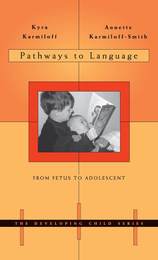
Our journey to language begins before birth, as babies in the womb hear clearly enough to distinguish their mother's voice. Canvassing a broad span of experimental and theoretical approaches, this book introduces new ways of looking at language development.
A remarkable mother-daughter collaboration, Pathways to Language balances the respected views of a well-known scholar with the fresh perspective of a younger colleague prepared to challenge current popular positions in these debates. The result is an unusually subtle, even-handed, and comprehensive overview of the theory and practice of language acquisition, from fetal speech processing to the development of child grammar to the sophisticated linguistic accomplishments of adolescence, such as engaging in conversation and telling a story.
With examples from the real world as well as from the psychology laboratory, Kyra Karmiloff and Annette Karmiloff-Smith look in detail at the way language users appropriate words and grammar. They present in-depth evaluations of different theories of language acquisition. They show how adolescent usage has changed the meaning of certain phrases, and how modern living has led to alterations in the lexicon. They also consider the phenomenon of atypical language development, as well as theoretical issues of nativism and empiricism and the specificity of human language. Their nuanced and open-minded approach allows readers to survey the complexity and breadth of the fascinating pathways to language acquisition.

Tobin describes the methodological connection between phonological theory and phonetics by way of a comprehensive and insightful survey of phonology’s controversial role in twentieth-century linguistics. He reviews the work of Saussure, Jakobson, Troubetzkoy, Martinet, Zipf, and Diver, among others, and discusses issues in distributional phonology through analyses of English, Italian, Latin, Hebrew, and Yiddish. Using his theory to explain various functional and pathological speech disorders, Tobin examines a wide range of deviant speech processes in aphasia, the speech of the hearing-impaired, and other syndromes of organic origin. Phonology as Human Behavior provides a unique set of principles connecting the phylogeny, ontogeny, and pathology of sound systems in human language.
To support this thesis, O'Grady develops a well-articulated, single level, categorial-type grammar that he uses to analyze syntactic categories, extraction, anaphora, extraposition, and quantifier placement in English and other languages. He shows that such grammars can be constructed via general learning strategies from notions such as dependency, adjacency, precedence, and continuity, and that the available acquisition data points to the emergence of the principles he proposes.
While exploratory, this book provides one of the few serious attempts to develop a theory of grammar and learning that does not posit faculty-specific innate principles. Principles of Grammar and Learning is an exemplary attempt to bring together issues and data from syntactic theory, language acquisition, and the more general study of the human mind.
Part 1 offers an overview of the developmental data pertaining to a range of syntactic phenomena, including word order, subject drop, embedded clauses, wh-questions, inversion, relative clauses, passives, and anaphora. Part 2 considers the various theories that have been advanced to explain the facts of development as well as the learnability problem, reporting on work in the mainstream formalist framework but also considering the results of alternative approaches.
Covering a wide range of perspectives in the modern study of syntactic development, this book is an invaluable reference for specialists in the field of language acquisition and provides an excellent introduction to the acquisition of syntax for students and researchers in psychology, linguistics, and cognitive science.
When humans learn languages, are they also learning how to create shared meaning? In The Usage-based Study of Language Learning and Multilingualism, a cadre of international experts say yes and offer cutting-edge research in usage-based linguistics to explore how language acquisition, in particular multilingual language acquisition, works.
Each chapter presents an original study that supports the view that language learning is initiated through local and meaningful communication with others. Over an accumulated history of such usage, people gradually create more abstract, interactive schematic representations, or a mental grammar. This process of acquiring language is the same for infants and adults and across varied contexts, such as the family, the classroom, the laboratory, a hospital, or a public encounter. Employing diverse methodologies to study this process, the contributors here work with target languages, including Cantonese, English, French, French Sign Language, German, Hebrew, Malay, Mandarin, Spanish, and Swedish, and offer a much-needed exploration of this growing area of linguistic research.
READERS
Browse our collection.
PUBLISHERS
See BiblioVault's publisher services.
STUDENT SERVICES
Files for college accessibility offices.
RECENTLY PUBLISHED





UChicago Accessibility Resources
home | accessibility | search | about | contact us
BiblioVault ® 2001 - 2024
The University of Chicago Press