
 A SCHOLARLY BOOK REPOSITORY

Available for the first time in English: the complete and annotated transcripts of Deleuze’s 1981 seminars on painting
From 1970 until 1987, Gilles Deleuze held a weekly seminar at the Experimental University of Vincennes and, starting in 1980, at Saint-Denis. In the spring of 1981, he began a series of eight seminars on painting and its intersections with philosophy. The recorded sessions, newly transcribed and translated into English, are now available in their entirety for the first time. Extensively annotated by philosopher David Lapoujade, On Painting illuminates Deleuze’s thinking on artistic creation, significantly extending the lines of thought in his book Francis Bacon.
Through paintings and writing by Rembrandt, Delacroix, Turner, Cézanne, Van Gogh, Klee, Pollock, and Bacon, Deleuze explores the creative process, from chaos to the pictorial fact. The introduction and use of color feature prominently as Deleuze elaborates on artistic and philosophical concepts such as the diagram, modulation, code, and the digital and the analogical. Through this scrutiny, he raises a series of profound and stimulating questions for his students: How does a painter ward off grayness and attain color? What is a line without contour? Why paint at all?
Written and thought in a rhizomatic manner that is thoroughly Deleuzian—strange, powerful, and novel—On Painting traverses both the conception of art history and the possibility of color as a philosophical concept.
Retail e-book files for this title are screen-reader friendly with images accompanied by short alt text and/or extended descriptions.
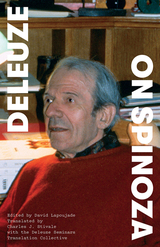
Through newly transcribed and translated lectures, Deleuze explores Spinoza’s philosophy concerning questions of good and evil and humanity’s potential for realizing a full life
Available for the first time in English, On Spinoza presents the annotated transcripts of Gilles Deleuze’s fifteen seminars on the seventeenth-century philosopher’s Ethics, delivered at Experimental University Center at Vincennes. Spinoza’s ambitious treatise was central to Deleuze’s thought, and his course provides an accessible framework for understanding the vitality of Spinoza’s philosophy.
In an informal classroom setting, Deleuze addresses fundamental aspects of Spinoza’s thought: How does one undo the negativity of harmful passions such as hate, resentment, and envy? How can a system of moral judgment based on good and evil be replaced by a more sophisticated ethics of the good and the bad? And since such questions commit Spinoza to a new theory of signs, Deleuze also delves into his thinking on how these signs should guide human existence and the differences between concepts of eternity, experienced in the here and now, and the immortality promised by philosophy and religion.
Building gradually from session to session, Deleuze shows how Spinoza rejects a hierarchical reality dominated by an authoritarian and impenetrable God, instead proposing a world ruled by light and reason in which all beings are equal. Annotated by David Lapoujade and including recorded exchanges with Deleuze’s students, On Spinoza offers a rare window into Deleuze’s teaching, offering readers a guide for linking Spinoza to other philosophers—including Deleuze himself.
Retail e-book files for this title are screen-reader friendly with image accompanied by short alt text and/or extended description.
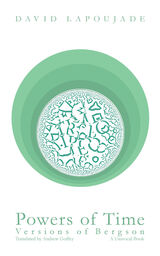
How is it that when we think of time, we hardly think of the role affect plays in granting us access to time: the sense of waiting, regret, mourning, melancholy? In Powers of Time, David Lapoujade returns to two central themes that continuously converge throughout the writings of the French philosopher Henri Bergson: durée (duration) and intuition. If duration is synonymous with memory, how are we then capable of thinking an authentic sense of the future? Does this mean that freedom is nothing more than a reprisal of our past?
Lapoujade uncovers multiple versions of Bergson: a philosopher of sympathy, a melancholic philosopher, a perspectivist Bergson, a spiritualist Bergson. Leading us beyond simplistic anthropomorphic conceptions of temporality and intuition, Lapoujade’s multiple Bergsons guide us to encounter a rapport with time, memory, and duration that places us in direct contact with the nonhuman flows and movements of the universe.
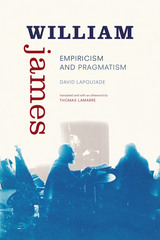

Philosophically analyzing the work of one of the twentieth century’s most popular, and peculiar, science fiction authors
Despite his enduring popularity, Philip K. Dick (1928–1982)—whose short stories and novels were adapted into or influenced many major films and television shows, including Blade Runner, Total Recall, The Truman Show, and The Man in the High Castle—has long been a marginal figure in American literature, even in the science fiction genre he helped revolutionize. Here, an influential French philosopher offers a major new perspective on an author who was known as much for his eccentricities and excesses as for his writing. For David Lapoujade, it is precisely the many ways in which Dick’s works seem to hover on the brink of losing all touch with reality that make him such a singular figure, both as a sci-fi author and as a thinker of contemporary life.
In Worlds Built to Fall Apart, Lapoujade defines sci-fi as a way of thinking through the creation of worlds and argues that Dick does so by creating worlds that fall rapidly to pieces. Whatever his mechanism to bring this about (drugs or madness, alien satellite transmissions or encroaching parallel universes), the effect is always to reveal reality to be a construction, in which certain people determine what appears as real to the rest of us. Orienting Dick within philosophy and drawing connections to a wide variety of other thinkers and artists, this remarkable reading shows how he proposes unstable, fluctuating futures in which tinkering with reality has become the best means of resisting total control.
Engaging with most of Philip K. Dick’s published works, as well as with several of his essays and his notorious psychic autobiography The Exegesis, Lapoujade hones in on the “war of the psyches” that underlies Dick’s critique of reality. He puts Dick’s work in conversation with a vast array of subjects—from cybernetics to schizoanalysis, and from Pop art to David Lynch, J. G. Ballard, and William S. Burroughs—revealing Dick’s oeuvre to comprise a profound reality defined by artifice, precarity, and control.
Retail e-book files for this title are screen-reader friendly.
READERS
Browse our collection.
PUBLISHERS
See BiblioVault's publisher services.
STUDENT SERVICES
Files for college accessibility offices.
RECENTLY PUBLISHED



UChicago Accessibility Resources
home | accessibility | search | about | contact us
BiblioVault ® 2001 - 2026
The University of Chicago Press