
 A SCHOLARLY BOOK REPOSITORY
The rise of an immensely powerful federal government in the twentieth century has tended to obscure the importance of state and local government in American history. Yet government at these lesser levels had the most direct and continuous effect on the lives of ordinary citizens. Through an analysis of late-nineteenth-century state legislatures in Illinois, Iowa, and Wisconsin,Ballard Campbell has written what one expert has called "the best book on legislative politics, past or present." The period he examines was one of rapid change and great challenge. Urbanization, industrialization, and increasing national integration forced innumerable difficult and important decisions on state legislators. Campbell is sensitive to these stresses on law-making, and skillfully analyzes the interplay between personal and constituent factors that affected lawmakers.
The author differentiates clearly between local and general aspects of state policymaking, giving full consideration to its more subjective and idiosyncratic elements. His comparison of partisan, economic, urban, ethnocultural, and regional influences on legislative behavior will serve as a model for all future studies.
By closely examining the substantive dimension of the governmental process and its relation to mass politics, Representative Democracy advances "the new political history." Campbell's discussion of legislative composition and procedure, the content and context of contested issues, and responses to these issues challenges numerous stereotypes about American state legislatures.

Griffis and Kusakabe were only a small piece of a vast transnational network of leading modernizers of Japan in the 1860s and 70s. The Japanese students in New Brunswick were young and innovative men of samurai and aristocratic lineage, who were sent by reform-minded leaders of Japan, which was undergoing a dramatic transformation. They came to New Brunswick seeking Western knowledge that was much needed for the modernization of a newly forming nation. New Brunswick became the hub of a network of Japanese nationals that extended to the major cities of New York, Philadelphia, and Boston, and from there to the smaller towns of New England. Once in New Brunswick, these Japanese students were embraced by Protestant ministers, educators, and missionaries—both men and women—whose network encompassed Rutgers College and the neighboring New Brunswick Theological Seminary, and which stretched to Dutch Reformed parishes throughout the Eastern seaboard, and westward as far as the Dutch enclave of Holland, Michigan. Meanwhile, the American teachers and missionaries who left for Japan became part of a network of reformist leaders and Japanese returnees that extended to schools, colleges, and missions in Japan, and formed the foundations of Japan’s modern educational system. Through contributions from scholars and archivists in the U.S., Canada, and Japan, Rutgers Meets Japan aims to reconstruct the early Rutgers-Japan connections and examine the role and impact of this transnational network on Japan and the U.S. in the late nineteenth century.
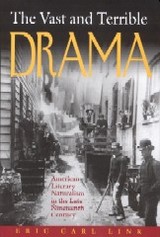
A broad treatment of the cultural, social, political, and literary under-pinnings of an entire period and movement in American letters
The Vast and Terrible Drama is a critical study of the context in which authors such as Oliver Wendell Holmes, Stephen Crane, Frank Norris, Theodore Dreiser, and Jack London created their most significant work. In 1896 Frank Norris wrote: "Terrible things must happen to the characters of the naturalistic tale. They must be twisted from the ordinary . . . and flung into the throes of a vast and terrible drama." There could be "no teacup tragedies here." This volume broadens our understanding of literary naturalism as a response to these and other aesthetic concerns of the 19th century.
Themes addressed include the traditionally close connection between French naturalism and American literary naturalism; relationships between the movement and the romance tradition in American literature, as well as with utopian fictions of the 19th century; narrative strategies employed by the key writers; the dominant naturalist theme of determinism; and textual readings that provide broad examples of the role of the reader. By examining these and other aspects of American literary naturalism, Link counters a century of criticism that has perhaps viewed literary naturalism too narrowly, as a subset of realism, bound by the conventions of realistic narration.
READERS
Browse our collection.
PUBLISHERS
See BiblioVault's publisher services.
STUDENT SERVICES
Files for college accessibility offices.
RECENTLY PUBLISHED


UChicago Accessibility Resources
home | accessibility | search | about | contact us
BiblioVault ® 2001 - 2026
The University of Chicago Press