front cover of The Alexander Medvedkin Reader
The Alexander Medvedkin Reader
Alexander Medvedkin
University of Chicago Press, 2016
Filmmaker Alexander Medvedkin (1900–89), a contemporary of Sergei Eisenstein and Alexander Dovzhenko, is celebrated today for his unique form of “total” documentary cinema, which aimed to bridge the distance between film and life, as well as for his use of satire during a period when the Soviet authorities preferred that laughter be confined to narrowly prescribed channels. This collection of selected writings by Medvedkin is the first of its kind and reveals how his work is a crucial link in the history of documentary film.

Although he was a dedicated Communist, Medvedkin’s satirical approach and social critiques ultimately led to his suppression by the Soviet regime. State institutions held back or marginalized his work, and for many years, his films were assumed to have been lost or destroyed. These texts, many assembled for this volume by Medvedkin himself, document for the first time his considerable achievements, experiments in film and theater, and attempts to develop satire as a major Soviet film genre. Through scripts, letters, autobiographical writings, and more, we see a Medvedkin supported and admired by figures like Eisenstein, Dovzhenko, and Maxim Gorky.

[more]

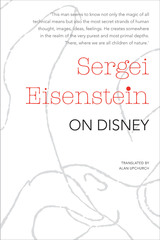
front cover of On Disney
On Disney
Sergei Eisenstein
Seagull Books, 2017
Few figures in cinema history are as towering as Russian filmmaker and theorist Sergei Mikhailovitch Eisenstein (1898–1948). Not only did Eisenstein direct some of the most important and lasting works of the silent era, including Strike, October, and Battleship Potemkin, as well as, in the sound era, the historical epics Alexander Nevsky and Ivan the Terrible—he also was a theorist whose insights into the workings of film were so powerful that they remain influential for both filmmakers and scholars today.

Seagull Books is embarking on a series of translations of key works by Eisenstein into English.  On Disney, which was begun in 1940 but was never finished, was part of a series of essays Eistenstein wrote on masters of cinema; for Eisenstein, Walt Disney offered a way to think about how such impulses and animism and totemism survived in modern consciousness and art. This edition presents the original, unfinished essay along with material on Disney that Eisenstein worked on in subsequent years but never succeeded in integrating with the original.
[more]


Send via email Share on Facebook Share on Twitter