
 A SCHOLARLY BOOK REPOSITORY
20 start with A start with A
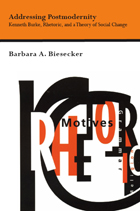
In Addressing Postmodernity, Barbara Biesecker examines the relationship between rhetoric and social change and the ways human beings transform social relations through the purposeful use of symbols. In discerning the conditions of possibility for social transformation and the role of human beings and rhetoric in it, Biesecker turns to the seminal work of Kenneth Burke.
Through a close reading of Burke's major works, A Grammar of Motives, A Rhetoric of Motives, and The Rhetoric of Religion: Studies in Logology, the author addresses the critical topic of the
fragmentation of the contemporary lifeworld revealing postmodernity will have a major impact on Burkeian scholarship and on the rhetorical critique of social relations in general.
Directly confronting the challenges posed by postmodernity to social theorists and critics alike and juxtaposing the work of Burke and Jurgen Habermas, Biesecker argues that a radicalized rereading of Burke's theory of the negative opens the way toward a resolutely rhetorical theory of social change and human agency.
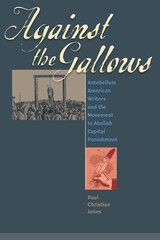
In Against the Gallows, Paul Christian Jones explores the intriguing cooperation of America’s writers—including major figures such as Walt Whitman, John Greenleaf Whittier, E. D. E. N. Southworth, and Herman Melville—with reformers, politicians, clergymen, and periodical editors who attempted to end the practice of capital punishment in the United States during the 1840s and 1850s. In an age of passionate reform efforts, the antigallows movement enjoyed broad popularity, waging its campaign in legislatures, pulpits, newspapers, and literary journals.
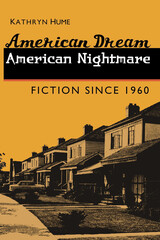
In breaking down the divisions among standard categories of race, religion, ethnicity, and gender, Hume identifies shared core concerns, values, and techniques among seemingly disparate and unconnected writers including T. Coraghessan Boyle, Ralph Ellison, Russell Banks, Gloria Naylor, Tim O'Brien, Maxine Hong Kingston, Walker Percy, N. Scott Momaday, John Updike, Toni Morrison, William Kennedy, Julia Alvarez, Thomas Pynchon, Leslie Marmon Silko, and Don DeLillo.
Hume explores fictional treatments of the slippage in the immigrant experience between America's promise and its reality. She exposes the political link between contemporary stories of lost innocence and liberalism's inadequacies. She also invites us to look at the literary challenge to scientific materialism in various searches for a spiritual dimension in life.
The expansive future promised by the American Dream has been replaced, Hume finds, by a sense of tarnished morality and a melancholy loss of faith in America's exceptionalism. American Dream, American Nightmare examines the differing critiques of America embedded in nearly a hundred novels and points to the source for recovery that appeals to many of the authors.

Challenging the common perception of poets as standing apart from the mainstream of American culture, Robert von Hallberg gives us a fresh and unpredictable assessment of the poetry that has come directly out of the American experience since 1945.
Who reads contemporary American poetry? More people than were reading new poetry in the 1920s, von Hallberg shows. How do poets respond to the public preoccupations of their readers? Often with fascination. Von Hallberg put the poems of Robert Creeley and John Ashbery together with the postwar outburst of systems analysis. The 1950s tourist poems of John Hollander, Adrienne Rich, W. S. Merwin, and James Merrill are treated as the cultural side of America’s postwar rise to global political power There are chapters on the political poems of the 1950s and 1960s, and on Robert Lowell’s sympathy for the imperialism of his liberal contemporaries. Poems of the 1970s on pop culture, especially Edward Dorn’s Slinger, and some from the suburbs of the 1980s, are shown to reflect a curious peace between the literary and the mass cultures.
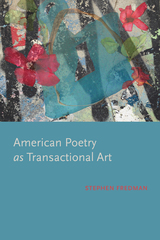
Many people think of poetry as a hermetic art, as though poets wrote only about themselves or as if the subject of poetry were finally only poetry—its forms and traditions. Indeed much of what constitutes poetry in the lyric tradition depends on a stringently controlled point of view and aims for a timeless, intransitive utterance. Stephen Fredman’s study proposes a different perspective.
American Poetry as Transactional Art explores a salient quality of much avant-garde American poetry that has so far lacked sustained treatment: namely, its role as a transactional art. Specifically Fredman describes this role as the ways it consistently engages in conversation, talk, correspondence, going beyond the scope of its own subjects and forms—its existential interactions with the outside world. Poetry operating in this vein draws together images, ideas, practices, rituals, and verbal techniques from around the globe, and across time—not to equate them, but to establish dialogue, to invite as many guests as possible to the World Party, which Robert Duncan has called the “symposium of the whole.”
Fredman invites new readers into contemporary poetry by providing lucid and nuanced analyses of specific poems and specific interchanges between poets and their surroundings. He explores such topics as poetry’s transactions with spiritual traditions and practices over the course of the twentieth century; the impact of World War II on the poetry of Charles Olson and George Oppen; exchanges between poetry and other art forms including sculpture, performance art, and ambient music; the battle between poetry and prose in the early work of Paul Auster and in Lyn Hejinian’s My Life. The epilogue looks briefly at another crucial transactional occasion: teaching American poetry in the classroom in a way that demonstrates that it is at the center of the arts and at the heart of American culture.
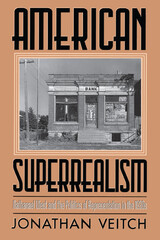
Nathanael West has been hailed as “an apocalyptic writer,” “a writer on the left,” and “a precursor to postmodernism.” But until now no critic has succeeded in fully engaging West’s distinctive method of negation. In American Superrealism, Jonathan Veitch examines West’s letters, short stories, screenplays and novels—some of which are discussed here for the first time—as well as West’s collaboration with William Carlos Williams during their tenure as the editors of Contact. Locating West in a lively, American avant-garde tradition that stretches from Marcel Duchamp to Andy Warhol, Veitch explores the possibilities and limitations of dada and surrealism—the use of readymades, scatalogical humor, human machines, “exquisite corpses”—as modes of social criticism. American Superrealism offers what is surely the definitive study of West, as well as a provocative analysis that reveals the issue of representation as the central concern of Depression-era America.
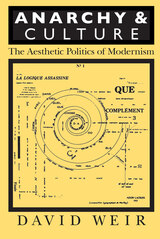
David Weir develops this thesis in several ways. He begins by considering the place of culture in the political thought of the classical anarchist thinkers William Godwin, Pierre-Joseph Proudhon, Mikhail Bakunin, and Peter Kropotkin. He then shows how the perceived "anarchy" of nineteenth-century society induced writers such as Matthew Arnold, Henry James, and Fyodor Dostoyevsky to turn away from politics and seek unity in the idea of a common culture.
Yet as other late-nineteenth-century writers and artists began to sympathize with anarchism, the prospect of a common culture became increasingly remote. In Weir's view, the affinity for anarchism that developed among members of the artistic avant-garde lies behind much of fin de siècle culture. Indeed, the emergence of modernism itself can be understood as the aesthetic realization of anarchist politics. In support of this contention, Weir shows that anarchism is the key aesthetic principle informing the work of a broad range of modernist figures, from Henrik Ibsen and James Joyce to dadaist Hugo Ball and surrealist Luis Buñuel.
Weir concludes by reevaluating the phenomenon of postmodernism as only the most recent case of the migration of politics into aesthetics, and by suggesting that anarchism is still very much with us as a cultural condition.
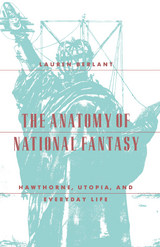
At the core of Berlant's work is a three-part study of The Scarlet Letter, analyzing the modes and effects of national identity that characterize the narrator's representation of Puritan culture and his construction of the novel's political present tense. This analysis emerges from an introductory chapter on American citizenship in the 1850s and a following chapter on national fantasy, ranging from Hawthorne's early work "Alice Doane's Appeal" to the Statue of Liberty. In her conclusion, Berlant suggests that Hawthorne views everyday life and local political identities as alternate routes to the revitalization of the political and utopian promises of modern national life.

The first book in English on medieval Czech literature.
Anne’s Bohemia is the first general book in English to introduce the little-known riches of medieval Bohemian culture. Alfred Thomas considers the development of Czech literature and society from the election of Count John of Luxembourg as king of Bohemia in 1310 to the year 1420, when the papacy declared a Catholic crusade against the Hussite reformers. This period is of particular relevance to the study of medieval England because of the marriage of Richard II to Anne of Bohemia, the figure around whom this book is focused.
Anne’s Bohemia provides a social context for the most important works of literature written in the Czech language, from the earliest spiritual songs and prayers to the principal Hussite and anti-Hussite tracts of the fifteenth century. The picture that emerges from Thomas’s close readings of these texts is one of a society undergoing momentous political and religious upheavals in which kings, queens, clergy, and heretics all played crucial roles. During the reign of Charles IV (1346-78), the Bohemian Lands became the administrative and cultural center of the Holy Roman Empire and Prague its splendid capital. Comparing and contrasting the situation in Bohemia with the England of Richard II, Anne’s Bohemia charts the growth and decline of the international court culture and the gradual ascendancy of the Hussite reformers in the fifteenth century. Expert but accessibly written, the book offers an engaging overview of medieval Bohemian culture for specialist and nonspecialist alike.ISBN 0-8166-3053-4 Cloth $49.95xxISBN 0-8166-3054-2 Paper $19.95x232 pages 6 black-and-white photos 5 7/8 x 9 AprilMedieval Cultures Series, volume 13Translation inquiries: University of Minnesota Press

Anti-Apocalypse was first published in 1994. Minnesota Archive Editions uses digital technology to make long-unavailable books once again accessible, and are published unaltered from the original University of Minnesota Press editions.
As the year 2000 looms, heralding a new millennium, apocalyptic thought abounds-and not merely among religious radicals. In politics, science, philosophy, popular culture, and feminist discourse, apprehensions of the End appear in images of cultural decline and urban chaos, forecasts of the end of history and ecological devastation, and visions of a new age of triumphant technology or a gender-free utopia. There is, Lee Quinby contends, a threatening "regime of truth" prevailing in the United States-and this regime, with its enforcement of absolute truth and morality, imperils democracy. In Anti-Apocalypse, Quinby offers a powerful critique of the millenarian rhetoric that pervades American culture. In doing so, she develops strategies for resisting its tyrannies.
Drawing on feminist and Foucauldian theory, Quinby explores the complex relationship between power, truth, ethics, and apocalypse. She exposes the ramifications of this relationship in areas as diverse as jeanswear magazine advertising, the Human Genome project, contemporary feminism and philosophy, texts by Henry Adams and Zora Neale Hurston, and radical democratic activism. By bringing together such a wide range of topics, Quinby shows how apocalypse weaves its way through a vast network of seemingly unrelated discourses and practices. Tracing the deployment of power through systems of alliance, sexuality, and technology, Quinby reveals how these power relationships produce conflicting modes of subjectivity that create possibilities for resistance. She promotes a variety of critical stances—genealogical feminism, an ethics of the flesh, and "pissed criticism"—as challenges to apocalyptic claims for absolute truth and universal morality. Far-reaching in its implications for social and cultural theory as well as for political activism, Anti-Apocalypse will engage readers across the cultural spectrum and challenge them to confront one of the most subtle and insidious orthodoxies of our day.Lee Quinby is associate professor of English and American studies at Hobart and William Smith Colleges. She is the author of Freedom, Foucault, and the Subject of America (1991) and coeditor (with Irene Diamond) of Feminism and Foucault: Reflections on Resistance (1988).
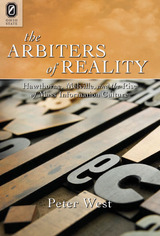
Locating Hawthorne and Melville in vivid and overlooked contexts—the Salem Murder scandal of 1830, which transformed Hawthorne's quiet city into a media-manufactured spectacle, and Melville's New York City of 1846–47, where the American Telegraph was powerfully articulating a nation at war—West portrays the romance as a reactive, deeply rhetorical literary form and a rich historical artifact.
In the early twenty-first century, it has become a postmodern cliché to place the word “reality” in scare quotes. The Arbiters of Reality suggests that attending to the construction of the real in public life is more than simply a language of critique: it must also be understood as a specific kind of romantic self-invention.
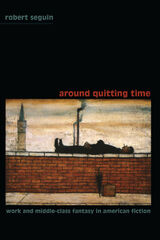
Tracing connections between the reconstruction of the labor process and the aesthetic dilemmas of modernism, between the emergence of the modern state and the structure of narrative, Seguin analyzes the work of Nathanael West, Ernest Hemingway, Willa Cather, John Barth, and others. These fictional narratives serve to demonstrate for Seguin the pattern of social sites and cultural phenomenon that have emerged where work and leisure, production and consumption, and activity and passivity coincide. He reveals how, by creating pathways between these seemingly opposed domains, the middle-class imaginary at once captures and suspends the dynamics of social class and opens out onto a political and cultural terrain where class is both omnipresent and invisible.
Aroung Quitting Time will interest critics and historians of modern U.S. culture, literary scholars, and those who explore the interaction between economic and cultural forms.
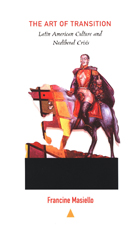
Masiello views representation as both a political and artistic device, concerned with the tensions between truth and lies, experience and language, and intellectuals and the marginal subjects they study and claim to defend. These often contentious negotiations, she argues, are most provocatively displayed through the spectacle of difference, which constantly crosses the literary stage, the market, and the North/South divide. While forcefully defending the ability of literature and art to advance ethical positions and to foster a critical view of neoliberalism, Masiello especially shows how issues of gender and sexuality function as integrating threads throughout this cultural project. Through discussions of visual art as well as literary work by prominent novelists and poets, Masiello sketches a broad landscape of vivid intellectual debate in the Southern Cone of Latin America.
The Art of Transition will interest Latin Americanists,literary and political theorists, art critics and historians, and those involved with the study of postmodernism and globalization.
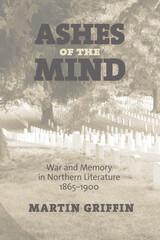
In Ashes of the Mind, Martin Griffin examines the work of five Northerners—three poets and two fiction writers—who over a period of four decades tried to understand and articulate the landscape of memory in postwar America, and in particular in that part of the nation that could, with most justification, claim the victory of its beliefs and values. The book begins with an examination of the rhetorical grandeur of James Russell Lowell's Harvard Commemoration Ode, ranges across Herman Melville's ironic war poetry, Henry James's novel of North-South reconciliation, The Bostonians, and Ambrose Bierce's short stories, and ends with the bitter meditation on race and nation presented by Paul Laurence Dunbar's elegy "Robert Gould Shaw." Together these texts reveal how a group of representative Northern writers were haunted in different ways by the memory of the
conflict and its fraught legacy.
Griffin traces a concern with individual and community loss, ambivalence toward victory, and a changing politics of commemoration in the writings of Lowell, Melville, James, Bierce, and Dunbar. What links these very different authors is a Northern memory of the war that became more complex and more compromised as the century went on, often replacing a sense of justification and achievement with a perception of irony and failed promise.
READERS
Browse our collection.
PUBLISHERS
See BiblioVault's publisher services.
STUDENT SERVICES
Files for college accessibility offices.
RECENTLY PUBLISHED



UChicago Accessibility Resources
home | accessibility | search | about | contact us
BiblioVault ® 2001 - 2024
The University of Chicago Press