
 A SCHOLARLY BOOK REPOSITORY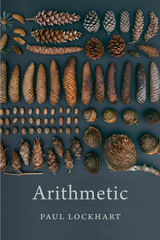
“Inspiring and informative…deserves to be widely read.”
—Wall Street Journal
“This fun book offers a philosophical take on number systems and revels in the beauty of math.”
—Science News
Because we have ten fingers, grouping by ten seems natural, but twelve would be better for divisibility, and eight is well suited to repeated halving. Grouping by two, as in binary code, has turned out to have its own remarkable advantages.
Paul Lockhart presents arithmetic not as rote manipulation of numbers—a practical if mundane branch of knowledge best suited for filling out tax forms—but as a fascinating, sometimes surprising intellectual craft that arises from our desire to add, divide, and multiply important things. Passionate and entertaining, Arithmetic invites us to experience the beauty of mathematics through the eyes of a beguiling teacher.
“A nuanced understanding of working with numbers, gently connecting procedures that we once learned by rote with intuitions long since muddled by education…Lockhart presents arithmetic as a pleasurable pastime, and describes it as a craft like knitting.”
—Jonathon Keats, New Scientist
“What are numbers, how did they arise, why did our ancestors invent them, and how did they represent them? They are, after all, one of humankind’s most brilliant inventions, arguably having greater impact on our lives than the wheel. Lockhart recounts their fascinating story…A wonderful book.”
—Keith Devlin, author of Finding Fibonacci

Paul Lockhart’s Mathematician’s Lament outlined how we introduce math to students in the wrong way. Measurement explains how math should be done. With plain English and pictures, Lockhart makes complex ideas about shape and motion intuitive and graspable, and offers a solution to math phobia by introducing us to math as an artful way of thinking and living.
In conversational prose that conveys his passion for the subject, Lockhart makes mathematics accessible without oversimplifying. He makes no more attempt to hide the challenge of mathematics than he does to shield us from its beautiful intensity. Favoring plain English and pictures over jargon and formulas, he succeeds in making complex ideas about the mathematics of shape and motion intuitive and graspable. His elegant discussion of mathematical reasoning and themes in classical geometry offers proof of his conviction that mathematics illuminates art as much as science.
Lockhart leads us into a universe where beautiful designs and patterns float through our minds and do surprising, miraculous things. As we turn our thoughts to symmetry, circles, cylinders, and cones, we begin to see that almost anyone can “do the math” in a way that brings emotional and aesthetic rewards. Measurement is an invitation to summon curiosity, courage, and creativity in order to experience firsthand the playful excitement of mathematical work.

A joyful and intimate celebration of the beauty and creativity of algebra from one of the foremost math educators of our time.
For many of us, algebra conjures up memories of dull classes spent wondering when we’d ever have to solve a system of equations or factor a polynomial. Indeed, most of the time, if we need to plan a budget or figure out how early to leave the house for work, common sense or a quick, seat-of-the-pants approximation is good enough.
But as mathematician Paul Lockhart argues in The Mending of Broken Bones, once we stop thinking of algebra in terms of its practical applications, we can appreciate it for the beautiful and gratifying subject that it is. In his hands, algebra is the delicate craft of untangling numerical puzzles to reveal the hidden patterns and often surprising behaviors of the numbers themselves. As Lockhart traverses numerical systems, slips into and out of higher-dimensional space, and delights in the intimate connections between algebra and geometry, we come to see the discipline from his viewpoint: not as the mundane exercises of our school years, but instead as an art form whose beauty lies in its elegant simplicity.
Written in Lockhart’s charming and conversational prose, The Mending of Broken Bones is an impassioned and deeply personal celebration of algebra that helps us experience the profound joys of mathematical discovery.
READERS
Browse our collection.
PUBLISHERS
See BiblioVault's publisher services.
STUDENT SERVICES
Files for college accessibility offices.
RECENTLY PUBLISHED



UChicago Accessibility Resources
home | accessibility | search | about | contact us
BiblioVault ® 2001 - 2026
The University of Chicago Press