
 A SCHOLARLY BOOK REPOSITORY
Conceived of as a memoir in poems of late-life love and its betrayal, Magic Lantern traces the borders of loss and investigates the source of our strength to traverse them, finding the roots of resilience in ordinary interactions and illuminating the undramatic power of simple connections. "At a time of our lives when the only hands / we can expect to touch us this gently / will be wearing latex gloves," Aleshire recounts a tender moment before romantic rupture. "The technician in the ER said softly, / trying to attach your heart monitors, / You’re so hairy, I’m not sure / this will stick, but I thought / it didn’t matter how intimately / they handled you; my love / had covered, would cover / you, before and after them." When the realization of the beloved’s treachery obliterates this lucidity and generosity, the speaker feels violated and estranged from herself, reducing the narrative of the affair to “what we did / in the dark, until we became / the dark.” The private destabilization of this heartache pales but compounds the shadows of a world already rent by international war and domestic political upheaval, but Aleshire orients toward another light source: the rewarding labor of building community and the noble pursuit of seeking meaning itself. The title poem executes a beautiful metacommentary on the value of art, which is to say going to the effort, trying for trying’s sake. At a local filmmaker’s screening, the speaker marvels at the powerful impression the artist has rendered with black-and-white film, astonished by how “the depths and brights, / shadows and gleams... make us watching / feel more.” In these deeply compassionate and vulnerable poems, Aleshire draws our attention to the artistry of our lives, the luminosity we stroke and orchestrate through our meticulous care and enduring bonds. This is the light we see by. A transportative seventh collection, Magic Lantern draws the disordered overwhelm of the human experience into a dazzling, seamless sequence of images, setting the ordinary into motion so that it not only coheres, but glows.
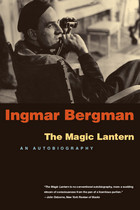
“When a film is not a document, it is a dream. . . . At the editing table, when I run the strip of film through, frame by frame, I still feel that dizzy sense of magic of my childhood.” Bergman, who has conveyed this heady sense of wonder and vision to moviegoers for decades, traces his lifelong love affair with film in his breathtakingly visual autobiography, The Magic Lantern.
More grand mosaic than linear account, Bergman’s vignettes trace his life from a rural Swedish childhood through his work in theater to Hollywood’s golden age, and a tumultuous romantic history that includes five wives and more than a few mistresses. Throughout, Bergman recounts his life in a series of deeply personal flashbacks that document some of the most important moments in twentieth-century filmmaking as well as the private obsessions of the man behind them. Ambitious in scope yet sensitively wrought, The Magic Lantern is a window to the mind of one of our era’s great geniuses.
“[Bergman] has found a way to show the soul’s landscape . . . . Many gripping revelations.”—New York Times Book Review
“Joan Tate’s translation of this book has delicacy and true pitch . . . The Magic Lantern is as personal and penetrating as a Bergman film, wry, shadowy, austere.”—New Republic
“[Bergman] keeps returning to his past, reassessing it, distilling its meaning, offering it to his audiences in dazzling new shapes.”—New York Times
“What Bergman does relate, particularly his tangled relationships with his parents, is not only illuminating but quite moving. No ‘tell-all’ book this one, but revealing in ways that much longer and allegedly ‘franker’ books are not.”—Library Journal
READERS
Browse our collection.
PUBLISHERS
See BiblioVault's publisher services.
STUDENT SERVICES
Files for college accessibility offices.
RECENTLY PUBLISHED






UChicago Accessibility Resources
home | accessibility | search | about | contact us
BiblioVault ® 2001 - 2026
The University of Chicago Press