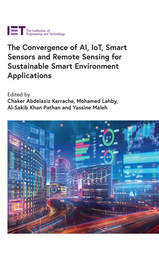
The Convergence of AI, IoT, Smart Sensors and Remote Sensing for Sustainable Smart Environment Applications
Chaker Abdelaziz Kerrache
The Institution of Engineering and Technology, 2026
AI and data-driven methods, particularly machine and deep learning models, have revolutionized image processing tasks such as object detection and segmentation, as well as inverse sensing tasks such as atmospheric condition monitoring. These models enable highly accurate predictions from large, labelled datasets. However, one of the key challenges with current AI systems is their opacity. While they deliver precise results, they often fail to provide clear insights into the underlying mechanisms driving these predictions. The lack of interpretability, especially in the context of sensing data, complicates the understanding of how internal features are represented and utilized. This issue is particularly pronounced in smart environment applications, where artificial intelligence techniques are increasingly employed, yet their internal workings remain largely opaque.
[more]