
 A SCHOLARLY BOOK REPOSITORY
Results by Title
2 books about Maturation (Psychology)
2 books about Maturation (Psychology)

The Age of Sex
Custom, Law, and Ritual in Twentieth-Century East Africa
Corrie Decker
University of Wisconsin Press, 2025
As in much of the world, societies in precolonial East Africa—what is now Kenya, Tanzania, and Uganda—used rites of passage to chart an individual’s social and developmental progress toward adulthood. Under European colonialism, from the 1890s to the 1960s, colonial judicial systems and the emerging genre of ethnography converged to subject African people to standardized definitions of childhood and adulthood. The coexistence of rites of passage and chronological age regulations generated confusion well into the postcolonial era, and the question of when childhood ends sparked extensive debates about gender, race, and development. Corrie Decker argues that ultimately these debates came down to “the age of sex.”
In The Age of Sex, Decker demonstrates how maturation became defined as the hypothetical moment when a girl becomes a woman capable of engaging in heterosexual activity and a boy becomes a man imbued with the right and responsibility to have heterosexual intercourse. Colonial ethnographic studies reduced complex precolonial rites of passage to “puberty rites” fixated on these sexual transformations. The resulting stereotypes influenced, in turn, how colonial and postcolonial court officials decided age-of-consent and other sex crime cases. Court rituals thus legally transformed girls into women by ruling on their sexual maturity and boys into men by sentencing them to corporal punishment, marking their acceptance of heterosexual responsibilities.
In The Age of Sex, Decker demonstrates how maturation became defined as the hypothetical moment when a girl becomes a woman capable of engaging in heterosexual activity and a boy becomes a man imbued with the right and responsibility to have heterosexual intercourse. Colonial ethnographic studies reduced complex precolonial rites of passage to “puberty rites” fixated on these sexual transformations. The resulting stereotypes influenced, in turn, how colonial and postcolonial court officials decided age-of-consent and other sex crime cases. Court rituals thus legally transformed girls into women by ruling on their sexual maturity and boys into men by sentencing them to corporal punishment, marking their acceptance of heterosexual responsibilities.
[more]
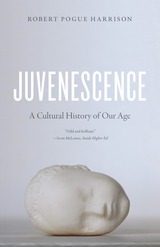
Juvenescence
A Cultural History of Our Age
Robert Pogue Harrison
University of Chicago Press, 2014
How old are you? The more thought you bring to bear on the question, the harder it is to answer. For we age simultaneously in different ways: biologically, psychologically, socially. And we age within the larger framework of a culture, in the midst of a history that predates us and will outlast us. Looked at through that lens, many aspects of late modernity would suggest that we are older than ever, but Robert Pogue Harrison argues that we are also getting startlingly younger—in looks, mentality, and behavior. We live, he says, in an age of juvenescence.
Like all of Robert Pogue Harrison's books, Juvenescence ranges brilliantly across cultures and history, tracing the ways that the spirits of youth and age have inflected each other from antiquity to the present. Drawing on the scientific concept of neotony, or the retention of juvenile characteristics through adulthood, and extending it into the cultural realm, Harrison argues that youth is essential for culture’s innovative drive and flashes of genius. At the same time, however, youth—which Harrison sees as more protracted than ever—is a luxury that requires the stability and wisdom of our elders and the institutions. “While genius liberates the novelties of the future,” Harrison writes, “wisdom inherits the legacies of the past, renewing them in the process of handing them down.”
A heady, deeply learned excursion, rich with ideas and insights, Juvenescence could only have been written by Robert Pogue Harrison. No reader who has wondered at our culture's obsession with youth should miss it.
Like all of Robert Pogue Harrison's books, Juvenescence ranges brilliantly across cultures and history, tracing the ways that the spirits of youth and age have inflected each other from antiquity to the present. Drawing on the scientific concept of neotony, or the retention of juvenile characteristics through adulthood, and extending it into the cultural realm, Harrison argues that youth is essential for culture’s innovative drive and flashes of genius. At the same time, however, youth—which Harrison sees as more protracted than ever—is a luxury that requires the stability and wisdom of our elders and the institutions. “While genius liberates the novelties of the future,” Harrison writes, “wisdom inherits the legacies of the past, renewing them in the process of handing them down.”
A heady, deeply learned excursion, rich with ideas and insights, Juvenescence could only have been written by Robert Pogue Harrison. No reader who has wondered at our culture's obsession with youth should miss it.
[more]
READERS
Browse our collection.
PUBLISHERS
See BiblioVault's publisher services.
STUDENT SERVICES
Files for college accessibility offices.
RECENTLY PUBLISHED




UChicago Accessibility Resources
home | accessibility | search | about | contact us
BiblioVault ® 2001 - 2026
The University of Chicago Press