
 A SCHOLARLY BOOK REPOSITORY

The history of the upper Yukon valley from the earliest Western contact with the Han in the 1840s has been one of continuous change. As a result of the gold rush, the Han suddenly became homeless in their own homeland. This book tells the story of that displacement and of current efforts by the Han to reclaim their lands and restore a vibrant way of life. In-depth profiles of Chief Isaac, Chief Charley, and others illustrate the critical importance of traditional leadership in stressful times.
Mishler and Simeone have carefully researched and compiled new information from historic records, adding their own, firsthand field observations and oral interviews with Elders during the 1970s, 1980s, and 1990s. They present detailed historical data on the fur trade, missionization, and the gold rush, as well as an analysis of Han social structure, settlement patterns, religion, subsistence, and expressive culture. The final chapter illustrates contemporary life in Eagle Village with two vivid ethnographic snapshots- a Christmas eve dance in 1972 and a long summer day in 1997. Appendices include a methodological essay, a historic chronology, rules for Han card games, and genealogies for many Han families. As a model of innovative ethnographic and ethnohistorical work, Han, People of the River makes an important contribution to anthropological and indigenous studies literature. As a vivid and deeply thoughtful depiction of the past, present, and future of the Han, it is meant for all Alaskans and everyone who cares about Alaska history and Alaska Native peoples.
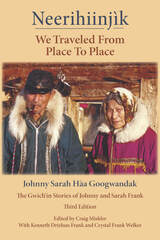
Johnny and Sarah Frank’s lives were steeped in the old ways of survival in the upland boreal forest of northeastern Alaska. Constantly on the move in search of game and other wild resources, sharing the harvest with others around them, and passing on their skills and cultural values through a rich tradition of oral literature, the Franks are vivid examples of how the Gwich’in people survived as a nation. Neerihiinjìk: We Traveled From Place To Place is a narrative of Johnny and Sarah’s life together. Both lived well into their nineties, and, through their abundant social warmth and manifest intelligence, they had an extraordinary influence on the lives of people around them.
The stories told by Johnny and Sarah in their native language are presented here with English translations on facing pages. The finished texts were transcribed from more than thirty-five hours of tape recordings. Johnny’s tales are focused on the days of long ago, the adventures of Indian warriors, and the feats and songs of powerful medicine men. Sarah, on the other hand, shapes her stories around her own daily life and her useful knowledge of the environment and its resources. Together, they present a balanced view of the Gwich’in world – the masculine and the feminine, the spiritual as well as the practical.
Neerihiinjìk adds greatly to the Franks’ reputation as rugged individuals who were versed in the ways of their ancestors and who figured prominently in the history of twentieth century Northern Dene.
READERS
Browse our collection.
PUBLISHERS
See BiblioVault's publisher services.
STUDENT SERVICES
Files for college accessibility offices.
RECENTLY PUBLISHED


UChicago Accessibility Resources
home | accessibility | search | about | contact us
BiblioVault ® 2001 - 2026
The University of Chicago Press