
 A SCHOLARLY BOOK REPOSITORY
Results by Title
2 books about Moldova
2 books about Moldova

From Communism to European Governance
The European Commission’s Support for Administrative Reforms in Romania, Serbia,and Moldova
Claudia Badulescu
Central European University Press, 2027
The fall of communism promised a new era of European governance – open, accountable, efficient administration – across Central and Eastern Europe and the Western Balkans. Three decades later, that promise feels yet to be fulfilled. From Communism to European Governance traces why. The book reconstructs the genesis, institutionalisation, and implementation of the European Commission’s support for domestic administrative reform in Romania (EU member), Serbia (EU candidate), and Moldova (EU neighbour), from 2000 to 2020. The findings challenge both optimistic narratives of EU-driven transformation and sceptical claims of external impotence. While EU engagement has strengthened legal frameworks, strategic planning, and administrative capacity, the depth and sustainability of reform depend on domestic ownership, credible incentives, and the resilience of political commitment. At a moment when EU enlargement has returned to the centre of European geopolitics, this is an essential read for scholars and policymakers engaged in governance reform across Europe and its neighbourhood.
[more]
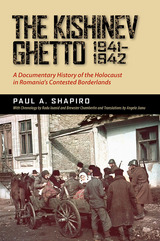
The Kishinev Ghetto, 1941–1942
A Documentary History of the Holocaust in Romania's Contested Borderlands
Paul A. Shapiro with chronology by Radu Ioanid and Brewster Chamberlin and translations by Angela Jianu
University of Alabama Press, 2015
The Kishinev Ghetto, 1941–1942 offers a wealth of primary sources and insightful commentary about the little-known slaughter of Jewish residents of Kishinev (Chisinau) under the military occupation by Romania under Marshal Ion Antonescu, a Hitler ally.
The Kishinev Ghetto, 1941–1942 sheds new light on the little-known historical events surrounding the creation, administration, and liquidation of the Kishinev (Chisinau) ghetto during the first months following the Axis attack on the Soviet Union (Operation Barbarossa) in late June 1941. Mass killings during the combined Romanian-German drive toward Kishinev in Bessarabia, after a year of Soviet rule in this Romanian border province, were followed by the shooting of thousands of Jews on the streets of the city during the first days of reestablished Romanian administration. Survivors were driven into a ghetto, persecuted, and liquidated by year’s end. The Kishinev Ghetto, 1941–1942 is the first major study of these events.
Often overshadowed by events in Germany and Poland, the history of the Holocaust in Romania, including what took place in Bessarabia (corresponding in large part with the territory of the modern Republic of Moldova), was obscured during decades of communist rule by denial and by policies that blocked access to wartime documentation. This book is the result of a lengthy research project that began with Paul A. Shapiro’s missions to Romania for the United States Holocaust Memorial Museum to negotiate access to these documents.
The volume includes:
· A preface describing the origin of the project in the immediate aftermath of the Ceausescu regime in Romania.
· A hundred-page study setting the events of the book within the historical context of Eastern European antisemitism, Romanian-Soviet conflict over control of Bessarabia, and Romania’s alliance with Nazi Germany.
· A thoughtfully curated collection of archival documents linked to the study.
· A chronology of related historical events.
· Twenty-one black and white photographs and a map of the ghetto.
Students and scholars of Holocaust history, Judaic studies, twentieth-century Eastern European history, Romania, Moldova, and historical Bessarabia will want to own this important, revealing volume.
Published in association with the United States Holocaust Memorial Museum
[more]
READERS
Browse our collection.
PUBLISHERS
See BiblioVault's publisher services.
STUDENT SERVICES
Files for college accessibility offices.
RECENTLY PUBLISHED


UChicago Accessibility Resources
home | accessibility | search | about | contact us
BiblioVault ® 2001 - 2026
The University of Chicago Press