
 A SCHOLARLY BOOK REPOSITORY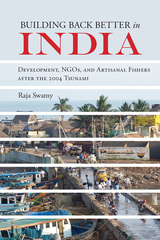
Disaster, development, and the struggle for coastal livelihoods in post-tsunami India.
Building Back Better in India: Development, NGOs, and Artisanal Fishers after the 2004 Tsunami addresses the ways in which natural disasters impact the strategies and priorities of neoliberalizing states in the contemporary era. In the light of growing scholarly and public concern over “disaster capitalism” and the tendency of states and powerful international financial institutions to view disasters as “opportunities” to “build back better,” Raja Swamy offers an ethnographically rich account of post-disaster reconstruction, its contested aims, and the mixed outcomes of state policy, humanitarian aid, and local resistance. Using the 2004 Indian Ocean tsunami as a case study, Swamy investigates the planning and implementation of a reconstruction process that sought to radically transform the geography of a coastal district in the Indian state of Tamil Nadu.
Drawing on an ethnographic study conducted in Tamil Nadu’s Nagapattinam District, Swamy shows how and why the state-led, multilaterally financed, and NGO-mediated reconstruction prioritized the displacement of coastal fisher populations. Exploring the substantive differences shaping NGO action, specifically in response to core political questions affecting the well-being of their ostensible beneficiaries, this account also centers the political agency of disaster survivors and their allies among NGOs in contesting the meanings of recovery while navigating the process of reconstruction.
If humanitarian aid brought together NGOs and fishers as givers and recipients of aid, it also revealed in its workings competing and sometimes contradictory assumptions, goals, interests, and strategies driving the fraught historical relationship between artisanal fishers and the state. Importantly, this research foregrounds the ambiguous role of NGOs involved in the distribution of aid, as well as the agency and strategic actions of the primary recipients of aid—the fishers of Nagapattinam—as they struggled with a reconstruction process that made receipt of the humanitarian gift of housing conditional on the formal abandonment of all claims to the coast. Building Back Better in India thus bridges scholarly concerns with disasters, humanitarianism, and economic development with those focused on power, agency, and resistance.
Cultures of Doing Good: Anthropologists and NGOs serves as a foundational text to advance a growing subfield of social science inquiry: the anthropology of nongovernmental organizations (NGOs). Thorough introductory chapters provide a short history of NGO anthropology, address how the study of NGOs contributes to anthropology more broadly, and examine ways that anthropological studies of NGOs expand research agendas spawned by other disciplines. In addition, the theoretical concepts and debates that have anchored the analysis of NGOs since they entered scholarly discourse after World War II are explained.
The wide-ranging volume is organized into thematic parts: “Changing Landscapes of Power,” “Doing Good Work,” and “Methodological Challenges of NGO Anthropology.” Each part is introduced by an original, reflective essay that contextualizes and links the themes of each chapter to broader bodies of research and to theoretical and methodological debates. A concluding chapter synthesizes how current lines of inquiry consolidate and advance the first generation of anthropological NGO studies, highlighting new and promising directions in this field.
In contrast to studies about surveys of NGOs that cover a single issue or region, this book offers a survey of NGO dynamics in varied cultural and political settings. The chapters herein cover NGO life in Tanzania, Serbia, the Czech Republic, Egypt, Peru, the United States, and India. The diverse institutional worlds and networks include feminist activism, international aid donors, USAID democracy experts, Romani housing activism, academic gender studies, volunteer tourism, Jewish philanthropy, Islamic faith-based development, child welfare, women’s legal arbitration, and environmental conservation.
The collection explores issues such as normative democratic civic engagement, elitism and professionalization, the governance of feminist advocacy, disciplining religion, the politics of philanthropic neutrality, NGO tourism and consumption, blurred boundaries between anthropologists as researchers and activists, and barriers to producing critical NGO ethnographies.
Winner of the 2015 Margaret Mead Award from the American Anthropological Association and the Society for Applied Anthropology
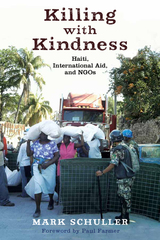
After Haiti’s 2010 earthquake, over half of U.S. households donated to thousands of nongovernmental organizations (NGOs) in that country. Yet we continue to hear stories of misery from Haiti. Why have NGOs failed at their mission?
Set in Haiti during the 2004 coup and aftermath and enhanced by research conducted after the 2010 earthquake, Killing with Kindness analyzes the impact of official development aid on recipient NGOs and their relationships with local communities. Written like a detective story, the book offers rich ethnographic comparisons of two Haitian women’s NGOs working in HIV/AIDS prevention, one with public funding (including USAID), the other with private European NGO partners. Mark Schuller looks at participation and autonomy, analyzing donor policies that inhibit these goals. He focuses on NGOs’ roles as intermediaries in “gluing” the contemporary world system together and shows how power works within the aid system as these intermediaries impose interpretations of unclear mandates down the chain—a process Schuller calls “trickle-down imperialism.”
Julia Elyachar studied the efforts of bankers, social scientists, ngo members, development workers, and state officials to turn the craftsmen and unemployed youth of Cairo into the vanguard of a new market society based on microenterprise. She considers these efforts in relation to the alternative notions of economic success held by craftsmen in Cairo, in which short-term financial profit is not always highly valued. Through her careful ethnography of workshop life, Elyachar explains how the traditional market practices of craftsmen are among the most vibrant modes of market life in Egypt. Long condemned as backward, these existing market practices have been seized on by social scientists and development institutions as the raw materials for experiments in “free market” expansion. Elyachar argues that the new economic value accorded to the cultural resources and social networks of the poor has fueled a broader process leading to their economic, social, and cultural dispossession.

Jude L. Fernando explores the paradoxical relationship between NGOs and capitalism, showing that supposedly progressive organisations often promote essentially the same policies and ideas as existing governments.
The book examines how a diverse group of NGOs have shaped state formation in Bangladesh and Sri Lanka. It argues that, rather than influencing state formation for the better, NGOs have been integrated into the capitalist system and their language adopted to give traditional exploitative social relations a transformative appearance.
This enlightening study will give pause to those who see NGOs as drivers of true social change and will encourage students of development studies to make a deeper analysis of state formation.
READERS
Browse our collection.
PUBLISHERS
See BiblioVault's publisher services.
STUDENT SERVICES
Files for college accessibility offices.
RECENTLY PUBLISHED



UChicago Accessibility Resources
home | accessibility | search | about | contact us
BiblioVault ® 2001 - 2026
The University of Chicago Press