logo for University of Chicago Press
The Lost Forms of Economic Knowledge
On the Balance of Living Beings
Arnaud Orain
University of Chicago Press, 2026

Traces the early history of economic knowledge developed by thinkers between the sixteenth and eighteenth centuries.

Tracking the pre-history of economic thought starting in the sixteenth century, The Lost Forms of Economic Knowledge investigates its origins prior to the emergence of political economy as an autonomous discipline in the late eighteenth century. French historian Arnaud Orain reconstructs the “lost forms” of economic knowledge that led to a world very different from our modern system of numerical abstraction and market regulation. As Orain shows, older approaches to the economy defined it as a relationship between humans and the environment. These earlier forms of economic thought relied on and sought to advance vernacular knowledge from figures such as naturalists, artisans, farmers, and merchants on how to harness the environment to our advantage. Nonetheless, the goal was not to maximize profit, but to satisfy our needs and live in harmony with nature. At a time in which natural resources are fast depleting, Orain argues, we could do worse than to consider alternative approaches to “economics” that lie in our past.

[more]

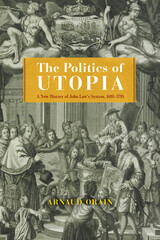
front cover of The Politics of Utopia
The Politics of Utopia
A New History of John Law's System, 1695–1795
Arnaud Orain
University of Chicago Press, 2024
A fascinating retelling of the first banking and financial collapse in eighteenth-century France.
 
The Scottish economist John Law has been described as the architect of modern central banking. His “System,” established in Regency France between 1716 and 1720, saw the founding of a bank issuing paper money and the establishment of state commercial and colonial enterprises aimed at consolidating public debt. What at first seemed like financial wizardry, however, resulted in rampant speculation and, ultimately, economic collapse. In The Politics of Utopia, historian Arnaud Orain offers a provocative rereading of this well-known episode.
 
Starting his story in the seventeenth century, Orain reconstructs the figures and ideas, long predating Law, that anticipated and laid the groundwork for the System, which, he argues, is best understood as a failed social utopia aimed at the total transformation of society. Overturning familiar narratives of this seismic event, this book rewrites a stunning chapter in economic history by dealing with the cultural, colonial, religious, and political dimensions of the (in)famous System up to the French Revolution, revealing new lessons for today’s fraught financial landscape.
[more]



Send via email Share on Facebook Share on Twitter