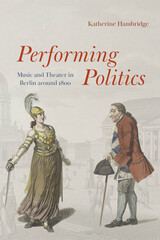
A new account of the emergence of modern cultural politics through a study of music and theater in Berlin around 1800.
Berlin around 1800 has been seen—at the time and since—as somewhat behind other major European cities in terms of its musical culture, peripheral to the momentous developments attributed to the period. By contrast, early nineteenth-century Berlin has been exhaustively studied as the site of a nascent German-national movement and the Prussian Reforms. In Performing Politics, Katherine Hambridge examines the confluence of music and politics in Berlin around 1800, engaging directly with the themes of being behind/ahead, central/peripheral, in order to tell new stories about nineteenth-century German history, musical and otherwise.
Performing Politics emphasizes events as much as repertoires, and non-canonical repertoires over the more familiar music of this period: dynastic birthday celebrations, the music of historical dramas, political song and communal singing, popular music theater. By focusing our attention on the unfamiliar specificity of Berlin Nationaltheater, Hambridge reenergizes our understanding of 1800–1815 as a key period in the development of musical and political modernity. Using sources largely unexploited by musicologists, and phenomena neglected by historians, she reveals the quotidian aesthetics, values, and practices that shaped both the sociopolitical narratives and musical developments of the time. Performing Politics is thus not only a history of music and theater in Berlin at a critical moment, but a music history of modern cultural politics.