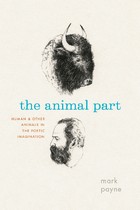
front cover of The Animal Part
The Animal Part
Human and Other Animals in the Poetic Imagination
Mark Payne
University of Chicago Press, 2010

How can literary imagination help us engage with the lives of other animals? The question represents one of the liveliest areas of inquiry in the humanities, and Mark Payne seeks to answer it by exploring the relationship between human beings and other animals in writings from antiquity to the present. Ranging from ancient Greek poets to modernists like Ezra Pound and William Carlos Williams, Payne considers how writers have used verse to communicate the experience of animal suffering, created analogies between human and animal societies, and imagined the kind of knowledge that would be possible if human beings could see themselves as animals see them.

The Animal Part
also makes substantial contributions to the emerging discourse of the posthumanities. Payne offers detailed accounts of the tenuousness of the idea of the human in ancient literature and philosophy and then goes on to argue that close reading must remain a central practice of literary study if posthumanism is to articulate its own prehistory. For it is only through fine-grained literary interpretation that we can recover the poetic thinking about animals that has always existed alongside philosophical constructions of the human.  In sum, The Animal Part marks a breakthrough in animal studies and offers a significant contribution to comparative poetics.

[more]

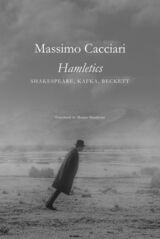
front cover of Hamletics
Hamletics
Shakespeare, Kafka, Beckett
Massimo Cacciari
Seagull Books, 2023
One of Italy's best-known contemporary philosophers and leftists offers a literature-informed take on our contemporary political situation.

During the dramatic course of the twentieth century, amid the clash of the titans which marked that era, humanity could still think in terms of partisan struggles in which large masses took sides against one another. The new millennium, by contrast, appears to have opened under the guise of generalized insecurity, which pertains not only to the historical and social situation, or to one’s personal psychological predicament, but to our very being. The Earth’s current faltering and the twilight of every convention that might govern it—where roles, images, and languages become confused by a lack of direction and distance—were already powerfully prophesied in Shakespeare’s Hamlet, and later in the works of Kafka and Beckett. In Hamletics, Massimo Cacciari, one of Italy’s foremost philosophers and leftist political figures, establishes a dialogue between these fateful authors, exploring the relationship between European nihilism and the aporias of action in the present.
[more]


Send via email Share on Facebook Share on Twitter