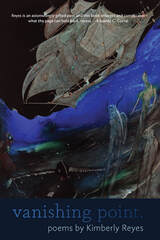
front cover of vanishing point.
vanishing point.
Kimberly Reyes
Omnidawn, 2023
A collection by award-winning poet Kimberly Reyes that explores erased histories.
 
Through her latest collection, Kimberly Reyes navigates the physical, hereditary, and liminal worlds between land, time, and memory. The poems in vanishing point. take us to San Francisco, Ireland, and the Atlantic Ocean, reclaiming and examining contested space as the poet seeks to revive left-behind histories, reconsider what we see, and reveal what we cannot see.
 
[more]

logo for Tagus Press
The Village of Vanished Souls
The Vanished Souls Duology, Book 1
Richard Zimler
Tagus Press, 2027

Winner of Book of the Year in Portugal, The Village of Vanished Souls is a sweeping historical tale inspired by authentic records of the Portuguese Inquisition and the real lives of villagers whose stories have long been forgotten.

Portugal, 1671—Nine-year-old Isaaque Zarco lives a peaceful life in the remote mountain village of Castelo Rodrigo, where he helps his mother prepare meals, roams the surrounding forests with his spirited best friend Lena, and learns about nature from the village apothecary, Samuel. But his idyllic childhood is shattered when Lena and her family suddenly vanish, followed by a series of brutal murders that plunge the isolated community into fear.

When Isaaque’s formidable Castilian grandmother visits, she says what no one else dares: the Inquisition is hunting descendants of Jews who continue to secretly practice. Then she entrusts Isaaque with an even more dangerous secret—that he, too, belongs to a secret Jewish family. As she introduces him to the forbidden traditions and sacred writings of their ancestors, Isaaque’s understanding of his parents, his village, and himself is transformed forever.

As Isaaque comes of age, he is drawn into a clandestine network that helps persecuted Jews escape Portugal. Every mission carries the risk of imprisonment, torture, and death, yet this dangerous work gives Isaaque a profound sense of purpose while deepening his commitment to his heritage. When he learns that his beloved grandmother is ill, he embarks on a journey that will expose long-buried family secrets and reveal that learning to embrace his heritage is only the beginning of what will soon be asked of him.

Inspired by the names, arrest records, and testimonies preserved in Inquisitional archives, The Village of Vanished Souls recreates a little-known chapter of history with vivid historical detail and emotional depth. At once an unforgettable coming-of-age story and a moving portrait of resilience, identity, faith, and love, it gives voice to people whose courage endured despite centuries of persecution and forced silence.


[more]

front cover of A Voice
A Voice
Selected Poems
Anzhelina Polonskaya
Northwestern University Press, 2004
Anzhelina Polonskaya is considered one of the freshest voices among young Russian poets. Unlike most of her contemporaries, she was not educated in the classic literary tradition, nor nurtured by the well-known Moscow and Petersburg journals. This has freed her from self-consciously struggling under the weight of her country's literary tradition, and her independent, even idiosyncratic, voice informs poems filled with sharp images, acute observations, and both the pains and joys of personal experience.

Drawn from her most recent Russian collections, A Voice: Selected Poems explores the poet's ongoing fascinations—desolate places, long journeys, a synesthesia of sensory stimulation, and the presence of death. Also on display is her Chekhovian gift for unexpected closure. This is a promising English-language debut from a poet already gaining international attention.
[more]

front cover of Vulnerability Index
Vulnerability Index
Poems
Elizabeth Robinson
Northwestern University Press, 2026
Poems from the halls of shelters, courthouses, and soup kitchens

During Elizabeth Robinson’s six years working with chronically unhoused people in Boulder, Colorado, her relationships with the community’s most vulnerable deepened—even as they were filtered through a web of paperwork, systems, and strictures. The Vulnerability Index questionnaire is just one such system. Ubiquitous in shelters across America, it is representative of the endless tasks that people living on the street must complete to receive even minor assistance. 

Moving between the local court, jail, shelter, and soup kitchen, Robinson’s poems capture the strange juxtapositions of the intimate, bureaucratic, and absurd that such spaces demand: a frostbite victim wants to share his state-sponsored recovery room with a friend from the street, a domestic violence survivor must change her name and even her social security number, an unhoused activist joins a vigil for another woman only to discover that she is, mistakenly, the person being mourned. Spare yet richly empathetic, Robinson’s verse works to implicate the reader’s own vulnerability on every page.
[more]


Send via email Share on Facebook Share on Twitter