
 A SCHOLARLY BOOK REPOSITORY
Results by Title
3 books about Postdictatorship Argentina
3 books about Postdictatorship Argentina
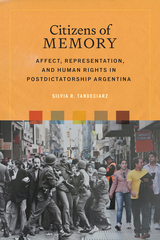
Citizens of Memory
Affect, Representation, and Human Rights in Postdictatorship Argentina
Silvia R. Tandeciarz
Bucknell University Press, 2026
Citizens of Memory explores efforts at recollection in post-dictatorship Argentina and the hoped-for futures they set in motion. The sites, images, narratives, and practices it analyzes address the dark years of state repression (1976-1983) while engaging ongoing debates about how this traumatic past should be transmitted to future generations. This insightful study approaches cultural recall via two theoretical principles—the first understands memory as a social construct that is as much about the past as it is of the present, and the second observes that what distinguishes memory from history is affect. Understanding recollection and storytelling as practices that can help constitute communities of belonging, Tandeciarz suggests that by inciting deep reflection and an active engagement with the legacies of state violence, interventions like those studied here may advance transitional justice and contribute to the construction of less violent futures.
Published by Bucknell University Press. Distributed worldwide by Rutgers University Press.
Published by Bucknell University Press. Distributed worldwide by Rutgers University Press.
[more]
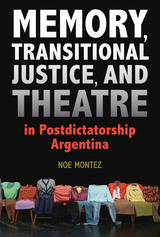
Memory, Transitional Justice, and Theatre in Postdictatorship Argentina
Noe Montez
Southern Illinois University Press, 2018
Author Noe Montez considers how theatre, as a site of activism, produces memory narratives that change public reception to a government’s transitional justice policies. Drawing on contemporary research in memory studies and transitional justice, Montez examines the Argentine theatre’s responses to the country’s transitional justice policies—truth and reconciliation hearings, trials, amnesties and pardons, and memorial events and spaces—that have taken place in the last decade of the twentieth century and the first two decades of the twenty-first century.
Montez explores how the sociohistorical phenomenon of the Teatroxlaidentidad—an annual showcase staged with the support of Argentina’s Grandmothers of the Plaza de Mayo—acted as a vehicle for drawing attention to the hundreds of children kidnapped from their families during the dictatorship and looks at why the memory narratives regarding the Malvinas Islands (also known as the Falklands) range from ideological appropriations of the islands, to absurdist commentaries about the failed war that signaled the dictatorship’s end, to the islands’ heavily contested status today.
Memory, Transitional Justice, and Theatre in Postdictatorship Argentina explores the vibrant role of theatrical engagement in postdictatorship Argentina, analyzes plays by artists long neglected in English-language articles and books, and explores the practicalities of staging performances in Latin America.
Montez explores how the sociohistorical phenomenon of the Teatroxlaidentidad—an annual showcase staged with the support of Argentina’s Grandmothers of the Plaza de Mayo—acted as a vehicle for drawing attention to the hundreds of children kidnapped from their families during the dictatorship and looks at why the memory narratives regarding the Malvinas Islands (also known as the Falklands) range from ideological appropriations of the islands, to absurdist commentaries about the failed war that signaled the dictatorship’s end, to the islands’ heavily contested status today.
Memory, Transitional Justice, and Theatre in Postdictatorship Argentina explores the vibrant role of theatrical engagement in postdictatorship Argentina, analyzes plays by artists long neglected in English-language articles and books, and explores the practicalities of staging performances in Latin America.
[more]
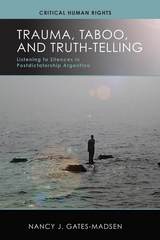
Trauma, Taboo, and Truth-Telling
Listening to Silences in Postdictatorship Argentina
Nancy J. Gates-Madsen
University of Wisconsin Press, 2018
Argentina’s repressive 1976–83 dictatorship, during which an estimated thirty thousand people were “disappeared,” prompted the postauthoritarian administrations and human rights groups to encourage public exposure of past crimes and traumas. Truth commissions, trials, and other efforts have aimed to break the silence and give voice to the voiceless. Yet despite these many reckonings, there are still silences, taboos, and unanswerable questions.
Nancy J. Gates-Madsen reads between the lines of Argentine cultural texts (fiction, drama, testimonial narrative, telenovela, documentary film) to explore the fundamental role of silence—the unsaid—in the expression of trauma. Her careful examination of the interplay between textual and contextual silences illuminates public debate about the meaning of memory in Argentina—which stories are being told and, more important, which are being silenced. The imposition of silence is not limited to the military domain or its apologists, she shows; the human rights community also perpetuates and creates taboos.
Nancy J. Gates-Madsen reads between the lines of Argentine cultural texts (fiction, drama, testimonial narrative, telenovela, documentary film) to explore the fundamental role of silence—the unsaid—in the expression of trauma. Her careful examination of the interplay between textual and contextual silences illuminates public debate about the meaning of memory in Argentina—which stories are being told and, more important, which are being silenced. The imposition of silence is not limited to the military domain or its apologists, she shows; the human rights community also perpetuates and creates taboos.
[more]
READERS
Browse our collection.
PUBLISHERS
See BiblioVault's publisher services.
STUDENT SERVICES
Files for college accessibility offices.
RECENTLY PUBLISHED


UChicago Accessibility Resources
home | accessibility | search | about | contact us
BiblioVault ® 2001 - 2025
The University of Chicago Press