
 A SCHOLARLY BOOK REPOSITORY
With a death rate of 5 percent, Alabama's Cahaba Federal Prison boasted a better survival rate than the notorious Confederate prisoner-of-war camps of Andersonville, Libby Prison, Elmira, Rock Island, Johnson's Island, and Camp Douglas. Yet it was a ghastly facility, a hastily converted agricultural warehouse so overcrowded that each man barely had space to lie down to sleep.
At the war's conclusion in 1865, however, in a harrowing reversal of the inmates' fates, captured Union soldiers were sent on a grueling overland march to the Mississippi River. Held there in camps at Vicksburg along with other prisoners of war, the soldiers embarked on the steamship Sultana for transportation north.
Traveling first to New Orleans and then heading north, the vessel held by some estimates six times more passengers than its safe limit, many of them ill, injured, or malnourished. The flow of the swollen Mississippi that April was wide, swift, and cold, and the Sultana struggled to make the journey. Then, on April 27, 1865, seven miles north of Memphis, a series of three boilers exploded within seconds of one another.
The lucky passengers were flung into the water as chunks of the Sultana blasted apart. The remaining wooden structure caught fire and the upper deck collapsed. Only an estimated one third of the passengers survived, hundreds of whom later died from their wounds.
First published in 1988, Bryant's account weaves together the many strands of the Cahaba story. Combining masterful storytelling and insightful analysis, he describes Civil War prisons, the history of the Cahaba Federal Prison and its construction, as well as the prison's commanders, prisoners, and local women who provided medical care and food to the prisoners. He tells of the violent struggles among Union inmates, a mutiny and flood that occurred during the final days of the camp, and the harrowing deaths of the liberated soldiers aboard the Sultana. Bryant's Cahaba Prison and the Sultana Disaster remains a vital part of any library of Civil War history.
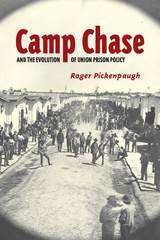
Camp Chase was a major Union POW camp and also served at various times as a Union military training facility and as quarters for Union soldiers who had been taken prisoner by the Confederacy and released on parole or exchanged. As such, this careful, thorough, and objective examination of the history and administration of the camp will be of true significance in the literature on the Civil War.
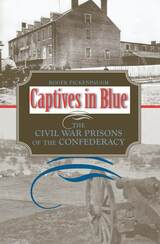
A study of Union prisoners in Confederate prisons
In Captives in Blue, Roger Pickenpaugh examines the ways the Confederate army contended with the growing prison population, the variations in the policies and practices of different Confederate prison camps, the effects these policies and practices had on Union prisoners, and the logistics of prisoner exchanges. He explores conditions that arose from conscious government policy decisions and conditions that were the product of local officials or unique local situations. He also considers how Confederate prisons and policies dealt with African American Union soldiers. Black soldiers held captive in Confederate prisons faced uncertain fates; many former slaves were returned to their former owners, while others faced harsh treatment in the camps. Drawing on prisoner diaries, Pickenpaugh provides compelling first-person accounts of life in prison camps often overlooked by scholars in the field.
This study of Union captives in Confederate prisons is a companion to Roger Pickenpaugh’s earlier groundbreaking book Captives in Gray: The Civil War Prisons of the Union and extends his examination of Civil War prisoner-of-war facilities into the Confederacy.
“This is a vivid description of conditions and events rarely described: the imprisonment of captured Confederate soldiers during the Civil War. Its many parallels to circumstances in Andersonville are especially intriguing.” —Jimmy Carter, 39th President of the United States
Contains contemporary reports from prisoners and witnesses humanize the grim realities of the POW camps
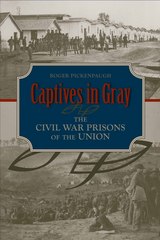
Captives in Gray is Civil War prison camp authority Roger Pickenpaugh’s acclaimed and definitive account of the Union’s POW camps. Combining his own extensive research into official records and a rich variety of letters and diaries with the best contemporary scholarship, Pickenpaugh covers every major northern camp.
Because the Union won few victories in 1861 and took few prisoners, the North had time to plan and build prison camps, an opportunity it largely squandered. Pickenpaugh gives illuminating accounts of the role and leadership of thrifty Lieutenant Colonel William Hoffman, the commissary general of prisoners for most of the conflict, and President Abraham Lincoln's secretaries of war, the incompetent Simon Cameron and the malignant Edwin M. Stanton.
Death came in many ways. Soldiers from the Deep South had no experience with extreme cold, and they died by the hundreds each winter. In one memorable freeze, Rock Island, Illinois, saw temperatures between twenty-eight and thirty-one degrees below zero. With insufficient fuel and inadequate shelter, clothing, and blankets, prisoners there and in other camps froze to death. Food rations varied widely. A few Confederates enjoyed better rations than they had in the CSA armies, but the majority supplemented their meager rations by eating rats, dogs, cats, and seagulls.
Poor medical care added to the death toll. Treatment was bad even by the standards of Civil War medicine, often due to Hoffman's reluctance to spend. Prisoners suffered from lice and scurvy, as well as pneumonia, measles, and a variety of fevers. As in both armies, diarrhea and dysentery were chronic. Smallpox epidemics killed many. Poor sanitation and drainage caused 385 deaths at Elmira, New York, in September 1864 alone.
During the war, over 12 percent of rebel prisoners, or 25,976 of the 214,865, died in captivity. Together with his Captives in Blue, Captives in Gray gives the fullest account of the experiences of prisoners of war in the American Civil War.
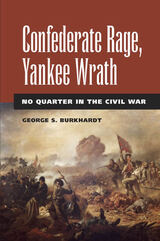
Author George S. Burkhardt details a fascinating case that the Confederates followed a consistent pattern of murder against the black soldiers who served in Northern armies after Lincoln’s 1863 Emancipation Proclamation. He shows subsequent retaliation by black soldiers and further escalation by the Confederates, including the execution of some captured white Federal soldiers, those proscribed as cavalry raiders, foragers, or house-burners, and even some captured in traditional battles.
Further disproving the notion of Confederates as victims who were merely trying to defend their homes, Burkhardt explores the motivations behind the soldiers’ actions and shows the Confederates’ rage at the sight of former slaves—still considered property, not men—fighting them as equals on the battlefield.
Burkhardt’s narrative approach recovers important dimensions of the war that until now have not been fully explored by historians, effectively describing the systemic pattern that pushed the conflict toward a black flag, take-no-prisoners struggle.
In 1937 during the Spanish Civil War, Arthur Koestler, a German exile writing for a British newspaper, was arrested by Nationalist forces in Málaga. He was then sentenced to execution and spent every day awaiting death—only to be released three months later under pressure from the British government. Out of this experience, Koestler wrote Darkness at Noon, his most acclaimed work in the United States, about a man arrested and executed in a Communist prison.
Dialogue with Death is Koestler’s riveting account of the fall of Málaga to rebel forces, his surreal arrest, and his three months facing death from a prison cell. Despite the harrowing circumstances, Koestler manages to convey the stress of uncertainty, fear, and deprivation of human contact with the keen eye of a reporter.
From the shooting of an unarmed prisoner at Montgomery, Alabama, to a successful escape from Belle Isle, from the swelling floodwaters overtaking Cahaba Prison to the inferno that finally engulfed Andersonville, A Perfect Picture of Hell is a collection of harrowing narratives by soldiers from the 12th Iowa Infantry who survived imprisonment in the South during the Civil War.
Editors Ted Genoways and Hugh Genoways have collected the soldiers' startling accounts from diaries, letters, speeches, newspaper articles, and remembrances. Arranged chronologically, the eyewitness descriptions of the battles of Shiloh, Corinth, Jackson, and Tupelo, together with accompanying accounts of nearly every famous Confederate prison, create a shared vision
In this singular examination of the American discourse over war and torture, Douglas V. Porpora, Alexander Nikolaev, Julia Hagemann May, and Alexander Jenkins investigate the opinion pages of American newspapers, television commentary, and online discussion groups to offer the first empirical study of the national conversation about the 2003 invasion of Iraq and the revelations of prisoner abuse at Abu Ghraib a year later. Post-Ethical Society is not just another shot fired in the ongoing culture war between conservatives and liberals, but a pensive and ethically engaged reflection of America’s feelings about itself and our actions as a nation. And while many writers and commentators have opined about our moral place in the world, the vast amount of empirical data amassed in Post-Ethical Society sets it apart—and makes its findings that much more damning.
“Among the many events which took place during the Revolutionary War from its commencement to its termination [are] the cruelties inflicted upon that unfortunate class of men who had the misfortune to be numbered among the prisoners [of the British] and more particularly those whom the dreadful chance of war had placed on board their prison ships at New York.” So begins the remarkable narrative of Thomas Dring. In 1824, Dring was an aging man of 65, retired in his native state of Rhode Island. Forty-two years before, he, like thousands of other young men, had been caught up in the American cause. In 1782, he had been captured by the British and sentenced to the infamous prison ship Jersey, a demasted hulk anchored in the East River off New York City. It is estimated that more than 11,000 men perished on the British prison ships over the course of the war, and their bones regularly washed up on the shore long after hostilities ceased. Dring survived to tell the tale, and in 1824, he decided to do just that. He was motivated partly because the fate of the prisoners was beginning to be doubted, that their hardships were thought to have been grossly exaggerated, and even that the entire experience had never occurred.
This book publishes for the first time the complete text of Dring’s handwritten manuscript, a major primary-source document, in which he describes the horrible conditions, treatment by guards, and experiences that he and others endured during captivity. Recollections of Life on the Prison Ship Jersey is a plea not to forget but instead to remember the inhumanity of the captors and the sacrifices of the captives—a message that continues to resonate today. Editor David Swain has provided an introductory essay and extensive notes that contain background information and historical documentation to accompany and illuminate the original manuscript.

Shadow Lives reveals the unseen side of the '9/11 wars': their impact on the wives and families of men incarcerated in Guantanamo, or in prison or under house arrest in Britain and the US. Victoria Brittain shows how these families have been made socially invisible and a convenient scapegoat for the state in order to exercise arbitrary powers under the cover of the 'War on Terror'.
A disturbing exposé of the perilous state of freedom and democracy in our society, the book reveals how a culture of intolerance and cruelty has left individuals at the mercy of the security services’ unverifiable accusations and punitive punishments.
Both a j'accuse and a testament to the strength and humanity of the families, Shadow Lives shows the methods of incarceration and social control being used by the British state and gives a voice to the families whose lives have been turned upside down. In doing so it raises urgent questions about civil liberties which no one can afford to ignore.
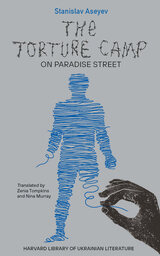
Finalist, 2024 PEN Translation Prize
In The Torture Camp on Paradise Street, Ukrainian journalist and writer Stanislav Aseyev details his experience as a prisoner from 2015 to 2017 in a modern-day concentration camp overseen by the Federal Security Bureau of the Russian Federation (FSB) in the Russian-controlled city of Donetsk. This memoir recounts an endless ordeal of psychological and physical abuse, including torture and rape, inflicted upon the author and his fellow inmates over the course of nearly three years of illegal incarceration spent largely in the prison called Izoliatsiia (Isolation). Aseyev also reflects on how a human can survive such atrocities and reenter the world to share his story.
Since February 2022, numerous cases of illegal detainment and extreme mistreatment have been reported in the Ukrainian towns and villages occupied by Russian forces during the full-scale invasion. These and other war crimes committed by Russian troops speak to the horrors wreaked upon Ukrainians forced to live in Russian-occupied zones. It is important to remember, however, that the torture and killing of Ukrainians by Russian security and military forces began long before 2022. Rendered deftly into English, Aseyev’s compelling account offers a critical insight into the operations of Russian forces in the occupied territories of Ukraine.
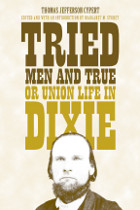
A gripping firsthand account of loyalty, resistance, and survival in Confederate Tennessee, this memoir reveals the untold story of Unionist courage behind enemy lines.
Tried Men and True, or Union Life in Dixie is the memoir of a Union supporter in south-central Tennessee. In it, he chronicles in vivid and emotional detail the local tensions between Unionists and Confederates during the Civil War South and offers a rare first-person account of the guerrilla war that devastated Western Tennessee.
Thomas Jefferson Cypert (1827-1918) was a staunch Union man of Wayne County, Tennessee. In 1863, he helped organize the Second Tennessee Mounted Infantry, a regiment of loyalist Southerners enlisted to combat Confederate cavalry in West Tennessee and Northern Alabama. Tried Men and True is Cypert’s memoir of his time as Captain of Company A, including his capture by Confederate cavalry and subsequent daring escape, in which he was aided by local Union sympathizers and slaves.
After the Civil War, Cypert served two terms in the Tennessee State Senate, one of them during the heated first years of Reconstruction, when Tennessee disenfranchised former rebels and attempted to establish Unionist Republican rule in the state. Cypert clearly wrote his memoir to defend Unionism, condemn secession and rebellion, and support loyalists’ claims for post-war power through an account of their wartime sacrifices. Never before published, the manuscript has been preserved in nearly perfect condition by Cypert’s descendants over the generations. This book is a remarkable and engagingly written account of resistance to the Confederacy by a group of southwestern Tennessee loyalists.
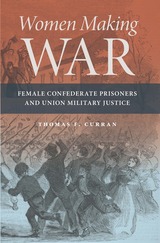
During the American Civil War, more than four hundred women were arrested and imprisoned by the Union Army in the St. Louis area. The majority of these women were fully aware of the political nature of their actions and had made conscious decisions to assist Confederate soldiers in armed rebellion against the U.S. government. Their crimes included offering aid to Confederate soldiers, smuggling, spying, sabotaging, and, rarely, serving in the Confederate army. Historian Thomas F. Curran’s extensive research highlights for the first time the female Confederate prisoners in the St. Louis area, and his thoughtful analysis shows how their activities affected Federal military policy.
Early in the war, Union officials felt reluctant to arrest women and waited to do so until their conduct could no longer be tolerated. The war progressed, the women’s disloyal activities escalated, and Federal response grew stronger. Some Confederate partisan women were banished to the South, while others were held at Alton Military Prison and other sites. The guerilla war in Missouri resulted in more arrests of women, and the task of incarcerating them became more complicated.
The women’s offenses were seen as treasonous by the Federal government. By determining that women—who were excluded from the politics of the male public sphere—were capable of treason, Federal authorities implicitly acknowledged that women acted in ways that had serious political meaning. Nearly six decades before U.S. women had the right to vote, Federal officials who dealt with Confederate partisan women routinely referred to them as citizens. Federal officials created a policy that conferred on female citizens the same obligations male citizens had during time of war and rebellion, and they prosecuted disloyal women in the same way they did disloyal men.
The women arrested in the St. Louis area are only a fraction of the total number of female southern partisans who found ways to advance the Confederate military cause. More significant than their numbers, however, is what the fragmentary records of these women reveal about the activities that led to their arrests, the reactions women partisans evoked from the Federal authorities who confronted them, the impact that women’s partisan activities had on Federal military policy and military prisons, and how these women’s experiences were subsumed to comport with a Lost Cause myth—the need for valorous men to safeguard the homes of defenseless women.
READERS
Browse our collection.
PUBLISHERS
See BiblioVault's publisher services.
STUDENT SERVICES
Files for college accessibility offices.
RECENTLY PUBLISHED





UChicago Accessibility Resources
home | accessibility | search | about | contact us
BiblioVault ® 2001 - 2025
The University of Chicago Press