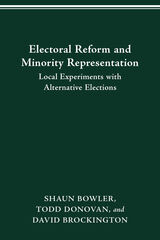
front cover of ELECTORAL REFORM AND MINORITY REPRESENTATION
ELECTORAL REFORM AND MINORITY REPRESENTATION
LOCAL EXPERIMENTS WITH ALTERNATIVE ELECTIONS
SHAUN BOWLER
The Ohio State University Press, 2003

Questions of minority representation have long plagued the U.S. voting systems. The standard election often leaves political, racial, or ethnic minorities with little chance of being represented. Race-conscious districting remains the primary policy tool used for providing representation of racial and ethnic minorities in the United States—and it continues to generate tremendous conflict. Can alternatives to race-conscious, single-member districts offer benefits that extend beyond simply providing descriptive representations of minorities?

This study examines one such “semi-proportional” representation election system: Cumulative Voting (CV). For over a decade, scores of local U.S. governments have been elected by Cumulative Voting. This provides us with the ability to examine the effects of CV elections over time. Moreover, the use of CV in the United States allows us to compare politics in places that adopted CV to highly similar places that did not. Electoral Reform and Minority Representation shares evidence that CV elections can produce minority representation that matches levels generated with the drawing of race-conscious “majority-minority” districting. It also offers evidence that the quality of democratic processes in CV communities is in several ways higher that those under districts.

Given America’s growing racial and ethnic diversity, and given successful legal challenges that limit the use of race-conscious districting Electoral Reform and Minority Representation suggests that Cumulative Voting may be a better way to achieve minority representation in U.S. politics.
[more]

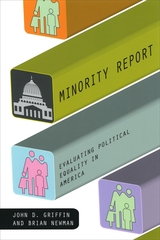
front cover of Minority Report
Minority Report
Evaluating Political Equality in America
John D. Griffin and Brian Newman
University of Chicago Press, 2008
Are the views of Latinos and African Americans underrepresented in our federal government?  For that matter, what does it mean to be represented equitably? Rather than taking for granted a single answer to these complex questions, John Griffin and Brian Newman use different measures of political equality to reveal which groups get what they want from government and what factors lead to their successes.
 
One of the first books to compare the representation of both African Americans and Latinos to that of whites, Minority Report shows that congressional decisions and federal policy tend to mirror the preferences of whites as a group and as individuals better than the preferences of either minority group, even after accounting for income disparities. This is far from the whole story, though, and the authors’ multifaceted approach illustrates the surprising degree to which group population size, an issue’s level of importance, the race or ethnicity of an office holder, and electoral turnout can affect how well government action reflects the views of each person or group. Sure to be controversial, Minority Report ultimately goes beyond statistical analyses to address the root question of what equal representation really means.
[more]

front cover of Mixed-Member Electoral Systems in Constitutional Context
Mixed-Member Electoral Systems in Constitutional Context
Taiwan, Japan, and Beyond
Edited by Nathan F. Batto, Chi Huang, Alexander C. Tan, and Gary W. Cox
University of Michigan Press, 2016
Reformers have promoted mixed-member electoral systems as the “best of both worlds.” In this volume, internationally recognized political scientists evaluate the ways in which the introduction of a mixed-member electoral system affects the configuration of political parties. The contributors examine several political phenomena, including cabinet post allocation, nominations, preelectoral coalitions, split-ticket voting, and the size of party systems and faction systems. Significantly, they also consider various ways in which the constitutional system—especially whether the head of government is elected directly or indirectly—can modify the incentives created by the electoral system.  

The findings presented here demonstrate that the success of electoral reform depends not only on the specification of new electoral rules per se but also on the political context—and especially the constitutional framework—within which such rules are embedded.

[more]


Send via email Share on Facebook Share on Twitter