front cover of Black Child, White Child
Black Child, White Child
The Developement of Racial Attitudes
Judith Porter
Harvard University Press, 1971
Racial attitudes are learned during the preschool years and directly reflect the attitudes and actions of American society. Using the self-portraits, stories, and doll-play of 400 children 3 to 5 years old, Judith Porter investigated the effects of such sociological variables as age, race, skin color, social class, interracial contact, and sex, both alone and in combination with other variables on the children's racial preferences. She is one of the first to relate these attitudes to actual interaction patterns in integrated kindergartens. Her research sheds new light on the ways in which early encounters with racism and prejudice affect the self-esteem, racial self-concept, and personality development of black children. Her study includes new findings on the effect of social class on the formation of racial attitudes. She concludes with a discussion of the implications of the data for theory, for future research, and for public policy, as well as specific recommendations for the creation of high-quality integrated nursery schools.
[more]

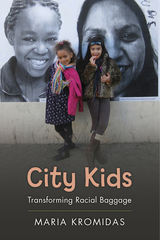
front cover of City Kids
City Kids
Transforming Racial Baggage
Kromidas, Maria
Rutgers University Press, 2016
Cosmopolitanism—the genuine appreciation of cultural and racial diversity—is often associated with adult worldliness and sophistication. Yet, as this innovative new book suggests, children growing up in multicultural environments might be the most cosmopolitan group of all. 
 
City Kids profiles fifth-graders in one of New York City’s most diverse public schools, detailing how they collectively developed a sophisticated understanding of race that challenged many of the stereotypes, myths, and commonplaces they had learned from mainstream American culture. Anthropologist Maria Kromidas spent over a year interviewing and observing these young people both inside and outside the classroom, and she vividly relates their sometimes awkward, often playful attempts to bridge cultural rifts and reimagine racial categories. Kromidas looks at how children learned race in their interactions with each other and with teachers in five different areas—navigating urban space, building friendships, carrying out schoolwork, dealing with the school’s disciplinary policies, and enacting sexualities. The children’s interactions in these areas contested and reframed race. Even as Kromidas highlights the lively and quirky individuals within this super-diverse group of kids, she presents their communal ethos as a model for convivial living in multiracial settings.   
 
By analyzing practices within the classroom, school, and larger community, City Kids offers advice on how to nurture kids’ cosmopolitan tendencies, making it a valuable resource for educators, parents, and anyone else who is concerned with America’s deep racial divides. Kromidas not only examines how we can teach children about antiracism, but also considers what they might have to teach us. 
 
[more]

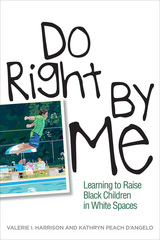
front cover of Do Right by Me
Do Right by Me
Learning to Raise Black Children in White Spaces
Valerie I. Harrison and Kathryn Peach D'Angelo
Temple University Press, 2021

For decades, Katie D’Angelo and Valerie Harrison engaged in conversations about race and racism. However, when Katie and her husband, who are white, adopted Gabriel, a biracial child, Katie’s conversations with Val, who is black, were no longer theoretical and academic. The stakes grew from the two friends trying to understand each other’s perspectives to a mother navigating, with input from her friend, how to equip a child with the tools that will best serve him as he grows up in a white family. 

Through lively and intimate back-and-forth exchanges, the authors share information, research, and resources that orient parents and other community members to the ways race and racism will affect a black child’s life—and despite that, how to raise and nurture healthy and happy children. These friendly dialogues about guarding a child’s confidence and nurturing positive racial identity form the basis for Do Right by Me. Harrison and D’Angelo share information on transracial adoption, understanding racism, developing a child’s positive racial identity, racial disparities in healthcare and education, and the violence of racism. 

Do Right by Me also is a story about friendship and kindness, and how both can be effective in the fight for a more just and equitable society.
[more]

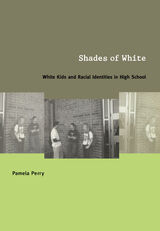
front cover of Shades of White
Shades of White
White Kids and Racial Identities in High School
Pamela Perry
Duke University Press, 2002
What does it mean to be young, American, and white at the dawn of the twenty-first century? By exploring this question and revealing the everyday social processes by which high schoolers define white identities, Pamela Perry offers much-needed insights into the social construction of race and whiteness among youth.
Through ethnographic research and in-depth interviews of students in two demographically distinct U.S. high schools—one suburban and predominantly white; the other urban, multiracial, and minority white—Perry shares students’ candor about race and self-identification. By examining the meanings students attached (or didn’t attach) to their social lives and everyday cultural practices, including their taste in music and clothes, she shows that the ways white students defined white identity were not only markedly different between the two schools but were considerably diverse and ambiguous within them as well. Challenging reductionist notions of whiteness and white racism, this study suggests how we might go “beyond whiteness” to new directions in antiracist activism and school reform.
Shades of White is emblematic of an emerging second wave of whiteness studies that focuses on the racial identity of whites. It will appeal to scholars and students of anthropology, sociology, and cultural studies, as well as to those involved with high school education and antiracist activities.
[more]


Send via email Share on Facebook Share on Twitter