
 A SCHOLARLY BOOK REPOSITORY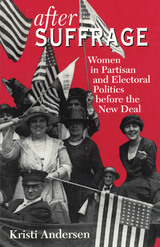
Andersen shows how women's participation was based on a conception of women's citizenship as indirect and disinterested. Gaining the right to vote, campaign, and run for office transformed women's citizenship; at the same time, women's independent partisan stance, their focus on social welfare concerns, and their use of new political techniques such as lobbying all helped to redefine politics.
This fresh, nuanced analysis of women voters, activists, candidates, and officeholders will interest scholars in political science and women's studies.
"In this rich and engaging book, Kristi Anderson presents a convincing argument that woman suffrage deserves greater scrutiny as a social, cultural, and political force in the development of American electoral and party politics."—Jane Junn, Political Science Quarterly
"Anderson's innovation in this book is to change the dominant question asked about American women's suffrage. . . . This book offers a much-needed corrective to the conventional conception that the enfranchisement of women had no significant effect on American society."—Inderjeet Parmar, Political Studies
"Anderson's book is an excellent treatment . . . and a sterling example of the value of using multiple research methods—also steeped within a deep understanding of context, culture, and historic trends—to explain something as complicated and nuanced as the impact of women's votes after suffrage."—Laura R. Woliver, Journal of Politics

Daughters of the Union casts a spotlight on some of the most overlooked and least understood participants in the American Civil War: the women of the North. Unlike their Confederate counterparts, who were often caught in the midst of the conflict, most Northern women remained far from the dangers of battle. Nonetheless, they enlisted in the Union cause on their home ground, and the experience transformed their lives.
Nina Silber traces the emergence of a new sense of self and citizenship among the women left behind by Union soldiers. She offers a complex account, bolstered by women's own words from diaries and letters, of the changes in activity and attitude wrought by the war. Women became wage-earners, participants in partisan politics, and active contributors to the war effort. But even as their political and civic identities expanded, they were expected to subordinate themselves to male-dominated government and military bureaucracies.
Silber's arresting tale fills an important gap in women's history. She shows the women of the North--many for the first time--discovering their patriotism as well as their ability to confront new economic and political challenges, even as they encountered the obstacles of wartime rule. The Civil War required many women to act with greater independence in running their households and in expressing their political views. It brought women more firmly into the civic sphere and ultimately gave them new public roles, which would prove crucial starting points for the late-nineteenth-century feminist struggle for social and political equality.

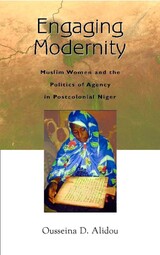
Engaging Modernity is Ousseina Alidou’s rich and compelling portrait of Muslim women in Niger as they confront the challenges and opportunities of the twentieth century. Contrary to Western stereotypes of passive subordination, these women are taking control of their own lives and resisting domination from indigenous traditions, westernization, and Islam alike.
Based on thorough scholarly research and extensive fieldwork—including a wealth of interviews—Alidou’s work offers insights into the meaning of modernity for Muslim women in Niger. Mixing biography with sociological data, social theory and linguistic analysis, this is a multilayered vision of political Islam, education, popular culture, and war and its aftermath. A gripping look at one of the Muslim world’s most powerful untold stories.
Runner-up for the Aidoo-Snyder Book Prize, Women’s Caucus of the African Studies Association
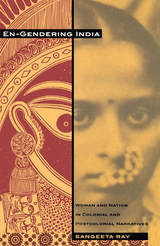
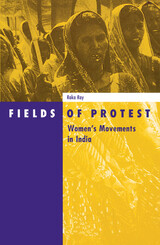
Through her readings of works by writers including Bankimchandra Chatterjee, Rabindranath Tagore, Harriet Martineau, Flora Annie Steel, Anita Desai, and Bapsi Sidhaa, Ray demonstrates that Indian women were presented as upper class and Hindu, an idealization that paradoxically served the needs of both colonial and nationalist discourses. The Indian nation’s goal of self-rule was expected to enable women’s full participation in private and public life. On the other hand, British colonial officials rendered themselves the protectors of passive Indian women against their “savage” male countrymen. Ray shows how the native woman thus became a symbol for both an incipient Indian nation and a fading British Empire. In addition, she reveals how the figure of the upper-class Hindu woman created divisions with the nationalist movement itself by underscoring caste, communal, and religious differences within the newly emerging state. As such, Ray’s study has important implications for discussions about nationalism, particularly those that address the concepts of identity and nationalism.
Building on recent scholarship in feminism and postcolonial studies, En-Gendering India will be of interest to scholars in those fields as well as to specialists in nationalism and nation-building and in Victorian, colonial, and postcolonial literature and culture.
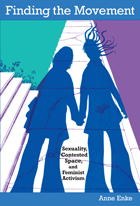
By considering the development of feminism through an analysis of public space, Enke expands and revises the historiography of second-wave feminism. She suggests that the movement was so widespread because it was built by people who did not identify themselves as feminists as well as by those who did. Her focus on claims to public space helps to explain why sexuality, lesbianism, and gender expression were so central to feminist activism. Her spatial analysis also sheds light on hierarchies within the movement. As women turned commercial, civic, and institutional spaces into sites of activism, they produced, as well as resisted, exclusionary dynamics.

Essays reveal the multiplicity of ways "compulsory masculinity" is imposed upon female leaders who wish to succeed in a man's world, and analyzes the use of interpersonal means to ensure masculine advantage. For example, only one woman in Congress was able to have a direct effect on any reproductive policy; other women experienced sexual harassment by offensive men, which resulted in their being distracted from performing as leaders.
Until now, studies of gender within the field of political science have focused centrally on women. Men have been studied as gendered beings whose thinking has shaped politics in ways advantageous to them, but this volume is unique in crossing multiple levels of analysis and demonstrating the interactive and reinforcing effects of gender power. The book is required reading for political scientists who have frequently been blind to masculinist assumptions and cultural belief systems when gender roles collide with leadership demands for women. It will also appeal to those in public administration and policy, sociology, and business studies.
"An important book that challenges the ways empirical research is done and the ways social scientists think about gender."--Nancy Hartsock, University of Washington
"A very useful book on gender and political leadership that weaves together scholarly research with practical applications and suggestions for change."--Virginia Sapiro, University of Wisconsin, Madison
"A very ambitious book, attempting no less than a paradigm shift in social science thinking."--Marcia Lynn Whicker, Rutgers University
Georgia Duerst-Lahti is Associate Dean and Associate Professor of Government, Beloit College. Rita Mae Kelly is Director and Chair of the School of Justice Studies, and Professor of Justice Studies, Political Science, and Women's Studies, Arizona State University.

Half-Life of a Zealot tells how the girl who spoke against “Reds” alongside her father became a fierce advocate for progressive change in America and abroad, an innovative philanthropist, and Bill Clinton’s Ambassador to Austria. In captivating prose, Hunt describes the warmth and wear of Southern Baptist culture, which instilled in her a calling to help those who are vulnerable. The reader is drawn into her full-throttle professional life as it competes with critical family needs.
Hunt gives a remarkably frank account of her triumphs and shortcomings; her sorrows, including a miscarriage and the failure of a marriage; the joys and struggles of her second marriage; and her angst over the life-threatening illness of one of her three children. She is candid about the opportunities her fortune has created, as well as the challenge of life as an heiress.
Much of Swanee Hunt’s professional life is devoted to expanding women’s roles in making and shaping public policy. She is the founding director of Harvard’s Women and Public Policy Program at the Kennedy School of Government, chair of the Initiative for Inclusive Security, and president of the Hunt Alternatives Fund.
Swanee Hunt’s autobiography brims over with strong women: her mother, whose religious faith and optimism were an inspiration; her daughter, who fights the social stigma of mental disorders; the women of war-torn Bosnia, who transformed their grief into action; and friends like Hillary Clinton, who used her position as First Lady to strengthen the voices of others.
Hunt is one more strong woman. Half-Life of a Zealot is her story—so far.

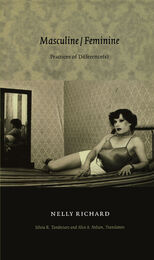
Richard helped to organize the 1987 International Conference on Latin American Women’s Literature in Santiago, one of the most significant literary events to take place under the Pinochet dictatorship. Published in Chile in 1993, Masculine/Feminine develops some of the key issues brought to the fore during that landmark meeting. Richard theorizes why the feminist movement has been crucial not only to the liberation of women but also to understanding the ways in which power operated under the military regime in Chile. In one of her most widely praised essays, she explores the figure of the transvestite, artistic imagery of which exploded during the Chilean dictatorship. She examines the politics and the aesthetics of this phenomenon, particularly against the background of prostitution and shantytown poverty, and she argues that gay culture works to break down the social demarcations and rigid structures of city life. Masculine/Feminine makes available, for the first time in English, one of Latin America’s most significant works of feminist theory.
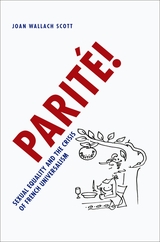
During the 1990s, le mouvement pour la parité successfully campaigned for women's inclusion in elective office with an argument that is unprecedented in the annals of feminism. The paritaristes insisted that if the abstract individual were thought of as sexed, then sexual difference would no longer be a relevant consideration in politics. Scott insists that this argument was neither essentialist nor separatist; it was not about women's special qualities or interests. Instead, parité was rigorously universalist—and for that reason was both misunderstood and a source of heated debate.

The culmination of one of the most famous long-term studies in American sociology, this examination of political attitudes among women who attended Bennington College in the 1930s and 1940s now spans five decades, from late adolescence to old age. Theodore Newcomb’s 1930s interviews at Bennington, where the faculty held progressive views that contrasted with those of the conservative families of the students, showed that political orientations are still quite malleable in early adulthood. The studies in 1959-60 and 1984 show the persistence of political attitudes over the adult life span: the Bennington women, raised in conservative homes, were liberalized in their college years and have remained politically involved and liberal in their views, even in their sixties and seventies.
Here the authors analyze the earlier studies and then introduce the 1984 data. Using data from National Election Studies for comparison, they show that the Bennington group is more liberal and hold its opinions more intensely than both older and younger Americans, with the exception of the generation that achieved political maturity in the 1960s. The authors point out that the majority of the Bennington women’s children are of this 1945–54 generation and suggest that this factor played an important role in the stability of the women’s political views. Within their own generation, the Bennington women also appear to hold stronger political views than other college-educated women.
Innovative in its methodology and extremely rich in its data, this work will contribute to developmental and social psychology, sociology, political science, women’s studies, and gerontology.
Why, after several generations of suffrage and a revival of the women's movement in the late 1960s, do women continue to be less politically active than men? Why are they less likely to seek public office or join political organizations? The Private Roots of Public Action is the most comprehensive study of this puzzle of unequal participation.
The authors develop new methods to trace gender differences in political activity to the nonpolitical institutions of everyday life--the family, school, workplace, nonpolitical voluntary association, and church. Different experiences with these institutions produce differences in the resources, skills, and political orientations that facilitate participation--with a cumulative advantage for men. In addition, part of the solution to the puzzle of unequal participation lies in politics itself: where women hold visible public office, women citizens are more politically interested and active. The model that explains gender differences in participation is sufficiently general to apply to participatory disparities among other groups--among the young, the middle-aged, and the elderly or among Latinos, African-Americans and Anglo-Whites.

Section One, "Gender, Citizenship, and Collectivity," includes Nancy Frazer and Linda Gordon's critique of dependency and citizenship; Iris Young on women as a social collective; Ruth Bloch on the feminization of public virtue in revolutionary America; Trisha Franzen on feminism and lesbian community, and Sonia Kruks on de Beauvoir and contemporary feminism.
"Collective Action and Women's Resistance," Section Two, features Louis Tilly's "Paths of Proletarianization"; Temma Kaplan's "Female Consciousness and Collective Action"; and five assessments of women's collective action worldwide: Samira Haj on Palestine, Arlene McLeod on Egypt, Gay Seidman on South Africa, Nancy Sternbach et al. on Latin America, and Anne Walthall on Japan.
Concluding with a section on gender and the state, Rethinking the Political also features Bronwyn Winter on the law and cultural relativism; Sherene Razack on sexual violence; Wendy Luttrell on educational institutions; Patricia Stamp on ethnic conflict in postcolonial Kenya; Elizabeth Schmidt on patriarchy and capitalism in Zimbabwe; and Muriel Nazzari on the "woman question" in post-revolutionary Cuba.
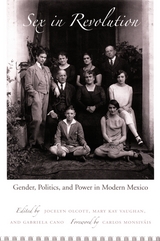
Concentrating on episodes and phenomena that occurred between 1915 and 1950, the contributors deftly render experiences ranging from those of a transgendered Zapatista soldier to upright damas católicas and Mexico City’s chicas modernas pilloried by the press and male students. Women refashioned their lives by seeking relief from bad marriages through divorce courts and preparing for new employment opportunities through vocational education. Activists ranging from Catholics to Communists mobilized for political and social rights. Although forced to compromise in the face of fierce opposition, these women made an indelible imprint on postrevolutionary society.
These essays illuminate emerging practices of femininity and masculinity, stressing the formation of subjectivity through civil-society mobilizations, spectatorship and entertainment, and locales such as workplaces, schools, churches, and homes. The volume’s epilogue examines how second-wave feminism catalyzed this revolutionary legacy, sparking widespread, more radically egalitarian rural women’s organizing in the wake of late-twentieth-century democratization campaigns. The conclusion considers the Mexican experience alongside those of other postrevolutionary societies, offering a critical comparative perspective.
Contributors. Ann S. Blum, Kristina A. Boylan, Gabriela Cano, María Teresa Fernández Aceves, Heather Fowler-Salamini, Susan Gauss, Temma Kaplan, Carlos Monsiváis, Jocelyn Olcott, Anne Rubenstein, Patience Schell, Stephanie Smith, Lynn Stephen, Julia Tuñón, Mary Kay Vaughan
How did women in an economically underdeveloped Central American country, with little history of organizing, feminism, or democracy, succeed in creating networks, organizations, and campaigns that carved out a gender identity and challenged dominant ideologies (both revolutionary and conservative)? In Still Fighting, Katherine Isbester seeks to understand. She analyzes the complex and rich case of Nicaragua in order to learn more about the dynamics of social movements in general and women’s organizing in particular.
Social movement theory offers Isbester an analytic tool to explain the extraordinary evolution of the Nicaraguan movement. She theorizes that a sustainable movement is composed of three elements: a focused goal, a mobilization of resources, and an identity. The lack of any one of these weakens a social movement. Isbester shows how this theory is borne out by the experience of the Nicaraguan women’s movement over the past thirty years. She demonstrates, for example, how the revolutionary government of the 1980s co-opted the women’s movement, crippling its ability to create an autonomous identity, choose it own goals, and mobilize resources independent of the state. Hence, it lost legitimacy, membership, and influence. She traces the movement’s resurgence in the 1990s, the result of its redefinition as an autonomous movement organized around an identity of care.
Still Fighting combines social theory with field research, leading a new wave of scholarship on women in Latin America. Isbester interviewed more than a hundred key participants in the women’s movement, in addition to members of the National Assembly, male leaders of other social movements, and women outside the movement. In Nicaragua, she was witness to much political organizing, enabling her to reveal the organic intricacy, as well as the historical path, of a social movement.
Still Fighting will be an important book for a broad range of students and professionals in the areas of social movements, social change, gender, politics, and Latin America.

“Kira Sanbonmatsu has done a masterful job of linking the representation of women in elective office to the activities of party organizations in the states. She combines qualitative and quantitative data to show how women are navigating the campaign process to become elected leaders and the changing role of party organizations in their recruitment and election. It is a significant contribution to the study of representative democracy.”
--Barbara Burrell, Northern Illinois University
“Sanbonmatsu has produced an excellent study that will invigorate research on the role of political parties and the recruitment of women candidates. Using a variety of methods and data sources, she has crafted a tightly constructed, clearly argued, and exceedingly well-written study. A commendable and convincing job.”
--Gary Moncrief, Boise State University
“Sanbonmatsu offers important insights in two neglected areas of American politics: the role of political parties in recruiting candidates and the continued under-representation of women in elected office. Connecting the two subjects through careful qualitative and statistical methods, insightful interpretation of the literature and interesting findings, the book is a significant new addition to scholarship on parties, gender, and political recruitment.”
--Linda Fowler, Dartmouth College
Kira Sanbonmatsu is Associate Professor of Political Science at Rutgers University and Senior Scholar at the Eagleton Institute of Politics’ Center for American Women and Politics (CAWP). She was previously associate professor at Ohio State University. She is the author of Democrats, Republicans, and the Politics of Women’s Place.

Prevailing accounts of the fate of women's movements in that decade ascribe their hardships to a postfeminist ideology or the result of a "backlash" against women, particularly in America. Sylvia Bashevkin's study excavates, however, a much more complex situation. By identifying the policies and goals held in common by feminists in all three countries and tracing their collision course with the conservative policies of the three administrations, she is able to document setbacks but also some progress, despite the right-of-center leaders. She also challenges the assumption that organized interests in the United States are less vulnerable in hard times than those in parliamentary systems, finding that the elections of Ronald Reagan, Brian Mulroney, and Margaret Thatcher had similar effects on both sides of the Atlantic. Her comparative analysis reveals that the policies of current leaders, while marginally better than their predecessors, will not allow women and women's movements to regain lost ground.
Organized thematically, rather than by country, Women on the Defensive describes the difficult relationship between feminists and conservatives during a time of bitter ideological and policy battles when the vibrant social movements of the 1960s and 1970s were seriously threatened.
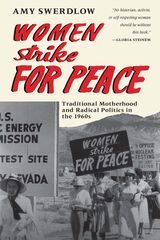
Women Strike for Peace began on November 1, 1961, when thousands of white, middle-class women walked out of their kitchens and off their jobs in a one-day protest against Soviet and American nuclear policies. The protest led to a national organization of women who fought against nuclear arms and U.S. intervention in Vietnam. While maintaining traditional maternal and feminine roles, members of WSP effectively challenged national policies—defeating a proposal for a NATO nuclear fleet, withstanding an investigation by the House Committee on Un-American Activities, and sending one of its leaders to Congress as a peace candidate.
As a study of a dissident group grounded in prescribed female culture, and the struggle of its members to avoid being trapped within that culture, this book adds a crucial new dimension to women's studies. In addition, this account of WSP's success as a grass roots, nonhierarchical movement will be of great interest to historians, political scientists, and anyone interested in peace studies or conflict resolution.
"Swerdlow has re-created a unique piece of American political history, a chapter of the international peace movement, and an origin of the modern feminist movement. No historian, activist, or self-respecting woman should be without Women Strike for Peace. It shows not only how one group of women created change, but also how they inevitably changed themselves."—Gloria Steinem
The transition to democracy in South Africa was one of the defining events in twentieth-century political history. The South African women’s movement is one of the most celebrated on the African continent. Shireen Hassim examines interactions between the two as she explores the gendered nature of liberation and regime change. Her work reveals how women’s political organizations both shaped and were shaped by the broader democratic movement. Alternately asserting their political independence and giving precedence to the democratic movement as a whole, women activists proved flexible and remarkably successful in influencing policy. At the same time, their feminism was profoundly shaped by the context of democratic and nationalist ideologies. In reading the last twenty-five years of South African history through a feminist framework, Hassim offers fresh insights into the interactions between civil society, political parties, and the state.
Hassim boldly confronts sensitive issues such as the tensions between autonomy and political dependency in feminists’ engagement with the African National Congress (ANC) and other democratic movements, and black-white relations within women’s organizations. She offers a historically informed discussion of the challenges facing feminist activists during a time of nationalist struggle and democratization.
Winner, Victoria Schuck Award for best book on women and politics, American Political Science Association
“An exceptional study, based on extensive research. . . . Highly recommended.”—Choice
“A rich history of women’s organizations in South African . . . . [Hassim] had observed at first hand, and often participated in, much of what she described. She had access to the informants and private archives that so enliven the narrative and enrich the analysis. She provides a finely balanced assessment.”—Gretchen Bauer, African Studies Review
READERS
Browse our collection.
PUBLISHERS
See BiblioVault's publisher services.
STUDENT SERVICES
Files for college accessibility offices.
RECENTLY PUBLISHED





UChicago Accessibility Resources
home | accessibility | search | about | contact us
BiblioVault ® 2001 - 2024
The University of Chicago Press