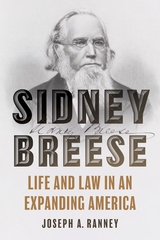
front cover of Sidney Breese
Sidney Breese
Life and Law in an Expanding America
Joseph A. Ranney
University of Illinois Press, 2026
A central figure in Illinois’ early history, Sidney Breese forged an eventful public life that spanned the state’s transition from a frontier territory to a modern industrial society. Joseph A. Ranney tells the story of the lasting achievements and far-reaching legal decisions that defined Breese’s career.

Born in New York, Breese moved to Illinois in 1818. An ambitious personality combined with acumen in law, politics, and business boosted Breese into the state’s frontier elite and involved him in the political controversies that roiled the Jacksonian Era. First a circuit court judge, Breese rose to the state Supreme Court before his election to the US Senate in 1842. Breese focused his senatorial energies on westward expansion and transforming the nation into a world power—ambitions symbolized by his pivotal role in the creation of the Illinois Central Railroad. After returning to the state Supreme Court, Breese ruled on essential cases that enshrined expansionist jurisprudence in American law and regulated the growing power of corporations in post–Civil War America.

A first full-length biography, Sidney Breese places the life of an overlooked figure within legal and Illinois history.
[more]

front cover of Wisconsin and the Shaping of American Law
Wisconsin and the Shaping of American Law
Joseph A. Ranney
University of Wisconsin Press, 2017
State laws affect nearly every aspect of our daily lives—our safety, personal relationships, and business dealings—but receive less scholarly attention than federal laws and courts. Joseph A. Ranney looks at how state laws have evolved and shaped American history, through the lens of the historically influential state of Wisconsin.

Organized around periods of social need and turmoil, the book considers the role of states as legal laboratories in establishing American authority west of the Appalachians, in both implementing and limiting Jacksonian reforms and in navigating legal crises before and during the Civil War—including Wisconsin's invocation of sovereignty to defy federal fugitive slave laws. Ranney also surveys judicial revolts, the reforms of the Progressive era, and legislative responses to struggles for civil rights by immigrants, women, Native Americans, and minorities in the nineteenth and twentieth centuries. Since the 1960s, battles have been fought at the state level over such issues as school vouchers, voting, and abortion rights.


[more]


Send via email Share on Facebook Share on Twitter