logo for Harvard University Press
Harvard Studies in Classical Philology, Volume 104
Nino Luraghi
Harvard University Press
Volume 104 of Harvard Studies in Classical Philology includes: Jeremy Rau, “Δ 384 Τυδῆ, Ο 339 Μηκιστῆ, and τ 136 Ὀδυσῆ”; Naomi Rood, “Craft Similes and the Construction of Heroes in the Iliad”; Yoav Rinon, “The Tragic Pattern of the Iliad”; Catherine Rubincam, “Herodotus and His Descendants: Numbers in Ancient and Modern Narratives of Xerxes’ Campaigns”; Chiara Thumiger, “Personal Pronouns as Identity Terms in Ancient Greek: The Surviving Tragedies and Euripides’ Bacchae”; Luis Andrés Bredlow Wenda, “Epicurus’ Letter to Herodotus: Some Textual Notes”; Ulrich Gotter, “Cultural Differences and Cross-Cultural Contact: Greek and Roman Concepts of Power”; Christopher Krebs, “Hebescere virtus (Sallust BC 12.1): Metaphorical Ambiguity”; Alexei A. Grishin, “Ludus in undis: An Acrostic in Eclogue 9”; Jackie Elliott, “Aeneas’ Generic Wandering and the Construction of the Latin Literary Past: Ennian Epic vs. Ennian Tragedy in the Language of the Aeneid”; Luis Rivero García, “Virgil Aeneid 6.445–446: A Critical Note”; Monika Asztalos, “The Poet’s Mirror: Horace’s Carmen 4.10”; Denis Rousset, “The City and Its Territory in the Province of Achaea and ‘Roman Greece’”; and Alexander Kirichenko, “Satire, Propaganda, and the Pleasure of Reading: Apuleius’ Stories of Curiosity in Context.”
[more]


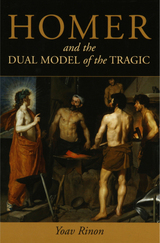
front cover of Homer and the Dual Model of the Tragic
Homer and the Dual Model of the Tragic
Yoav Rinon
University of Michigan Press, 2008
Homer and the Dual Model of the Tragic interprets both of Homer's epics as demonstrating a sense of "the Tragic." While this view of human experience and society is customarily linked with Greek tragedy rather than epic, Rinon uses close readings of the texts to argue persuasively that both The Iliad and The Odyssey present a view of pathos interwoven with the knowledge that it is unavoidable and inexplicable. Using Aristotle's Poetics as a guide toward defining eutuchia and dystuchia, Rinon analyzes specific sections of the epics. He touches on the Cyclops episode and its use of Bakhtinian "heteroglossia," on the use of Hephaestus' creativity in both epics in the emergence of tragic signification, and on Demodocus' songs in book 8 of The Odyssey as seen through André Gide's mise en abîme. Other detailed readings look at individual themes and characters in the poems, including the image of the dog, the speeches in the ninth book of The Iliad, and numerous minor characters. Yoav Rinon's integration of classical philology, narratology, and post-colonial studies makes Homer and the Dual Model of the Tragic a widely interdisciplinary book, one that will appeal to both specialists and undergraduates in comparative literature, philosophy, and classical studies.
[more]


Send via email Share on Facebook Share on Twitter