logo for University of Michigan Press
Becoming a Poet
Elizabeth Bishop with Marianne Moore and Robert Lowell
David Kalstone
University of Michigan Press, 2001
Becoming a Poet traces the evolution of Elizabeth Bishop's poetic career through her friendships with other poets, notably Marianne Moore and Robert Lowell. Published in 1989 following critic David Kalstone's death, with the help of a number of his friends and colleagues, it was greeted with uniformly enthusiastic praise. Hailed at that time as "one of the most sensitive appreciations of Elizabeth Bishop's genius ever composed" and "a first-rate piece of criticism" and "a masterpiece of understanding about friendship and about poetry," it has been largely unavailable in recent years.
[more]

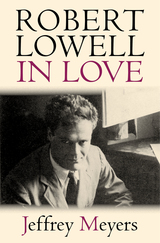
front cover of Robert Lowell in Love
Robert Lowell in Love
Jeffrey Meyers
University of Massachusetts Press, 2016
Robert Lowell was known not only as a great poet but also as a writer whose devotion to his art came at a tremendous personal cost. In this book, his third on Robert Lowell, Jeffrey Meyers examines the poet's impassioned, troubled relationships with the key women in his life: his mother, Charlotte Winslow Lowell; his three wives—Jean Stafford, Elizabeth Hardwick, and Caroline Blackwood; nine of his many lovers; his close women friends—Mary McCarthy, Elizabeth Bishop, and Adrienne Rich; and his most talented students, Anne Sexton and Sylvia Plath.

Lowell's charismatic personality, compelling poetry, and literary fame attracted lovers and friends who were both frightened and excited by his aura of brilliance and danger. He loved the idea of falling in love, and in his recurring manic episodes he needed women at the center of his emotional and artistic life. Each affair became an intense dramatic episode. Though he idealized his loves and encouraged their talents, his frenetic affairs and tortured marriages were always conducted on his own terms. Robert Lowell in Love tells the story of the poet in the grip of love and gives voice to the women who loved him, inspired his poetry, and suffered along with him.

[more]

logo for Harvard University Press
Robert Lowell
Nihilist as Hero
Vereen M. Bell
Harvard University Press, 1983

Here is a bold new vision of one of America’s most distinguished and controversial poets. Vereen Bell gives us a subtly reasoned account of the pattern of Robert Lowell’s poetic life, of his struggle to live in “the world as is.” Bell contends that Lowell’s poetry is characterized above all by its chronic and systematic pessimism, but that, paradoxically, Lowell’s reluctance to accept the consequences of his own unsparing vision is what gives his poetry its vigor, richness, and tonal complexity. The Lowell that is revealed is spiritually disconsolate but at the same time unable to suppress a deep-seated idealism.

Drawing on his thorough knowledge of the complete Lowell canon, Bell devotes particular attention to eight of the volumes, concentrating on the last phase of Lowell’s career, from Notebook (and its revision, History) through Day by Day. His readings bring a new understanding of Lowell’s art.
[more]

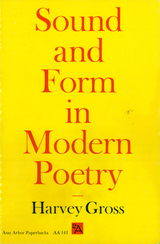
front cover of Sound and Form in Modern Poetry
Sound and Form in Modern Poetry
A Study of Prosody from Thomas Hardy to Robert Lowell
Harvey Gross
University of Michigan Press, 1964
Sound and Form in Modern Poetry: A Study of Prosody from Thomas Hardy to Robert Lowell by Harvey Gross offers a comprehensive and nuanced exploration of poetic form and prosody in twentieth-century poetry. Delving deeply into the rhythmic and sonic dimensions that shape modern English verse, Gross guides readers through both traditional metrical conventions and the innovative departures of modern poets.Navigating the “dark wood” of conflicting theories and approaches to poetic rhythm, Gross traces the evolution of English-language prosody from the late nineteenth century to the mid-twentieth century. The book provides detailed analyses of the techniques and stylistic achievements of poets such as Thomas Hardy, W. B. Yeats, Robert Frost, Marianne Moore, Ezra Pound, T. S. Eliot, Hart Crane, W. H. Auden, Dylan Thomas, and Robert Lowell. Gross doesn't just analyze meter—he considers a broader concept of rhythmic structure, one that encompasses visual, syntactic, and auditory patterns and recognizes prosody as a vital means by which poetry communicates feeling, expectation, and psychological process.Blending close readings, literary criticism, and insights from linguistics and aesthetics, Sound and Form in Modern Poetry challenges simplistic accounts of meter and embraces the complexity of both metrical and nonmetrical verse. Generously referencing both classical and contemporary critics, the book supplies readers with a clear framework for understanding the convergences and tensions between tradition and innovation in modern poetry. Essential for students, scholars, and poetry lovers alike, Gross’s study reveals how the nuances of sound and rhythm are central to a poem’s expressive power.
[more]


Send via email Share on Facebook Share on Twitter