
 A SCHOLARLY BOOK REPOSITORY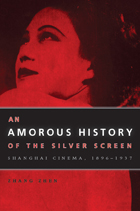
The first sustained historical study of the emergence of cinema in China, An Amorous History of the Silver Screen is a fascinating narrative that illustrates the immense cultural significance of film and its power as a vehicle for social change. Named after a major feature film on the making of Chinese cinema, only part of which survives, An Amorous History of the Silver Screen reveals the intricacies of this cultural movement and explores its connections to other art forms such as photography, architecture, drama, and literature. In light of original archival research, Zhang Zhen examines previously unstudied films and expands the important discussion of how they modeled modern social structures and gender roles in early twentieth-century China.
The first volume in the new and groundbreaking series Cinema and Modernity, An Amorous History of the Silver Screen is an innovative—and well illustrated—look at the cultural history of Chinese modernity through the lens of this seminal moment in Shanghai cinema.
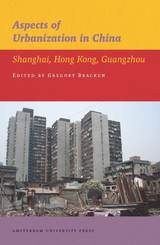

Body, Society, and Nation tells the story of China’s unfolding modernity by exploring the changing ideas, practices, and systems related to health and body in late nineteenth- and twentieth-century Shanghai. The pursuit of good health loomed large in Chinese political, social, and economic life. Yet, “good health” had a range of associations beyond individual well-being. It was also an integral part of Chinese nation-building, a goal of charitable activities, a notable outcome of Western medical science, a marker of modern civilization, and a commercial catchphrase. With the advent of Western powers, Chinese notions about personal hygiene and the body gradually expanded. This transformation was complicated by indigenous medical ideas, preexisting institutions and social groups, and local cultures and customs.
This study explores the many ways that members of the various strata of Shanghai society experienced and understood multiple meanings of health and body within their everyday lives. Chieko Nakajima traces the institutions they established, the regulations they implemented, and the practices they brought to the city as part of efforts to promote health. In doing so, she explains how local practices and customs fashioned and constrained public health and, in turn, how hygienic modernity helped shape and develop local cultures and influenced people’s behavior.
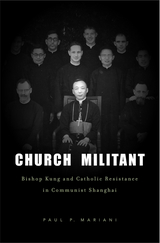
By 1952 the Chinese Communist Party had suppressed all organized resistance to its regime and stood unopposed, or so it has been believed. Internal party documents—declassified just long enough for historian Paul Mariani to send copies out of China—disclose that one group deemed an enemy of the state held out after the others had fallen. A party report from Shanghai marked “top-secret” reveals a determined, often courageous resistance by the local Catholic Church. Drawing on centuries of experience in struggling with the Chinese authorities, the Church was proving a stubborn match for the party.
Mariani tells the story of how Bishop (later Cardinal) Ignatius Kung Pinmei, the Jesuits, and the Catholic Youth resisted the regime’s punishing assault on the Shanghai Catholic community and refused to renounce the pope and the Church in Rome. Acting clandestinely, mirroring tactics used by the previously underground CCP, Shanghai’s Catholics persevered until 1955, when the party arrested Kung and 1,200 other leading Catholics. The imprisoned believers were later shocked to learn that the betrayal had come from within their own ranks.
Though the CCP could not eradicate the Catholic Church in China, it succeeded in dividing it. Mariani’s secret history traces the origins of a deep split in the Chinese Catholic community, where relations between the “Patriotic” and underground churches remain strained even today.
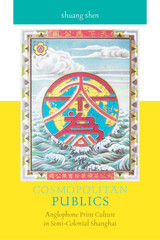
Cosmopolitan Publics focuses on China's "cosmopolitans," Western-educated intellectuals who returned to Shanghai in the late 1920s to publish in English and who, ultimately, became both cultural translators and citizens of the wider world. Shuang Shen highlights their work in publications such as The China Critic and T'ien Hsia, providing readers with a broader understanding of the role and function of cultural mixing, translation, and multilingualism in China's cultural modernity.
Decades later, as nationalist biases and political restrictions emerged within China, the influence of the cosmopolitans was neglected and the significance of cosmopolitan practice was underplayed. Shen's encompassing study revisits and presents the experience of Chinese modernity as far more heterogeneous, emergent, and transnational than it has been characterized until now.

This book explores the Daoist encounter with modernity through the activities of Chen Yingning (1880–1969), a famous lay Daoist master, and his group in early twentieth-century Shanghai. In contrast to the usual narrative of Daoist decay, with its focus on monastic decline, clerical corruption, and popular superstitions, this study tells a story of Daoist resilience, reinvigoration, and revival.
Between the 1920s and 1940s, Chen led a group of urban lay followers in pursuing Daoist self-cultivation techniques as a way of ensuring health, promoting spirituality, forging cultural self-identity, building community, and strengthening the nation. In their efforts to renew and reform Daoism, Chen and his followers became deeply engaged with nationalism, science, the religious reform movements, the new urban print culture, and other forces of modernity.
Since Chen and his fellow practitioners conceived of the Daoist self-cultivation tradition as a public resource, they also transformed it from an “esoteric” pursuit into a public practice, offering a modernizing society a means of managing the body and the mind and of forging a new cultural, spiritual, and religious identity.
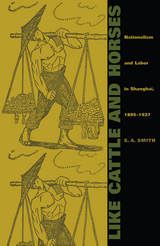
While the massive wave of labor protest in the 1920s was principally an expression of militant nationalism rather than of class consciousness, Smith argues, elements of a precarious class identity were in turn forged by the very discourse of nationalism. By linking work-related demands to the defense of the nation, anti-imperialist nationalism legitimized participation in strikes and sensitized workers to the fact that they were worthy of better treatment as Chinese citizens. Smith shows how the workers’ refusal to be treated “like cattle and horses” (a phrase frequently used by workers to describe their condition) came from a new but powerfully felt sense of dignity. In short, nationalism enabled workers to interpret the anger they felt at their unjust treatment in the workplace in political terms and to create a link between their position as workers and their position as members of an oppressed nation. By focusing on the role of the working class, Like Cattle and Horses is one of very few studies that examines nationalism “from below,” acknowledging the powerful agency of nonelite forces in promoting national identity.
Like Cattle and Horses will interest historians of labor, modern China, and nationalism, as well as those engaged in the study of revolutions and revolt.
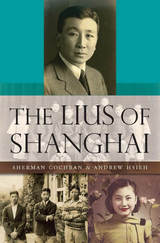
From the Sino-Japanese War to the Communist Revolution, the onrushing narrative of modern China can drown out the stories of the people who lived it. Yet a remarkable cache of letters from one of China’s most prominent and influential families, the Lius of Shanghai, sheds new light on this tumultuous era. Sherman Cochran and Andrew Hsieh take us inside the Lius’ world to explore how the family laid the foundation for a business dynasty before the war and then confronted the challenges of war, civil unrest, and social upheaval.
Cochran and Hsieh gained access to a rare collection containing a lifetime of letters exchanged by the patriarch, Liu Hongsheng, his wife, Ye Suzhen, and their twelve children. Their correspondence offers a fascinating look at how a powerful family navigated the treacherous politics of the period. They discuss sensitive issues—should the family collaborate with the Japanese occupiers? should it flee after the communist takeover?—as well as intimate domestic matters like marital infidelity. They also describe the agonies of wartime separation, protracted battles for control of the family firm, and the parents’ struggle to maintain authority in the face of swiftly changing values.
Through it all, the distinctive voices of the Lius shine through. Cochran and Hsieh’s engaging prose reveals how each member of the family felt the ties that bound them together. More than simply a portrait of a memorable family, The Lius of Shanghai tells the saga of modern China from the inside out.
In 1872 in the treaty port of Shanghai, British merchant Ernest Major founded one of the longest-lived and most successful of modern Chinese-language newspapers, the Shenbao. His publication quickly became a leading newspaper in China and won praise as a "department store of news," a "forum for intellectual discussion and moral challenge," and an "independent mouthpiece of the public voice." Located in the International Settlement of Shanghai, it was free of government regulation. Paradoxically, in a country where the government monopolized the public sphere, it became one of the world's most independent newspapers.
As a private venture, the Shenbao was free of the ideologies that constrained missionary papers published in China during the nineteenth century. But it also lacked the subsidies that allowed these papers to survive without a large readership. As a purely commercial venture, the foreign-managed Shenbao depended on the acceptance of educated Chinese, who would write for it, read it, and buy it. This book sets out to analyze how the managers of the Shenbao made their alien product acceptable to Chinese readers and how foreign-style newspapers became alternative modes of communication acknowledged as a powerful part of the Chinese public sphere within a few years. In short, it describes how the foreign Shenbao became a "newspaper for China."
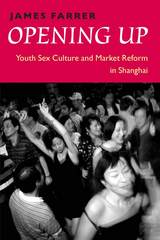
More and more men and women in China these days are having sex before marriage, creating a new youth sex culture based on romance, leisure, and free choice. The Chinese themselves describe these changes as an "opening up" in response to foreign influences and increased Westernization. Farrer explores these changes by tracing the basic elements in talk about sex and sexuality in Shanghai. He then shows how Chinese youth act out the sometimes-contradictory meanings of sex in the new market society. For Farrer, sexuality is a lens through which we can see how China imagines and understands itself in the wake of increased globalization. Through personal storytelling, neighborhood gossip, and games of seduction, young men and women in Shanghai balance pragmatism with romance, lust with love, and seriousness with play, collectively constructing and individually coping with a new culture based on market principles. With its provocative glimpse into the sex lives of young Chinese, then, Opening Up offers something even greater: a thoughtful consideration of China as it continues to develop into an economic superpower.
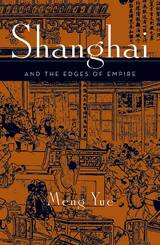
Calling into question conventional ways of conceptualizing modernity, colonialism, and intercultural relations, Meng Yue examines such cultural practices as the work of the commercial press, street theater, and literary arts, and shows that what appear to be minor cultural changes often signal the presence of larger political and economic developments. Engaging theories of modernity and postcolonial and global cultural studies, Meng Yue reveals the paradoxical interdependence between imperial and imperialist histories and the retranslation of culture that characterized the most notable result of China’s urban relocation—the emergence of the international city of Shanghai.
Meng Yue is assistant professor of East Asian languages and literature at the University of California, Irvine.
A common generalization about the Nationalist Government in China during the 1927-1937 decade has been that Chiang Kai-shek's regime was closely allied with the capitalists in Shanghai. This book brings to light a different picture--that Nanking sought to control the capitalists politically, to prevent them from having a voice in the political structure, and to milk the wealth of the urban economy for government coffers. This study documents major political conflicts between the capitalists and the government and demonstrates that the regime gradually suppressed the main organizations of the capitalists and gained control of many of their financial and industrial enterprises.
This is the first systematic examination of the political role of the Shanghai capitalists during the Nanking decade. A number of related issues--the operation of the government bond market, the role of the Shanghai underworld and its ties to Chiang Kai-shek, the personalities and policies of key government officials such as TV. Soong and H.H. Kung, the Japanese attempt to control the economic policies of the Nanking government, and the growth of "bureaucratic capitalism"--are brought into focus.
A common generalization about the Nationalist Government in China during the 1927-1937 decade has been that Chiang Kai-shek's regime was closely allied with the capitalists in Shanghai. This book brings to light a different picture--that Nanking sought to control the capitalists politically, to prevent them from having a voice in the political structure, and to milk the wealth of the urban economy for government coffers. This study documents major political conflicts between the capitalists and the government and demonstrates that the regime gradually suppressed the main organizations of the capitalists and gained control of many of their financial and industrial enterprises.
This is the first systematic examination of the political role of the Shanghai capitalists during the Nanking decade. A number of related issues--the operation of the government bond market, the role of the Shanghai underworld and its ties to Chiang Kai-shek, the personalities and policies of key government officials such as TV. Soong and H.H. Kung, the Japanese attempt to control the economic policies of the Nanking government, and the growth of "bureaucratic capitalism"--are brought into focus.
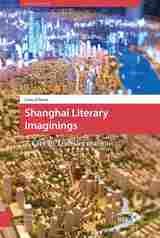
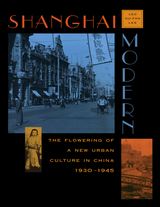
In the midst of China’s wild rush to modernize, a surprising note of reality arises: Shanghai, it seems, was once modern indeed, a pulsing center of commerce and art in the heart of the twentieth century. This book immerses us in the golden age of Shanghai urban culture, a modernity at once intrinsically Chinese and profoundly anomalous, blending new and indigenous ideas with those flooding into this “treaty port” from the Western world.
A preeminent specialist in Chinese studies, Leo Ou-fan Lee gives us a rare wide-angle view of Shanghai culture in the making. He shows us the architecture and urban spaces in which the new commercial culture flourished, then guides us through the publishing and filmmaking industries that nurtured a whole generation of artists and established a bold new style in urban life known as modeng. In the work of six writers of the time, particularly Shi Zhecun, Mu Shiying, and Eileen Chang, Lee discloses the reflection of Shanghai’s urban landscape—foreign and familiar, oppressive and seductive, traditional and innovative. This work acquires a broader historical and cosmopolitan context with a look at the cultural links between Shanghai and Hong Kong, a virtual genealogy of Chinese modernity from the 1930s to the present day.
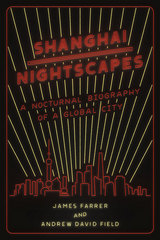
The book begins by examining the history of the jazz-age dance scenes that arose in the ballrooms and nightclubs of Shanghai’s foreign settlements. During its heyday in the 1930s, Shanghai was known worldwide for its jazz cabarets that fused Chinese and Western cultures. The 1990s have seen the proliferation of a drinking, music, and sexual culture collectively constructed to create new contact zones between the local and tourist populations. Today’s Shanghai night scenes are simultaneously spaces of inequality and friction, where men and women from many different walks of life compete for status and attention, and spaces of sociability, in which intercultural communities are formed. Shanghai Nightscapes highlights the continuities in the city’s nightlife across a turbulent century, as well as the importance of the multicultural agents of nightlife in shaping cosmopolitan urban culture in China’s greatest global city.
To listen to an audio diary of a night out in Shanghai with Farrer and Field, click here: http://n.pr/1VsIKAw.
Analyzing a Chinese city’s dazzling rise to global megacity status
Until around 1990, Shanghai was China’s premier but sluggish industrial center. Now at the beginning of the twenty-first century, the joint impact of global forces and state power has turned Shanghai into a dynamic megacity. Shanghai’s remarkable growth in economy, infrastructure, and global presence has prompted questions about the Shanghai “miracle.” This collection places the city’s unprecedented rise in a rare comparative examination of U.S. cities, as well as with Asian megacities Singapore and Hong Kong, providing a nuanced account of how Shanghai’s politics, economy, society, and space have been transformed by macro- and micro-level forces.
Contributors: Stephen W. K. Chiu, Chinese U of Hong Kong; K. C. Ho, National U of Singapore; John D. Kasarda, U of North Carolina; Hanlong Lu, Shanghai Academy of Social Sciences; Tai-lok Lui, Chinese U of Hong Kong; Ann R. Markusen, U of Minnesota; Anthony M. Orum, U of Illinois, Chicago; Yuan Ren, Fudan U Shanghai; Saskia Sassen, Columbia U; Jiaming Sun, Texas A&M U, Commerce; Fulong Wu, Cardiff U; Pingkang Yu, George Washington U; Tingwei Zhang, U of Illinois, Chicago; Zhenhua Zhou, Development Research Center, Shanghai Municipal Government.
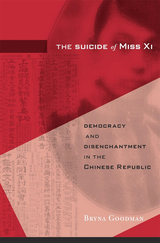
A suicide scandal in Shanghai reveals the social fault lines of democratic visions in China’s troubled Republic in the early 1920s.
On September 8, 1922, the body of Xi Shangzhen was found hanging in the Shanghai newspaper office where she worked. Although her death occurred outside of Chinese jurisdiction, her US-educated employer, Tang Jiezhi, was kidnapped by Chinese authorities and put on trial. In the unfolding scandal, novelists, filmmakers, suffragists, reformers, and even a founding member of the Chinese Communist Party seized upon the case as emblematic of deep social problems. Xi’s family claimed that Tang had pressured her to be his concubine; his conviction instead for financial fraud only stirred further controversy.
The creation of a republic ten years earlier had inspired a vision of popular sovereignty and citizenship premised upon gender equality and legal reform. After the quick suppression of the first Chinese parliament, commercial circles took up the banner of democracy in their pursuit of wealth. But, Bryna Goodman shows, the suicide of an educated “new woman” exposed the emptiness of republican democracy after a flash of speculative finance gripped the city. In the shadow of economic crisis, Tang’s trial also exposed the frailty of legal mechanisms in a political landscape fragmented by warlords and enclaves of foreign colonial rule.
The Suicide of Miss Xi opens a window onto how urban Chinese in the early twentieth century navigated China’s early passage through democratic populism, in an ill-fated moment of possibility between empire and party dictatorship. Xi Shangzhen became a symbol of the failures of the Chinese Republic as well as the broken promises of citizen’s rights, gender equality, and financial prosperity betokened by liberal democracy and capitalism.
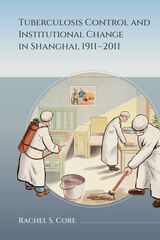
Tuberculosis Control and Institutional Change in Shanghai, 1911–2011 is the first book on the most widespread and deadly infectious disease in China, both historically and today. Weaving together interviews with data from periodicals and local archives in Shanghai, Rachel Core examines the rise and fall of tuberculosis control in China from the 1950s to the 1990s. Under the socialist work unit system, the vast majority of people had guaranteed employment, a host of benefits tied to their workplace, and there was little mobility—factors that made the delivery of medical and public health services possible in both urban and rural areas. The dismantling of work units amid wider market reforms in the 1980s and 1990s led to the rise of temporary and casual employment and a huge migrant worker population, with little access to health care, creating new challenges in TB control. This study of Shanghai will provide valuable lessons for historians, social scientists, public health specialists, and many others working on public health infrastructure on both the national and global levels.
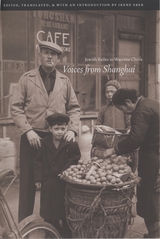
When Hitler came to power and the German army began to sweep through Europe, almost 20,000 Jewish refugees fled to Shanghai. A remarkable collection of the letters, diary entries, poems, and short stories composed by these refugees in the years after they landed in China, Voices from Shanghai fills a gap in our historical understanding of what happened to so many Jews who were forced to board the first ship bound for anywhere.
Once they arrived, the refugees learned to navigate the various languages, belief systems, and ethnic traditions they encountered in an already booming international city, and faced challenges within their own community based on disparities in socioeconomic status, levels of religious observance, urban or rural origin, and philosophical differences. Recovered from archives, private collections, and now-defunct newspapers, these fascinating accounts make their English-languge debut in this volume. A rich new take on Holocaust literature, Voices from Shanghai reveals how refugees attempted to pursue a life of creativity despite the hardships of exile.
With numerous essays that reflect Shanghai’s relationship to film and scene reviews of such iconic titles as Street Angel, Temptress Moon, Kung Fu Hustle, and Skyfall, World Film Locations: Shanghai is essential reading for all scholars of China’s urban culture.
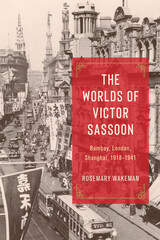
In this book, historian Rosemary Wakeman brings to life the frenzied, crowded streets, markets, ports, and banks of Bombay, London, and Shanghai. In the early twentieth century, these cities were at the forefront of the sweeping changes taking the world by storm as it entered an era of globalized commerce and the unprecedented circulation of goods, people, and ideas. Wakeman explores these cities and the world they helped transform through the life of Victor Sassoon, who in 1924 gained control of his powerful family’s trading and banking empire. She tracks his movements between these three cities as he grows his family’s fortune and transforms its holdings into a global juggernaut. Using his life as its point of entry, The Worlds of Victor Sassoon paints a broad portrait not just of wealth, cosmopolitanism, and leisure but also of the discrimination, exploitation, and violence wreaked by a world increasingly driven by the demands of capital.
READERS
Browse our collection.
PUBLISHERS
See BiblioVault's publisher services.
STUDENT SERVICES
Files for college accessibility offices.
RECENTLY PUBLISHED




UChicago Accessibility Resources
home | accessibility | search | about | contact us
BiblioVault ® 2001 - 2024
The University of Chicago Press