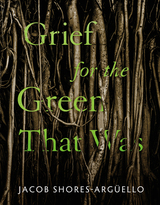
Moving tenderly across memory, continents, and literary forms, Jacob Shores-Argüello’s tightly woven cross-genre collection evolves a private family bereavement into an exploration of collective ecological grief. Following the death of his mother, the speaker navigates between his Costa Rican heritage and his Oklahoma upbringing, eventually arriving at something like healing on the banks of New Zealand’s Whanganui River—the first river in the world granted legal personhood.
Structured around a Spanish nursery rhyme, Grief for the Green That Was finds solace in the prospect of citizenship for a more-than-human world, a possibility it approaches through perspectival shifts and innovative forms—including footnoted poems, hybrid fiction, and an experimental choose-your-own-adventure sequence—that overturn lyric and storytelling conventions.
A book about what we inherit and what we leave behind, both in families and in landscapes, Grief for the Green That Was examines how climate change affects not just the physical world but also our emotional and spiritual relationships to place. Here Shores-Argüello creates a new language for twenty-first-century grief that refuses to separate the personal from the planetary.