
 A SCHOLARLY BOOK REPOSITORY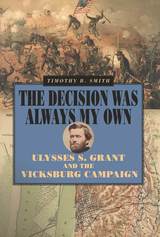
The Vicksburg Campaign, argues Timothy B. Smith, is the showcase of Ulysses S. Grant’s military genius. From October 1862 to July 1863, Grant tried repeatedly to capture the Confederate river city. His final, daring move allowed him to land an army in Mississippi and fight his way to the gates of Vicksburg. He captured the city and Confederate garrison on July 4, 1863, opening the Mississippi River for the Union.
This volume presents a fast-paced reexamination of Grant’s decision-making process during the Vicksburg maneuvers, battles, and siege. Smith details the course of campaigning on military, political, administrative, and personal levels. The successful military campaign required Grant to handle President Lincoln’s impatience, as well as to deal with troublesome general John A. McClernand, all while juggling administrative work. In addition, Grant was more than a military genius—he was also a husband and a father, and Smith shows how Grant’s family played a role in every decision he made.
Grant’s nontraditional choices went against the accepted theories of war, supply, and operations, as well as against the chief thinkers of the day, such as Henry Halleck, Grant’s superior. Yet Grant pulled off the victory in compelling fashion. In the first in-depth examination in decades, Smith shows how Grant’s decisions created and won the Civil War’s most brilliant, complex, decisive, and lengthy campaign.
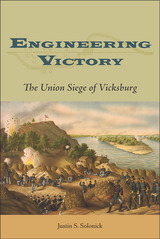
On May 25, 1863, after driving the Confederate army into defensive lines surrounding Vicksburg, Mississippi, Union major general Ulysses S. Grant and his Army of the Tennessee laid siege to the fortress city. With no reinforcements and dwindling supplies, the Army of Vicksburg finally surrendered on July 4, yielding command of the Mississippi River to Union forces and effectively severing the Confederacy. In this illuminating volume, Justin S. Solonick offers the first detailed study of how Grant’s midwesterners serving in the Army of the Tennessee engineered the siege of Vicksburg, placing the event within the broader context of U.S. and European military history and nineteenth-century applied science in trench warfare and field fortifications. In doing so, he shatters the Lost Cause myth that Vicksburg’s Confederate garrison surrendered due to lack of provisions. Instead of being starved out, Solonick explains, the Confederates were dug out.
After opening with a sophisticated examination of nineteenth-century military engineering and the history of siege craft, Solonick discusses the stages of the Vicksburg siege and the implements and tactics Grant’s soldiers used to achieve victory. As Solonick shows, though Grant lacked sufficient professional engineers to organize a traditional siege—an offensive tactic characterized by cutting the enemy’s communication lines and digging forward-moving approach trenches—the few engineers available, when possible, gave Union troops a crash course in military engineering. Ingenious midwestern soldiers, in turn, creatively applied engineering maxims to the situation at Vicksburg, demonstrating a remarkable ability to adapt in the face of adversity. When instruction and oversight were not possible, the common soldiers improvised. Solonick concludes with a description of the surrender of Vicksburg, an analysis of the siege’s effect on the outcome of the Civil War, and a discussion of its significance in western military history.
Solonick’s study of the Vicksburg siege focuses on how the American Civil War was a transitional one with its own distinct nature, not the last Napoleonic war or the herald of modern warfare. At Vicksburg, he reveals, a melding of traditional siege craft with the soldiers’ own inventiveness resulted in Union victory during the largest, most successful siege in American history.
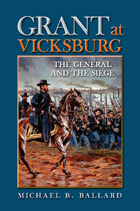
After an overview of Grant’s early Civil War career from his first battle through the early stages of the attacks on Vicksburg, Ballard describes in detail how Grant conducted the siege, examining his military decisions, placement of troops, strategy and tactics, engineering objectives, and relationships with other officers. Grant’s worried obsession with a perceived danger of a rear attack by Joseph Johnston’s Confederate army, Ballard shows, affected his decision making, and shows how threats of Confederate action occupied more of Grant’s time than did the siege itself.
In addition, Ballard soundly dispels a false story about Grant’s alleged drinking binge early in the siege that has been taken as truthful by many historians, examines how racism in Grant’s army impacted the lives of freed black people and slaves in the Vicksburg area, and explores Grant’s strained relationship with John McClernand, a politically appointed general from Illinois. The book concludes with the surrender of Vicksburg on July 4, 1863, the expulsion of Johnston and his army from the region, and demonstrates the impact of the siege on the outcome on the short and long-terms of Grant’s military career.
By analyzing Grant’s personality during the siege and how he dealt with myriad issues as both a general and an administrator, Grant at Vicksburg offers a revealing rendering of the legendary general.
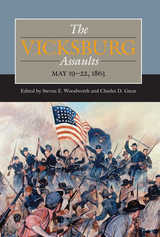
But due to difficult terrain, strong defenses, and uncoordinated movements, the quick triumph Grant desired was unattainable. On the afternoon of May 19, with little rest, preparation, or reconnaissance, Union forces charged the Confederate lines only to be repulsed. A respite between the assaults allowed both sides to reinforce their positions. Early on May 22 the Union artillery sought to soften the stronghold’s defenses before the general attack, but despite the Union forces’ preparation, the fighting proved even more disorganized and vicious. Again Grant failed to move Pemberton. Not wanting to risk more soldiers in a third attack, Grant conceded to the necessity of laying siege. Confederate morale climbed as the Southerners realized they had held their ground against an overwhelming force.
Editors Steven E. Woodworth and Charles D. Grear have assembled five captivating essays that examine Grant’s unsuccessful assaults against Confederate defensive lines around Vicksburg. Ranging from military to social history, the essays further historical debates on prominent topics, such as the reactions of Midwesterners to the first failures of Grant’s Vicksburg campaign. Two essays from opposing sides analyze the controversial decisions surrounding the Railroad Redoubt, the site of the bloodiest fighting on May 22. Another investigates how the tenacity of Texan reinforcements forced Union soldiers to abandon their gains.
Peppered with first-hand observations and bolstered by an impressive depth of research, this anthology is an invitingly written account and comprehensive assessment. By zeroing in on the two assaults, the contributors offer essential clarity and understanding of these important events within the larger scope of the Civil War’s Vicksburg Campaign.
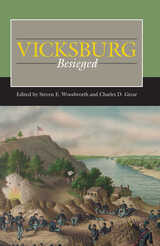
Vicksburg, Mississippi, held strong through a bitter, hard-fought, months-long Civil War campaign, but General Ulysses S. Grant’s forty-day siege ended the stalemate and, on July 4, 1863, destroyed Confederate control of the Mississippi River. In the first anthology to examine the Vicksburg Campaign’s final phase, nine prominent historians and emerging scholars provide in-depth analysis of previously unexamined aspects of the historic siege.
Ranging in scope from military to social history, the contributors’ invitingly written essays examine the role of Grant’s staff, the critical contributions of African American troops to the Union Army of the Tennessee, both sides’ use of sharpshooters and soldiers’ opinions about them, unusual nighttime activities between the Union siege lines and Confederate defensive positions, the use of West Point siege theory and the ingenuity of Midwestern soldiers in mining tunnels under the city’s defenses, the horrific experiences of civilians trapped in Vicksburg, the Louisiana soldier's defense of Jackson amid the strains of piano music, and the effect of the campaign on Confederate soldiers from the Trans-Mississippi region.
The contributors explore how the Confederate Army of Mississippi and residents of Vicksburg faced food and supply shortages as well as constant danger from Union cannons and sharpshooters. Rebel troops under the leadership of General John C. Pemberton sought to stave off the Union soldiers, and though their morale plummeted, the besieged soldiers held their ground until starvation set in. Their surrender meant that Grant’s forces succeeded in splitting in half the Confederate States of America.
Editors Steven E. Woodworth and Charles D. Grear, along with their contributors—Andrew S. Bledsoe, John J. Gaines, Martin J. Hershock, Richard H. Holloway, Justin S. Solonick, Scott L. Stabler, and Jonathan M. Steplyk—give a rare glimpse into the often overlooked operations at the end of the most important campaign of the Civil War.
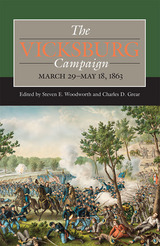
Ulysses S. Grant’s ingenious campaign to capture the last Confederate stronghold on the Mississippi River was one of the most decisive events of the Civil War and one of the most storied military expeditions in American history. The ultimate victory at Vicksburg effectively cut the Confederacy in two, gave control of the river to Union forces, and delivered a devastating blow from which the South never fully recovered. Editors Steven E. Woodworth and Charles D. Grear have assembled essays by prominent and emerging scholars, who contribute astute analysis of this famous campaign’s most crucial elements and colorful personalities.
Encompassed in this first of five planned volumes on the Vicksburg campaign are examinations of the pivotal events that comprised the campaign’s maneuver stage, from March to May of 1863. The collection sheds new light on Grant’s formidable intelligence network of former slaves, Mississippi loyalists, and Union spies; his now legendary operations to deceive and confuse his Confederate counterparts; and his maneuvers from the perspective of classic warfare. Also presented are insightful accounts of Grant’s contentious relationship with John A. McClernand during the campaign; interactions between hostile Confederate civilians and Union army troops; and the planning behind such battles as Grierson’s Raid, Port Gibson, Raymond, Jackson, Champion Hill, and Big Black River Bridge.
READERS
Browse our collection.
PUBLISHERS
See BiblioVault's publisher services.
STUDENT SERVICES
Files for college accessibility offices.
RECENTLY PUBLISHED




UChicago Accessibility Resources
home | accessibility | search | about | contact us
BiblioVault ® 2001 - 2026
The University of Chicago Press