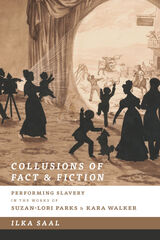
front cover of Collusions of Fact and Fiction
Collusions of Fact and Fiction
Performing Slavery in the Works of Suzan-Lori Parks and Kara Walker
Saal, Ilka
University of Iowa Press, 2021
Collusions of Fact and Fiction traces a generational shift in late twentieth-century African American cultural engagements with the history and legacies of transatlantic slavery. With a focus on works by playwright Suzan-Lori Parks and visual artist Kara Walker, the book explores how, in comparison to the first wave of neo-slave narratives of the 1970s and 1980s, artists of the 1990s and early 2000s tend to approach the past from the vantage point of a liberal entanglement of fact and fiction as well as a highly playful, often humorous, and sometimes irreverent signifying on entrenched motifs, iconographies, and historiographies.

Saal argues that the attempt to reconstruct or recuperate the experience of African Americans under slavery is no longer at stake in the works of artists growing up in the post–Civil Rights era. Instead, they lay bare the discursive dimension of our contemporary understanding of the past and address the continued impact of its various verbal and visual signs upon contemporary identities. In this manner, Parks and Walker stake out new possibilities for engaging the past and inhabiting the present and future.
 
[more]

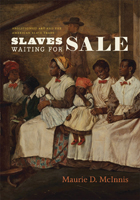
front cover of Slaves Waiting for Sale
Slaves Waiting for Sale
Abolitionist Art and the American Slave Trade
Maurie D. McInnis
University of Chicago Press, 2011

In 1853, Eyre Crowe, a young British artist, visited a slave auction in Richmond, Virginia. Harrowed by what he witnessed, he captured the scene in sketches that he would later develop into a series of illustrations and paintings, including the culminating painting, Slaves Waiting for Sale, Richmond, Virginia.

This innovative book uses Crowe’s paintings to explore the texture of the slave trade in Richmond, Charleston, and New Orleans, the evolving iconography of abolitionist art, and the role of visual culture in the transatlantic world of abolitionism. Tracing Crowe’s trajectory from Richmond across the American South and back to London—where his paintings were exhibited just a few weeks after the start of the Civil War—Maurie D. McInnis illuminates not only how his abolitionist art was inspired and made, but also how it influenced the international public’s grasp of slavery in America. With almost 140 illustrations, Slaves Waiting for Sale brings a fresh perspective to the American slave trade and abolitionism as we enter the sesquicentennial of the Civil War.

[more]


Send via email Share on Facebook Share on Twitter