front cover of Fitness Fiesta!
Fitness Fiesta!
Selling Latinx Culture through Zumba
Petra R. Rivera-Rideau
Duke University Press, 2024
As a fitness brand, Zumba Fitness has cultivated a devoted fan base of fifteen million participants spread across 180 countries. In Fitness Fiesta! Petra R. Rivera-Rideau analyzes how Zumba uses Latin music and dance to create and sell a vision of Latinness that’s tropical, hypersexual, and party-loving. Rivera-Rideau focuses on the five tropes that the Zumba brand uses to create this Latinness: authenticity, fiesta, fun, dreams, and love. Closely examining videos, ads, memes, and press coverage as well as interviews she conducted with instructors, Rivera-Rideau traces how Zumba Fitness constructs its ideas of Latinx culture by carefully balancing a longing for apparent authenticity with a homogenization of a marketable “south of the border”-style vacation. She shows how Zumba Fitness claims to celebrate Latinx culture and diversity while it simultaneously traffics in the same racial and ethnic stereotypes that are used to justify racist and xenophobic policies targeting Latinx communities in the United States. In so doing, Rivera-Rideau demonstrates not only the complex relationship between Latinidad and neoliberal, postracial America but also what that relationship means for the limits and possibilities of multicultural citizenship today.
[more]

front cover of From Threatening Guerrillas to Forever Illegals
From Threatening Guerrillas to Forever Illegals
US Central Americans and the Cultural Politics of Non-Belonging
Yajaira M. Padilla
University of Texas Press, 2022

The experience of Central Americans in the United States is marked by a vicious contradiction. In entertainment and information media, Salvadorans, Guatemalans, Nicaraguans, and Hondurans are hypervisible as threatening guerrillas, MS-13 gangsters, maids, and “forever illegals.” Central Americans are unseen within the broader conception of Latinx community, foreclosing avenues to recognition.

Yajaira M. Padilla explores how this regime of visibility and invisibility emerged over the past forty years—bookended by the right-wing presidencies of Ronald Reagan and Donald Trump—and how Central American immigrants and subsequent generations have contested their rhetorical disfiguration. Drawing from popular films and TV, news reporting, and social media, Padilla shows how Central Americans in the United States have been constituted as belonging nowhere, imagined as permanent refugees outside the boundaries of even minority representation. Yet in documentaries about cross-border transit through Mexico, street murals, and other media, US Central Americans have counteracted their exclusion in ways that defy dominant paradigms of citizenship and integration.


[more]

front cover of Indigenomicon
Indigenomicon
American Indians, Video Games, and the Structures of Dispossession
Jodi A. Byrd
Duke University Press, 2025
Settler colonial studies and Indigenous studies are often assumed to be the same intellectual project. In Indigenomicon, Jodi A. Byrd examines the differences between the two fields by bringing video game studies and Indigenous studies into conversation with Black studies, queer studies, and Indigenous feminist critique. Byrd theorizes “the image of the law of the Indigenous” as structuring dispossession in games including Assassin’s Creed, Animal Crossing, BioShock Infinite, and Demon Souls. They demonstrate how games and play might reveal histories of slavery, genocide, and theft of Indigenous lands even as their structures obscure Indigenous spatial and embodied practices that prioritize relationships with land, water, plants, and spirits. With ground and relationality defined as key concepts, Byrd centers Indigenous visions of dystopias to reveal how game spaces encode settler structures of governance even as the design of games might yet provide vital modes of resistance to Indigenous erasure.
[more]

front cover of Lost in Translation
Lost in Translation
Orientalism, Cinema, and the Enigmatic Signifier
Homay King
Duke University Press, 2010
In a nuanced exploration of how Western cinema has represented East Asia as a space of radical indecipherability, Homay King traces the long-standing association of the Orient with the enigmatic. The fantasy of an inscrutable East, she argues, is not merely a side note to film history, but rather a kernel of otherness that has shaped Hollywood cinema at its core. Through close readings of The Lady from Shanghai, Chinatown, Blade Runner, Lost in Translation, and other films, she develops a theory of the “Shanghai gesture,” a trope whereby orientalist curios and décor become saturated with mystery. These objects and signs come to bear the burden of explanation for riddles that escape the Western protagonist or cannot be otherwise resolved by the plot. Turning to visual texts from outside Hollywood which actively grapple with the association of the East and the unintelligible—such as Michelangelo Antonioni’s Chung Kuo: Cina, Wim Wenders’s Notebook on Cities and Clothes, and Sophie Calle’s Exquisite Pain—King suggests alternatives to the paranoid logic of the Shanghai gesture. She argues for the development of a process of cultural “de-translation” aimed at both untangling the psychic enigmas prompting the initial desire to separate the familiar from the foreign, and heightening attentiveness to the internal alterities underlying Western subjectivity.
[more]

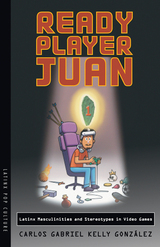
front cover of Ready Player Juan
Ready Player Juan
Latinx Masculinities and Stereotypes in Video Games
Carlos Gabriel Kelly González
University of Arizona Press, 2023
Written for all gaming enthusiasts, this book fuses Latinx studies and video game studies to document how Latinx masculinities are portrayed in high-budget action-adventure video games, inviting Latinxs and others to insert their experiences into games made by an industry that fails to see them.

The book employs an intersectional approach through performance theory, border studies, and lived experience to analyze the designed identity “Player Juan.” Player Juan manifests in video game representations through a discourse of criminality that sets expectations of who and what Latinxs can be and do. Developing an original approach to video game experiences, the author theorizes video games as border crossings, and defines a new concept—digital mestizaje—that pushes players, readers, and scholars to deploy a Latinx way of seeing and that calls on researchers to consider a digital object’s constructive as well as destructive qualities.

[more]

front cover of Unsettling
Unsettling
Jews, Whiteness, and Incest in American Popular Culture
Eli Bromberg
Rutgers University Press, 2021
By analyzing how various media told stories about Jewish celebrities and incest, Unsettling illustrates how Jewish community protective politics impacted the representation of white male Jewish masculinity in the 1990s. Chapters on Woody Allen, Roseanne Barr, and Henry Roth demonstrate how media coverage of their respective incest denials (Allen), allegations (Barr), and confessions (Roth) intersect with a history of sexual antisemitism, while an introductory chapter on Jewish second-wave feminist criticism of Sigmund Freud considers how Freud became “white” in these discussions. Unsettling reveals how film, TV, and literature have helped displace once prevalent antisemitic stereotypes onto those who are non-Jewish, nonwhite, and poor. In considering how whiteness functions for an ethnoreligious group with historic vulnerability to incest stereotype as well as contemporary white privilege, Unsettling demonstrates how white Jewish men accused of incest, and even those who defiantly confess it, became improbably sympathetic figures representing supposed white male vulnerability.
 
[more]


Send via email Share on Facebook Share on Twitter