
 A SCHOLARLY BOOK REPOSITORY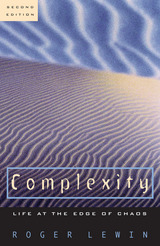
"[Complexity] is that curious mix of complication and organization that we find throughout the natural and human worlds: the workings of a cell, the structure of the brain, the behavior of the stock market, the shifts of political power. . . . It is time science . . . thinks about meaning as well as counting information. . . . This is the core of the complexity manifesto. Read it, think about it . . . but don't ignore it."—Ian Stewart, Nature
This second edition has been brought up to date with an essay entitled "On the Edge in the Business World" and an interview with John Holland, author of Emergence: From Chaos to Order.

That experience, along with the guidance of leaders in systems thinking and racial justice, convinced her that the world’s thorniest problems may be easier to tackle together than one by one. That’s multisolving: using a single investment of time or money to solve many problems at the same time. (Reduced fossil fuel use = improvements in climate, health, equity, economics, and more.) While the idea of killing two birds with one stone (or “filling two needs with one deed”) is age-old, and the notion of co-benefits in policy-making has been around for years, Multisolving addresses the current mismatch between complex, deeply intertwined societal issues and our siloed approach to them.
This unique resource is for local school boards that need revenue for their students but don’t want to overtax low-income seniors. It is for nonprofits working to reduce food waste and combat the root causes of hunger while increasing racial justice. It is for seaside communities that can protect themselves from flooding while also improving biodiversity with a living coastline. It may also be for you: doing the work you know is imperative but that is sometimes overwhelming, a tiny drop in a swirling ocean.
Multisolving can’t promise a list of “fifty simple things to make everything OK.” What it does offer are strategies to build solidarity between diverse groups, overcome powerful interests, and create lasting change that benefits us all.
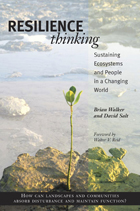
Written by scientist Brian Walker and science communicator David Salt, Resilience Thinking explains how human and natural systems operate as dynamic networks shaped by cycles of disturbance, renewal, and evolution. The book explores what qualities make a system resilient—such as diversity, modularity, and the ability to learn—and how these qualities can be nurtured to ensure long-term sustainability.
Clear, concise, and engaging, the book offers more than just theory. Through five real-world case studies, readers see how resilience thinking can be applied across landscapes, communities, and industries to navigate risk, foster innovation, and expand future options. Whether managing a watershed, planning urban growth, or designing policy, this approach equips decision-makers with tools for thinking beyond linear models and toward systems that can absorb shocks and keep functioning.
Resilience Thinking is essential reading for environmental professionals, business leaders, and anyone seeking smarter ways to steward resources in a complex, interconnected world.
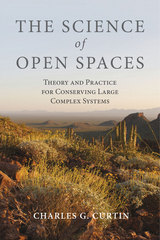
The Science of Open Spaces turns conventional conservation paradigms on their heads, proposing that in thinking about complex natural systems, whether the arid spaces of the southwestern United States or open seas shared by multiple nations, we must go back to "first principles"--those fundamental physical laws of the universe--and build innovative conservation from the ground up based on theory and backed up by practical experience. Curtin walks us through such foundational science concepts as thermodynamics, ecology, sociology, and resilience theory, applying them to real-world examples from years he has spent designing large-scale, place-based collaborative research programs in the United States and around the world.
Compelling for not only theorists and students, but also practitioners, agency personnel, and lay readers, this book offers a thoughtful and radical departure from business-as-usual management of Earth's dwindling wide-open spaces.
Both metaphor and framework, the systems concept as articulated by its earliest proponents highlights relationship and interconnectedness among the biological, ecological, social, psychological, and technological dimensions of our increasingly complex lives. Seeking to transcend the reductionism and mechanism of classical science-which they saw as limited by its focus on the discrete, component parts of reality-the general systems community hoped to complement this analytic approach with a more holistic orientation. As one of many systems traditions, the general systems group was specifically interested in fostering collaboration and integration among different disciplinary perspectives, with an emphasis on nurturing more participatory and truly democratic forms of social organization.
The Science of Synthesis documents a unique episode in the history of modern thought, one that remains relevant today. This book will be of interest to historians of science, system thinkers, scholars and practicioners in the social sciences, management, organization development and related fields, as well as the general reader interested in the history of ideas that have shaped critical developments in the second half of the twentieth century.
Did you know that you are more closely related to a mushroom than to a daisy? That crocodiles are closer to birds than to lizards? That dinosaurs are still among us? That the terms "fish," "reptiles," and "invertebrates" do not indicate scientific groupings? All this is the result of major changes in classification, whose methods have been totally revisited over the last thirty years.
Modern classification, based on phylogeny, no longer places humans at the center of nature. Groups of organisms are no longer defined by their general appearance, but by their different individual characteristics. Phylogeny, therefore, by showing common ancestry, outlines a tree of evolutionary relationships from which one can retrace the history of life.
This book diagrams the tree of life according to the most recent methods of classification. By showing how life forms arose and developed and how they are related, The Tree of Life presents a key to the living world in all its dazzling variety.,
READERS
Browse our collection.
PUBLISHERS
See BiblioVault's publisher services.
STUDENT SERVICES
Files for college accessibility offices.
RECENTLY PUBLISHED





UChicago Accessibility Resources
home | accessibility | search | about | contact us
BiblioVault ® 2001 - 2025
The University of Chicago Press