
 A SCHOLARLY BOOK REPOSITORY
Results by Title
2 books about Thompson, Mary
2 books about Thompson, Mary
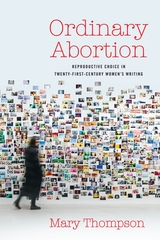
Ordinary Abortion
Reproductive Choice in Twenty-First-Century Women’s Writing
Mary Thompson
The Ohio State University Press, 2026
Considers the undramatic prevalence of abortion in the United States and how it has shaped twenty-first-century women’s writing.
The Supreme Court’s Dobbs v. Jackson (2022) decision, which erased the constitutional right to abortion, abruptly redramatized access in the United States. Yet twenty-first-century literature written before Dobbs reflects a landscape in which abortion appears as an undramatic, routine part of women’s lives. In Ordinary Abortion, Mary Thompson argues that many contemporary women writers depict abortion as a commonplace decision intertwined with health, education, career, sexuality, relationships, family-making, and motherhood.
Drawing on American poetry, fiction, nonfiction, memoir, and dystopian writing, Ordinary Abortion examines how ideas about abortion circulate through literature and how literary forms, in turn, shape readers’ understandings of reproduction and politics. Thompson traces new plots, characters, narrative strategies, and genres emerging around birth control, unplanned pregnancy, termination, and family formation. These works reveal renewed thematic attention to abortion’s relationship with motherhood and mother-loss, neoliberal pressures, stratified reproduction, masculinity, violence, care work, and disability.
Ultimately, Ordinary Abortion shows that abortion literature extends far beyond stories centered on crisis or choice. Instead, twenty-first-century women’s writing reveals a quiet, pervasive truth: Abortion has long been woven into everyday American life, normalized in ways that public discourse has often failed to acknowledge.
The Supreme Court’s Dobbs v. Jackson (2022) decision, which erased the constitutional right to abortion, abruptly redramatized access in the United States. Yet twenty-first-century literature written before Dobbs reflects a landscape in which abortion appears as an undramatic, routine part of women’s lives. In Ordinary Abortion, Mary Thompson argues that many contemporary women writers depict abortion as a commonplace decision intertwined with health, education, career, sexuality, relationships, family-making, and motherhood.
Drawing on American poetry, fiction, nonfiction, memoir, and dystopian writing, Ordinary Abortion examines how ideas about abortion circulate through literature and how literary forms, in turn, shape readers’ understandings of reproduction and politics. Thompson traces new plots, characters, narrative strategies, and genres emerging around birth control, unplanned pregnancy, termination, and family formation. These works reveal renewed thematic attention to abortion’s relationship with motherhood and mother-loss, neoliberal pressures, stratified reproduction, masculinity, violence, care work, and disability.
Ultimately, Ordinary Abortion shows that abortion literature extends far beyond stories centered on crisis or choice. Instead, twenty-first-century women’s writing reveals a quiet, pervasive truth: Abortion has long been woven into everyday American life, normalized in ways that public discourse has often failed to acknowledge.
[more]
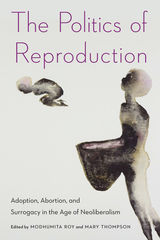
The Politics of Reproduction
Adoption, Abortion, and Surrogacy in the Age of Neoliberalism
Edited by Modhumita Roy and Mary Thompson
The Ohio State University Press, 2019
The Politics of Reproduction: Adoption, Abortion and Surrogacy in the Age of Neoliberalism uniquely brings together three sites of reproduction and reproductive politics to demonstrate their entanglement in creating or restricting options for family-making. The original essays in this collection—which draw from a wide range of disciplinary and theoretical perspectives—are attentive to neoliberalism’s reshaping of economies and intimacies to better understand the politics of reproduction. By looking at particular instances (surrogacy in Mexico, forced sterilization in Peru, and racialized biopolitics in post-Katrina Mississippi, among other sites), The Politics of Reproduction focuses on the effects of a radically altered economic landscape on individual choice-making. As a whole, the volume critically engages the question of choice to better understand the costs of a political and ideological climate that encourages, even demands, individual solutions to intractable social problems. Whose choices are amplified in the use of new biomedical technologies and assisted reproduction? Why and how are we discouraged from understanding the economic motivations behind the “choice” to surrender a baby for adoption or to become a surrogate or to seek an abortion? Attentive to the historical, cultural, and ideological conjunctures of reproductive politics, The Politics of Reproduction makes a distinctive contribution to feminist analyses of the specific challenges posed by neoliberalism to reproductive possibilities, politics, and justice in the contemporary moment.
[more]
READERS
Browse our collection.
PUBLISHERS
See BiblioVault's publisher services.
STUDENT SERVICES
Files for college accessibility offices.
RECENTLY PUBLISHED





UChicago Accessibility Resources
home | accessibility | search | about | contact us
BiblioVault ® 2001 - 2026
The University of Chicago Press