
 A SCHOLARLY BOOK REPOSITORY
4 start with F start with F
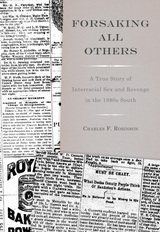
An intensely dramatic true story, Forsaking All Others recounts the fascinating case of an interracial couple who attempted, in defiance of
society’s laws and conventions, to formalize their relationship in the post-Reconstruction South. It was an affair with tragic consequences, one that entangled the protagonists in a miscegenation trial and, ultimately, a desperate act of revenge.
From the mid-1870s to the early 1880s, Isaac Bankston was the proud sheriff of Desha County, Arkansas, a man so prominent and popular that he won five consecutive terms in office. Although he was married with two children, around 1881 he entered into a relationship with Missouri Bradford, an African American woman who bore his child. Some two years later, Missouri and Isaac absconded
to Memphis, hoping to begin a new life there together. Although Tennessee lawmakers had made miscegenation a felony, Isaac’s dark complexion enabled the couple to apply successfully for a marriage license and take their vows. Word of the marriage quickly spread, however, and Missouri and Isaac were charged with unlawful cohabitation. An attorney from Desha County, James Coates, came to Memphis to act as special prosecutor in the case. Events then took a surprising turn as Isaac chose to deny his white heritage in order to escape conviction. Despite this victory in court, however, Isaac had been publicly disgraced, and his sense of honor propelled him into a violent confrontation with Coates, the man he considered most responsible for his downfall. Charles F. Robinson uses Missouri and Isaac’s story to examine key aspects of post-Reconstruction society, from the rise of miscegenation laws and the particular burdens they placed on anyone who chose to circumvent them, to the southern codes of honor that governed both social and individual behavior, especially among white men. But most of all, the book offers a compelling personal narrative with important implications for our supposedly more
tolerant times.
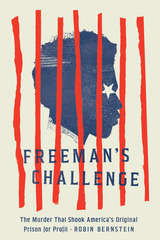
In the early nineteenth century, as slavery gradually ended in the North, a village in New York State invented a new form of unfreedom: the profit-driven prison. Uniting incarceration and capitalism, the village of Auburn built a prison that enclosed industrial factories. There, “slaves of the state” were leased to private companies. The prisoners earned no wages, yet they manufactured furniture, animal harnesses, carpets, and combs, which consumers bought throughout the North. Then one young man challenged the system.
In Freeman’s Challenge, Robin Bernstein tells the story of an Afro-Native teenager named William Freeman who was convicted of a horse theft he insisted he did not commit and sentenced to five years of hard labor in Auburn’s prison. Incensed at being forced to work without pay, Freeman demanded wages. His challenge triggered violence: first against him, then by him. Freeman committed a murder that terrified and bewildered white America. And white America struck back—with aftereffects that reverberate into our lives today in the persistent myth of inherent Black criminality. William Freeman’s unforgettable story reveals how the North invented prison for profit half a century before the Thirteenth Amendment outlawed slavery “except as a punishment for crime”—and how Frederick Douglass, Harriet Tubman, and other African Americans invented strategies of resilience and resistance in a city dominated by a citadel of unfreedom.
Through one Black man, his family, and his city, Bernstein tells an explosive, moving story about the entangled origins of prison for profit and anti-Black racism.
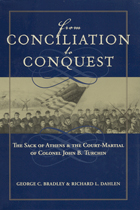
In the summer of 1862, the U.S. Army court martialed Colonel John B. Turchin, a Russian-born Union officer, for "outrages" committed by his troops in Athens, Alabama
In the summer of 1862, the U.S. Army court martialed Colonel John B. Turchin, a Russian-born Union officer, for offenses committed by his troops in Athens, Alabama, including looting, safe cracking, the vandalization of homes, and the rape of young black women. The pillage of Athens violated a government policy of conciliation; it was hoped that if Southern civilians were treated gently as citizens of the United States, they would soon return their allegiance to the federal government.
By examining the volunteers who made up Turchin’s force, the colonel's trial, his subsequent promotion, the policy debate surrounding the incident and the public reaction to the outcome, the authors further illuminate one of the most provocative questions in Civil War studies: how did the policy set forth by President Lincoln evolve from one of conciliation to one far more modern in nature, placing the burden of war on the civilian population of the South?
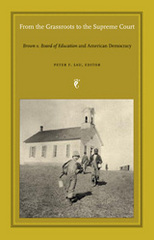
The contributors illuminate the breadth of developments that led to Brown, from the parallel struggles for social justice among African Americans in the South and Mexican, Asian, and Native Americans in the West during the late nineteenth century to the political and legal strategies implemented by the National Association for the Advancement of Colored People (naacp) in the twentieth century. Describing the decision’s impact on local communities, essayists explore the conflict among African Americans over the implementation of Brown in Atlanta’s public schools as well as understandings of the ruling and its relevance among Puerto Rican migrants in New York City. Assessing the legacy of Brown today, contributors analyze its influence on contemporary law, African American thought, and educational opportunities for minority children.
Contributors
Tomiko Brown-Nagin
Davison M. Douglas
Raymond Gavins
Laurie B. Green
Christina Greene
Blair L. M. Kelley
Michael J. Klarman
Peter F. Lau
Madeleine E. Lopez
Waldo E. Martin Jr.
Vicki L. Ruiz
Christopher Schmidt
Larissa M. Smith
Patricia Sullivan
Kara Miles Turner
Mark V. Tushnet
READERS
Browse our collection.
PUBLISHERS
See BiblioVault's publisher services.
STUDENT SERVICES
Files for college accessibility offices.
RECENTLY PUBLISHED


UChicago Accessibility Resources
home | accessibility | search | about | contact us
BiblioVault ® 2001 - 2024
The University of Chicago Press