front cover of Accidental Occidental
Accidental Occidental
Economics and Culture of Transition in Mitteleuropa, the Baltic and the Balkan Area
Lajos Bokros
Central European University Press, 2013
Besides providing a historical record of the long road from the economic agenda of the 1917 Bolshevik revolution to the present transition from communism, this book can be considered a staunch defense of market capitalism and liberal democracy. Any celebration of the current transition in Eastern Europe necessarily affirms the superiority of a market system over a non-market one and of a democratic system over a non-democratic one. The author does not deny the failures, shortcomings or imperfections of market economy and democracy. Nor does he take the survival of market capitalism and liberal democracy for granted. On the contrary, by highlighting the valiant and painful process of transition and attempting to understand its economics and culture, he seeks to contribute to the theoretical (academic) and practical (political) defense of Western civilization.
[more]

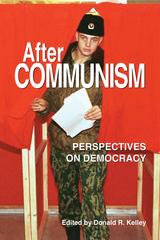
front cover of After Communism
After Communism
Perspectives on Democracy
Donald R. Kelley
University of Arkansas Press, 2003
In this collection, top scholars of Soviet and post-Soviet studies convene to explore communism's aftermath. They consider state building and consitutionalism; the transition to market capitalism and democracy across Eastern Europe; the political development of Muslim states; the complex and differential developments of electoral systems; the risks and opportunities of nationalism; and new political and economic activities in Russia, from corruption to contracts. Editor Donald Kelley introduces the volume with a synthesis of the theoretical and empirical findings of the volume, and his brief chapter introductions place each contribution in relation to the other essays and to larger debates on democratization.
[more]

front cover of After Independence
After Independence
Making and Protecting the Nation in Postcolonial and Postcommunist States
Lowell W. Barrington, Ed.
University of Michigan Press, 2006
The majority of the existing work on nationalism has centered on its role in the creation of new states. After Independence breaks new ground by examining the changes to nationalism after independence in seven new states. This innovative volume challenges scholars and specialists to rethink conventional views of ethnic and civic nationalism and the division between primordial and constructivist understandings of national identity.

"Where do nationalists go once they get what they want? We know rather little about how nationalist movements transform themselves into the governments of new states, or how they can become opponents of new regimes that, in their view, have not taken the self-determination drive far enough. This stellar collection contributes not only to comparative theorizing on nationalist movements, but also deepens our understanding of the contentious politics of nationalism's ultimate product--new countries."
--Charles King, Chair of the Faculty and Ion Ratiu Associate Professor, Georgetown University School of Foreign Service

"This well-integrated volume analyzes two important variants of nationalism-postcolonial and postcommunist-in a sober, lucid way and will benefit students and scholars alike."
--Zvi Gitelman, University of Michigan


Lowell W. Barrington is Associate Professor of Political Science, Marquette University.
[more]

front cover of After the Czars and Commissars
After the Czars and Commissars
Journalism in Authoritarian Post-Soviet Central Asia
Eric Freedman
Michigan State University Press, 2011
From Czarism and Bolshevism to the current post-communist era, the media in Central Asia has been tightly constrained. Though the governments in the region assert that a free press is permitted to operate, research has shown this to be untrue. In all five former Soviet republics of Central Asia, the media has been controlled, suppressed, punished, and often outlawed. This enlightening collection of essays investigates the reasons why these countries have failed to develop independent and sustainable press systems. It documents the complex relationship between the press and governance, nation-building, national identity, and public policy. In this book, scholars explore the numerous and broad-reaching implications of media control in a variety of contexts, touching on topics such as Internet regulation and censorship, press rights abuses, professional journalism standards and self-censorship, media ownership, ethnic newspapers, blogging, Western broadcasting into the region, and coverage of terrorism.
[more]

front cover of Altering States
Altering States
Ethnographies of Transition in Eastern Europe and the Former Soviet Union
Daphne Berdahl, Matti Bunzl, and Martha Lampland, Editors
University of Michigan Press, 2000
The dominant focus in transition studies to date has been on economic and political factors -- analyses generally conducted at the national or international level. The essays in Altering States instead bring us a closer look at what has been happening in everyday life in urban contexts in Germany, the Czech Republic, Slovakia, Austria, Hungary, Romania, Armenia, and Russia. The contributors to the volume -- all anthropologists -- use ethnographic methods to make visible problems and challenges that have until now been obscured. From synagogue restoration in Eastern Europe to gay tourism in Prague to the politics of rock music in Hungary, specific, local topics lead the authors to confront difficult questions of individual agency and discursive practices in the move away from socialism. Broader themes touched on include race and ethnicity, sexuality and postcoloniality, the politics of environmental restoration, and memory and remembrance in the politics of history. Altering States will fill an important gap in the study of transition in Eastern Europe and the former Soviet Union. It will appeal to anthropologists, political scientists, and sociologists and will be accessible to undergraduate and graduate students alike.
[more]

front cover of The Anatomy of Post-Communist Regimes
The Anatomy of Post-Communist Regimes
A Conceptual Framework
Bálint Magyar
Central European University Press, 2021

Offering a single, coherent framework of the political, economic, and social phenomena that characterize post-communist regimes, this is the most comprehensive work on the subject to date. Focusing on Central Europe, the post-Soviet countries and China, the study provides a systematic mapping of possible post-communist trajectories.

At exploring the structural foundations of post-communist regime development, the work discusses the types of state, with an emphasis on informality and patronalism; the variety of actors in the political, economic, and communal spheres; the ways autocrats neutralize media, elections, etc. The analysis embraces the color revolutions of civil resistance (as in Georgia and in Ukraine) and the defensive mechanisms of democracy and autocracy; the evolution of corruption and the workings of “relational economy”; an analysis of China as “market-exploiting dictatorship”; the sociology of “clientage society”; and the instrumental use of ideology, with an emphasis on populism. Beyond a cataloguing of phenomena—actors, institutions, and dynamics of post-communist democracies, autocracies, and dictatorships—Magyar and Madlovics also conceptualize everything as building blocks to a larger, coherent structure: a new language for post-communist regimes.

While being the most definitive book on the topic, the book is nevertheless written in an accessible style suitable for both beginners who wish to understand the logic of post-communism and scholars who are interested in original contributions to comparative regime theory. The book is equipped with QR codes that link to www.postcommunistregimes.com, which contains interactive, 3D supplementary material for teaching.

[more]

front cover of Assessing the Value of Law in Transition Economies
Assessing the Value of Law in Transition Economies
Peter Murrell, Editor
University of Michigan Press, 2001
Does law play a role in the economies that are moving from Soviet-style socialism to market capitalism? The essays in this book examine that question, providing a vivid picture of how the new institutions of capitalism affect the lives of business people, legal practitioners, investors, and bureaucrats. They analyze the determinants of successful institutional reform, suggesting that law can influence economic behavior even in inhospitable environments. Contributors--including economists, political scientists, and legal and business scholars--examine the pathways through which legal and institutional reforms affect behavior and identify the circumstances under which such reforms add value. They ask: What are the microeconomic mechanisms by which law contributes to the activities of economic agents? How do the characteristics of economic agents affect their ability to use the law? Which spheres of the economy are most affected by institutional reforms and where does law fail? What are the preconditions for effective legal and institutional reforms? Which types of political processes produce a workable system of economic legislation? The focus throughout is on the analysis of the individual economic agent who is subject to the new institutions, and thus the decisions of the individual actor, the shopkeeper, the lawyer, the court, the legislator-politician, the enterprise, the bureaucrat, the regulatory authority, and the outside investor. There are lessons on research methodology, on the economic role of institutions, and on the practice of institutional development. The focus is on the transition economies, but the conclusions and methodologies are pertinent when understanding the role of law in any context. The book will be important reading for scholars and practitioners with a wide range of interests and in a wide range of disciplines and of interest to all those concerned with economic, legal, and institutional development, economists, political scientists, lawyers, and development specialists alike.
[more]

front cover of Austerities and Aspirations
Austerities and Aspirations
A Comparative History of Growth, Consumption, and Quality of Life in East Central Europe since 1945
Béla Tomka
Central European University Press, 2020

This monograph provides an analysis of the economic performance and living standard in Czechoslovakia and its successor states, Hungary, and Poland since 1945. The novelty of the book lies in its broad comparative perspective: it places East Central Europe in a wider European framework that underlines the themes of regional disparities and European commonalities. Going beyond the traditional growth paradigm, the author systematically studies the historical patterns of consumption, leisure, and quality of life—aspects that Tomka argues can best be considered in relation to one other. By adopting this “triple approach,” he undertakes a truly interdisciplinary research drawing from history, economics, sociology, and demography.

As a result of Tomka’s three-pillar comparative analysis, the book makes a major contribution to the debates on the dynamics of economic growth in communist and postcommunist East Central Europe, on the socialist consumer culture along with its transformation after 1990, and on how the accounts on East Central Europe can be integrated into the emerging field of historical quality of life research.

[more]

front cover of Between Past and Future
Between Past and Future
The Revolution of 1989 and Their Aftermath
Sorin Antohi
Central European University Press, 2000
The tenth anniversary of the collapse of communism in Central and Eastern Europe is the basis for this text which reflects upon the past ten years and what lies ahead for the future. An international group of academics and public intellectuals, including former dissidents and active politicians, engage in an exchange on the antecedents, causes, contexts, meanings and legacies of the 1989 revolutions. The contributors address various issues including liberal democracy and its enemies; modernity and discontent; economic reforms and their social impact; ethnicity; nationalism and religion; geopolitics; electoral systems and political power; European integration; and the demise of Yugoslavia.
[more]

front cover of Brokers and Bureaucrats
Brokers and Bureaucrats
Building Market Institutions in Russia
Timothy Frye
University of Michigan Press, 2000
A classic problem of social order prompts the central questions of this book: Why are some groups better able to govern themselves than others? Why do state actors sometimes delegate governing power to other bodies? How do different organizations including the state, the business community, and protection rackets come to govern different markets? Scholars have used both sociological and economic approaches to study these questions; here Timothy Frye argues for a different approach. He seeks to extend the theoretical and empirical scope of theories of self-governance beyond groups that exist in isolation from the state and suggests that social order is primarily a political problem.
Drawing on extensive interviews, surveys, and other sources, Frye addresses these question by studying five markets in contemporary Russia, including the currency futures, universal and specialized commodities, and equities markets. Using a model that depicts the effect of state policy on the prospects for self-governance, he tests theories of institutional performance and offers a political explanation for the creation of social capital, the formation of markets, and the source of legal institutions in the postcommunist world. In doing so, Frye makes a major contribution to the study of states and markets.
The book will be important reading for academic political scientists, economists (especially those who study the New Institutional Economics), legal scholars, sociologists, business-people, journalists, and students interested in transitions.
Timothy Frye is Assistant Professor of Political Science, The Ohio State University.
[more]

front cover of A Concise Field Guide to Post-Communist Regimes
A Concise Field Guide to Post-Communist Regimes
Actors, Institutions, and Dynamics
Bálint Madlovics
Central European University Press, 2022

While the literature of hybrid regimes has given up the presumption that post-communist countries must democratize, its language and concepts still mostly relate to Western democracies. Magyar and Madlovics strongly argue for a vocabulary and grammar tailored to the specifics of the region. In 120 theses they unfold a conceptual framework with (1) a typology of post-communist regimes and (2) a detailed presentation of ideal-type actors and the political, economic, and social phenomena in these regimes. The book is a more digestible companion to the 800-page The Anatomy of Post-Communist Regimes (CEU Press, 2020), which was a detailed theoretical study with plenty of empirical illustrations.

Each of the 120 theses contains a statement and its concise discussion supported by illustrative tables, figures, and QR-codes that connect the interested reader to the more detailed analysis in the Anatomy. In a condensed variety, this book has kept the holistic approach of the Anatomy and treats the spheres of political, market, and communal action as parts of a single, coherent whole. The endeavor to synthesize a vast range of ideas does not, however, result in a too complicated text. On the contrary, freed from the implicit presumptions of democracy theory, the new terminology yields a readily usable toolkit of unambiguous means of expression to speak about post-communism.

[more]

logo for Pluto Press
Control and Subversion
Gender Relations in Tajikistan
Colette Harris
Pluto Press, 2004
Control and Subversion makes an important contribution to the study of Muslim societies in general, while also being a unique study of a neglected area – post-Soviet Tajikistan – a country gaining increasing importance in the international arena of Central Asia. The book presents an intimate view of this society, told through ethnographically collected life histories, unusually including men’s as well as women’s. Despite developing significant gender theories (notably reframing work of Judith Butler), and maintaining high academic standards, it remains as readable as a popular novel.
Control and Subversion investigates the relationship of gender to the inner workings of social control, such as exposing ways in which Tajik society threatens men’s masculinity, thereby bringing them to force family members into conformity, irrespective of the suffering this may cause. It examines how masculine and feminine gender characteristics influence personal relationships and explores gender relations at their most intimate – from the secret musings of adolescent girls, through the painful experiences of young men, to the trauma of sexual initiation. Although largely concentrating on contemporary life, the book also discusses historical materials and Soviet influence on Tajik society. Control and Subversion is essential reading for anyone interested in Central Asia, Muslim societies, the lives of Muslim women, or gender in a Muslim context.
[more]

front cover of The Crosses of Auschwitz
The Crosses of Auschwitz
Nationalism and Religion in Post-Communist Poland
Geneviève Zubrzycki
University of Chicago Press, 2006

In the summer and fall of 1998, ultranationalist Polish Catholics erected hundreds of crosses outside Auschwitz, setting off a fierce debate that pitted Catholics and Jews against one another. While this controversy had ramifications that extended well beyond Poland’s borders, Geneviève Zubrzycki sees it as a particularly crucial moment in the development of post-Communist Poland’s statehood and its changing relationship to Catholicism.

In The Crosses of Auschwitz, Zubrzycki skillfully demonstrates how this episode crystallized latent social conflicts regarding the significance of Catholicism in defining “Polishness” and the role of anti-Semitism in the construction of a new Polish identity. Since the fall of Communism, the binding that has held Polish identity and Catholicism together has begun to erode, creating unease among ultranationalists. Within their construction of Polish identity also exists pride in the Polish people’s long history of suffering. For the ultranationalists, then, the crosses at Auschwitz were not only symbols of their ethno-Catholic vision, but also an attempt to lay claim to what they perceived was a Jewish monopoly over martyrdom.

This gripping account of the emotional and aesthetic aspects of the scene of the crosses at Auschwitz offers profound insights into what Polishness is today and what it may become.
[more]

front cover of Cultural Formations Of Postcommunism
Cultural Formations Of Postcommunism
Emancipation, Transition, Nation, and War
Michael D. Kennedy
University of Minnesota Press, 2002

A powerful exposition of how culture shapes social and political change.

"Transition" is the name typically given to the time of radical change following the fall of communism, connoting a shift from planned to market economy, from dictatorship to democracy. Transition is also, in Michael Kennedy’s analysis, a culture in its own right-with its own contentions, repressions, and unrealized potentials. By elaborating transition as a culture of power and viewing it in its complex relation to emancipation, nationalism, and war, Kennedy’s book clarifies the transformations of postcommunism as well as, more generally, the ways in which culture articulates social change. This ambitious work is, in effect, a nuanced critical-cultural sociology of change.

Kennedy examines transition culture’s historical foundation by looking at the relationship among perestroika, Poland, and Hungary, and considers its structure and practice in the following decade across fields and nations. His wide-ranging analysis-of the artifacts of transition culture’s proponents, of interviews with providers and recipients of technical assistance in business across Eastern Europe, and of focus groups assessing the successes and failures of social change in Estonia and Ukraine-suggests a transition culture deeply implicated in nationalism. But this association, Kennedy contends, is not necessarily antithetical to transition’s emancipation. By reconsidering transition culture’s relationship to the Wars of Yugoslav Succession and communism’s negotiated collapse in Poland and Hungary, he shows how transition might be reconceived in terms of solidarity, freedom, and peace. Distinguished by its focus on culture, not only within particular nations but in the transnational community organized around transition, this book will help reframe the debate about postcommunist social change.
[more]

front cover of The Czech and Slovak Republics
The Czech and Slovak Republics
Twenty years of Independence, 1993–2013
M. Mark Stolarik
Central European University Press, 2017
The essays in the book compare the Czech Republic and Slovakia since the breakup of Czechoslovakia in 1993. The papers deal with the causes of the divorce and discuss the political, economic and social developments in the new countries. This is the only English-language volume that presents the synoptic findings of leading Czech, Slovak, and North American scholars in the field.The authors include two former Prime Ministers of the Czech Republic and Slovakia, eight leading scholars (four Czechs and four Slovaks), and eight knowledgeable commentators from North America. The most significant new insight is that in spite of predictions by various pundits in the Western World that Czechia would flourish after the breakup and Slovakia would languish, the opposite has happened. While the Czech Republic did well in its early years, it is now languishing while Slovakia, which had a rough start, is now doing very well. Anyone interested in the history of the Czech and Slovak Republics over the last twenty years will find gratification in reading this book.
[more]

front cover of Desiring China
Desiring China
Experiments in Neoliberalism, Sexuality, and Public Culture
Lisa Rofel
Duke University Press, 2007
Through window displays, newspapers, soap operas, gay bars, and other public culture venues, Chinese citizens are negotiating what it means to be cosmopolitan citizens of the world, with appropriate needs, aspirations, and longings. Lisa Rofel argues that the creation of such “desiring subjects” is at the core of China’s contingent, piece-by-piece reconfiguration of its relationship to a post-socialist world. In a study at once ethnographic, historical, and theoretical, she contends that neoliberal subjectivities are created through the production of various desires—material, sexual, and affective—and that it is largely through their engagements with public culture that people in China are imagining and practicing appropriate desires for the post-Mao era.

Drawing on her research over the past two decades among urban residents and rural migrants in Hangzhou and Beijing, Rofel analyzes the meanings that individuals attach to various public cultural phenomena and what their interpretations say about their understandings of post-socialist China and their roles within it. She locates the first broad-based public debate about post-Mao social changes in the passionate dialogues about the popular 1991 television soap opera Yearnings. She describes how the emergence of gay identities and practices in China reveals connections to a transnational network of lesbians and gay men at the same time that it brings urban/rural and class divisions to the fore. The 1999–2001 negotiations over China’s entry into the World Trade Organization; a controversial women’s museum; the ways that young single women portray their longings in relation to the privations they imagine their mothers experienced; adjudications of the limits of self-interest in court cases related to homoerotic desire, intellectual property, and consumer fraud—Rofel reveals all of these as sites where desiring subjects come into being.
[more]

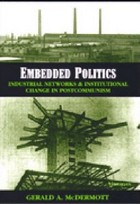
front cover of Embedded Politics
Embedded Politics
Industrial Networks and Institutional Change in Postcommunism
Gerald A. McDermott
University of Michigan Press, 2003
Embedded Politics offers a unique framework for analyzing the impact of past industrial networks on the way postcommunist societies build new institutions to govern the restructuring of their economies. Drawing on a detailed analysis of communist Czechoslovakia and contemporary Czech industries and banks, Gerald A. McDermott argues that restructuring is best advanced through the creation of deliberative or participatory forms of governance that encourages public and private actors to share information and take risks. Further, he contends that institutional and organizational changes are intertwined and that experimental processes are shaped by how governments delegate power to local public and private actors and monitor them.
Using comparative case analysis of several manufacturing sectors, Embedded Politics accounts for change and continuity in the formation of new economic governance institutions in the Czech Republic. It analytically links the macropolitics of state policy with the micropolitics of industrial restructuring. Thus the book advances an alternative approach for the comparative study of institutional change and industrial adjustment.
As a historical and contemporary analysis of Czech firms and public institutions, this book will command the attention of students of postcommunist reforms, privatization, and political-economic transitions in general. But also given its interdisciplinary approach and detailed empirical analysis of policy-making and firm behavior, Embedded Politics is a must read for scholars of politics, economics, sociology, political economy, business organization, and public policy.
Gerald A. McDermott is Assistant Professor of Management in The Wharton School of Management at The University of Pennsylvania. His research applies recent advances in comparative political economy and industrial organization, including theories of social networks, historical institutionalism, and incomplete markets to analyze issues of economic governance, firm creation, and industrial restructuring in advanced and newly industrialized countries. As evidenced by Embedded Politics, his current focus is on problems of institutional and organizational learning in the formation of meso-level governance institutions in emerging market and postsocialist economies.
McDermott also works as Senior Research Fellow at the IAE Escuela de Direccion y Negocios at Universidad Austral in Buenos Aires, and he has served as Project Coordinator at the Inter-American Development Bank. He has consulted for the Finance, Private Sector, and Infrastructure Division at the World Bank and advised the Deputy Foreign Minister of the Czech Republic. In addition he has published many papers and book chapters on entrepreneurship, privatization, institutions, and networks in Central Europe and Latin America.
[more]

front cover of Envisioning Eastern Europe
Envisioning Eastern Europe
Postcommunist Cultural Studies
Michael D. Kennedy, Editor
University of Michigan Press, 1994
How does one envision the sequel to communist rule in Eastern Europe and the Soviet Union? In this volume of postcommunist cultural studies, artists, activists, and experts capture the complexity of ideological transformations and identities in formation in this region. The contributors reach beyond the discourses of civil society and nationalism, which usually structure our imagination of alternatives, to consider how the utopia, memory, and monuments of socialism might be transformed after the death of their communist master; how the Yugoslav War is shaped by the creation, and destruction, of fantasy; the range of alternative nationalisms in Eastern Europe; and how the civil society project is threatened, and how it might be reconstructed. By challenging the simple identities of citizen, consumer, and capitalist embedded in the discussion of political options with more complex images, this volume opens up the analysis of "transition" and encourages a new theoretical imagination that draws on interdisciplinary engagements among literary studies, history, political theory, psychoanalysis, and sociology.Contributors are Andrew Arato, Nicolae Harsanyi, Michael D. Kennedy, Vitaly Komar, Alexander Melamid, Ina Merkel, Edmund Mokrzycki, Mykola Ryabchuk, Renata Salecl, Vladimir Tismaneanu, and Konrad Weiss.
[more]

front cover of The Evolution of Agrarian Institutions
The Evolution of Agrarian Institutions
A Comparative Study of Post-Socialist Hungary and Bulgaria
Mieke Meurs
University of Michigan Press, 2001
The Evolution of Agrarian Institutions studies the unexpectedly slow and uneven growth of private agriculture in postsocialist East-Central Europe. Comparing developments in Hungary and Bulgaria, Mieke Meurs offers an explanation for this slow growth and examines its implications for efficiency and income distribution in postsocialist agriculture.
With the collapse of the state socialist regimes in East-Central Europe, it was widely expected that collectivized agriculture would quickly be remade in the glowing image of China--a patchwork of small, privately run farms yielding rapid increases in output and incomes. However, the European experience has been quite different; while socialist collective farms have disappeared, collective forms of organization have persisted, and private farming has been slow to emerge. Meurs argues that an understanding of the causes of the slow emergence of private farming is essential to effective policy intervention in agriculture. This book contributes to such an understanding through analyzing variations in farm organization and rural market development and comparing agricultural restructuring in Hungary and Bulgaria.
The Evolution of Agrarian Institutions is unique in its combination of original survey data, published data on land use, and published historical data. It also tests two institutionalist explanations for the pace and direction of change in agricultural organization. This book will be of interest to economists, political scientists, sociologists, scholars working in the area of rural development in emerging countries, and anyone with an interest in transitional economics.
Mieke Meurs is Associate Professor of Economics, American University.

[more]

front cover of From East Germans to Germans?
From East Germans to Germans?
The New Postcommunist Elites
Jennifer A. Yoder
Duke University Press, 1999
In 1990 Germany launched an experiment to transplant democracy into a formerly communist country, effectively dismantling the system of the German Democratic Republic and rebuilding it in the likeness of the democratic Federal Republic of Germany. From East Germans to Germans? examines the role of the first generation of democratically elected political elites in the former GDR’s transition to democracy.
Although the quick transplant of a ready-made democratic system supported by West German financial backing and expertise provided benefits, problems arose for the development of postcommunist political leadership and for the growth of mass support for the democratic system. Jennifer A. Yoder analyzes the implications of the transition process for democratic legitimation and integration. Based on field research in East Germany that included interviews with parliamentarians, her study addresses issues such as culture, identity, and the lack of continuity between the old and new political elites. Although the availability of West German role models, together with pressure to conform, allowed the process of decommunization to occur much faster than elsewhere in Eastern Europe, the cultural differences between east and west are more extensive and complex than previously assumed. Unification has also been followed by a reinvigoration of regional interests. Yoder shows how some political elites have adopted western German patterns, while others openly criticize many of the practices and policies originating in Bonn and present themselves as democratic alternatives and advocates for East German interests in the new Germany. Indeed, for many East Germans, these new regional elites are regarded as the only representatives of their interests in the western-dominated political system.
Providing insight into elite-building at a time of transition and a valuable alternative to the “institutions versus culture” debate found in traditional analyses of political change, this book will interest political scientists and students and scholars of European politics and German studies.
[more]

logo for Pluto Press
From Fear to Fraternity
A Russian Tale of Crime, Economy and Modernity
Patricia Rawlinson
Pluto Press, 2010

The end of communism marked the re-emergence of a huge rise in organised crime across Russia and Eastern Europe. High-profile efforts to combat it have met with little success.
 
Patricia Rawlinson argues that burgeoning crime rates result not only from the failures of communism but also from the problems of free market economies.
 
Drawing on interviews with members of the Russian criminal underworld, the business community, journalists and the militia, she argues that organised crime provides us with a barometer of economic well-being, not just for Russia but for any market economy.

[more]

logo for Pluto Press
Globalization and Its Discontents
The Rise of Postmodern Socialisms
Edited by Roger Burbach, Boris Kagarlitsky, and Orlando Nunez
Pluto Press, 1997

front cover of Green Barons, Force-of-Circumstance Entrepreneurs, Impotent Mayors
Green Barons, Force-of-Circumstance Entrepreneurs, Impotent Mayors
Rural Change in the Early Years of Post-Socialist Capitalist Democracy
Nigel Swain
Central European University Press, 2013
An exemplary study in comparative contemporary history, this monograph looks at rural change in six countries: Bulgaria, Czech Republic, Hungary, Poland, Romania and Slovakia. In the 1990s most of these nations experienced a fourth radical restructuring of agricultural relations in the twentieth century, and all went through the dramatic transition from communism to capitalism. The author analyzes attempts to activate democracy on a local level and recreate farming structures and non-agricultural businesses based on private ownership and private enterprise. He describes the emergence of a new business class that seeks to dominate local government structures; the recuperation of former communist farming entities by former managers; and the transformation of peasants into rural citizens, who nevertheless remain the underdogs. Swain exposes common features as well as specific divergences between the six countries; he portrays the winners, losers and engineers of transformations. He situates his themes in a wider context that will appeal to a broad range of social scientists and historians.
[more]

front cover of Havana beyond the Ruins
Havana beyond the Ruins
Cultural Mappings after 1989
Anke Birkenmaier and Esther Whitfield, eds.
Duke University Press, 2011
In Havana beyond the Ruins, prominent architects, scholars, and writers based in and outside of Cuba analyze how Havana has been portrayed in literature, music, and the visual arts since Soviet subsidies of Cuba ceased, and the Cuban state has re-imagined Havana as a destination for international tourists and business ventures. Cuba’s capital has experienced little construction since the revolution of 1959; many of its citizens live in poorly maintained colonial and modernist dwellings. It is this Havana—of crumbling houses, old cars, and a romantic aura of ruined hopes—that is marketed in picture books, memorabilia, and films. Meanwhile, Cuba remains a socialist economy, and government agencies maintain significant control of urban development, housing, and employment. Home to more than two million people and a locus of Cuban national identity, Havana today struggles with the some of the same problems as other growing world cities, including slums and escalating social and racial inequalities. Bringing together assessments of the city’s dwellings and urban development projects, Havana beyond the Ruins provides unique insights into issues of memory, citizenship, urban life, and the future of the revolution in Cuba.

Contributors
Emma Álvarez-Tabío Albo
Eric Felipe-Barkin
Anke Birkenmaier
Velia Cecilia Bobes
Mario Coyula-Cowley
Elisabeth Enenbach
Sujatha Fernandes
Jill Hamberg
Patricio del Real
Cecelia Lawless
Jacqueline Loss
Orlando Luis Pardo Lazo
Antonio José Ponte
Nicolás Quintana
Jose Quiroga
Laura Redruello
Rafael Rojas
Joseph L. Scarpaci
Esther Whitfield
[more]

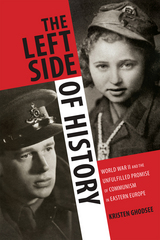
front cover of The Left Side of History
The Left Side of History
World War II and the Unfulfilled Promise of Communism in Eastern Europe
Kristen Ghodsee
Duke University Press, 2015
In The Left Side of History Kristen Ghodsee tells the stories of partisans fighting behind the lines in Nazi-allied Bulgaria during World War II: British officer Frank Thompson, brother of the great historian E.P. Thompson, and fourteen-year-old Elena Lagadinova, the youngest female member of the armed anti-fascist resistance. But these people were not merely anti-fascist; they were pro-communist, idealists moved by their socialist principles to fight and sometimes die for a cause they believed to be right. Victory brought forty years of communist dictatorship followed by unbridled capitalism after the fall of the Berlin Wall in 1989. Today in democratic Eastern Europe there is ever-increasing despair, disenchantment with the post-communist present, and growing nostalgia for the communist past. These phenomena are difficult to understand in the West, where “communism” is a dirty word that is quickly equated with Stalin and Soviet labor camps. By starting with the stories of people like Thompson and Lagadinova, Ghodsee provides a more nuanced understanding of how communist ideals could inspire ordinary people to make extraordinary sacrifices.
[more]

front cover of Liberalism After Communism
Liberalism After Communism
The Implications of the 1993 Elections to the Federal Assembly
Jerzy Szacki
Central European University Press, 1995
This study is devoted to recent developments in Central European (especially Polish) political thought, and concentrates on the emergence of liberal ideas, a subject largely neglected by Western observers. It provides a clear account of protoliberal and liberal thinking in Central Europe both before and after 1989, a critical appraisal of the democratic opposition to communism, and an analysis of economic liberalism as its rival orientation. The author examines the changes which occur in classical liberal ideas when they are implemented in a region with practically no liberal tradition and no socioeconomic infrastructure, and shows how liberal ideas in Central Europe are becoming constructivist, functioning as the ideological justification for a new kind of Utopian social engineering that aims at constructing capitalism.
[more]

front cover of The Long 1989
The Long 1989
Decades of Global Revolution
Kyrill Kunakhovich
Central European University Press, 2019
The fall of communism in Europe is now the frame of reference for any mass mobilization, from the Arab Spring to the Occupy movement to Brexit. Even thirty years on, 1989 still figures as a guide and motivation for political change. It is now a platitude to call 1989 a "world event," but the chapters in this volume show how it actually became one. 
The authors of these nine essays consider how revolutionary events in Europe resonated years later and thousands of miles away: in China and South Africa, Chile and Afghanistan, Turkey and the USA. They trace the circulation of people, practices, and concepts that linked these countries, turning local developments into a global phenomenon. At the same time, they examine the many shifts that revolution underwent in transit. All nine chapters detail the process of mutation, adaptation, and appropriation through which foreign affairs found new meanings on the ground. They interrogate the uses and understandings of 1989 in particular national contexts, often many years after the fact. Taken together, this volume asks how the fall of communism in Europe became the basis for revolutionary action around the world, proposing a paradigm shift in global thinking about revolution and protest.
[more]

logo for Pluto Press
Losing Control
Global Security in the 21st Century
Paul Rogers
Pluto Press, 2010

When Losing Control was first published a decade ago it was years ahead of its time. Its argument was simple - the real causes of global insecurity were the widening socio-economic divide, global marginalisation and environmental limitations, especially climate change and conflict over energy resources.

Paul Rogers, one of the most original thinkers on international security, pointed to a world in which irregular warfare from the margins would prevent powerful states from maintaining their position. He even predicted accurately how the United States would respond to a catastrophic attack.

The new edition brings the whole analysis right up to date, arguing persuasively that the world’s elite cannot maintain control and that a far more emancipatory and sustainable approach to global security has to be developed.
[more]

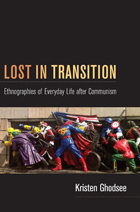
front cover of Lost in Transition
Lost in Transition
Ethnographies of Everyday Life after Communism
Kristen Ghodsee
Duke University Press, 2011
Lost in Transition tells of ordinary lives upended by the collapse of communism. Through ethnographic essays and short stories based on her experiences with Eastern Europe between 1989 and 2009, Kristen Ghodsee explains why it is that so many Eastern Europeans are nostalgic for the communist past. Ghodsee uses Bulgaria, the Eastern European nation where she has spent the most time, as a lens for exploring the broader transition from communism to democracy. She locates the growing nostalgia for the communist era in the disastrous, disorienting way that the transition was handled. The privatization process was contested and chaotic. A few well-connected foreigners and a new local class of oligarchs and criminals used the uncertainty of the transition process to take formerly state-owned assets for themselves. Ordinary people inevitably felt that they had been robbed. Many people lost their jobs just as the state social-support system disappeared. Lost in Transition portrays one of the most dramatic upheavals in modern history by describing the ways that it interrupted the rhythms of everyday lives, leaving confusion, frustration, and insecurity in its wake.
[more]

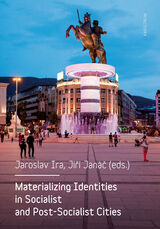
front cover of Materializing Identities in Socialist and Post-Socialist Cities
Materializing Identities in Socialist and Post-Socialist Cities
Edited by Jaroslav Ira and Jirí Janác
Karolinum Press, 2017
Following the so-called “Material Turn” of historiography, this book explores the materialization of identity in urban space—specifically in Eastern Europe and Central Asia. Urban spaces played an important role in the formation of national identities in post-socialist successor states across the region, while at the same time the articulation of national identities markedly affected the appearance of these post-socialist cities. Beginning with an overview of socialist and post-socialist cities in recent urban history, contributors trace the post-socialist intertwining of space and identities in case studies that include Astana and Almaty in Kazakhstan, Chișinău and Tiraspol in Moldova, and Skopje in Macedonia, while also linking this phenomenon to socialist urbanism, as in postwar Minsk, Belarus.
[more]

front cover of Mission Accomplished
Mission Accomplished
On Founding Constitutional Adjudication in Central Europe
Radoslav Procházka
Central European University Press, 2002
Examines constitutional jurisdiction in the so-called Visegrad Four: Poland, Hungary, the Czech Republic and Slovakia. The creation of constitutional courts was one of the major milestones in the re-creation of the democratic system in these countries. In Europe constitutional courts exert much of the functions of the Supreme Court of the US. However, the immediate western European samples showed marked differences, which is why besides similarities, the theory and practice of constitutional law show differences in these four countries. Procházka analyses and explains these similarities and differences. 

Mission Accomplished contributes to the literature on comparative constitutional law by offering insights into the constitutional discourses that go beyond the discussion of notorious cases and events in these four countries. Procházka argues that the various historical, cultural, socio-psychological, political and institutional contexts have translated into different modes of constitutional adjudication and interpretation.
[more]

front cover of Narratives Unbound
Narratives Unbound
Historical studies in post-communist Eastern Europe
Péter Apor
Central European University Press, 2007
The first work that covers the post-Communist development of historical studies in six Eastern European countries: Bulgaria, Czech Republic, Hungary, Poland, Romania, and Slovakia. A uniquely critical and qualitative analysis from a comparative and critical perspective, written by scholars from the region itself. Focusing on the first post-Communist decade, 1989–1999, the book offers a longer-term perspective that includes the immediate 'prehistory' of that momentous decade as well as its 'posthistoire'. The authors capture the spirit of 1989, that heady mix of elation, surprise, determination, and hope: l'ivresse du possible. This was the paradoxical beginning of Eastern European post-Communism: ushered in by 'anti-Utopian' revolutions, and slowly finding its course towards a bureaucratic, imitative, challenging, and anachronistic restoration of a capitalism that had changed almost beyond recognition when it had mutated into the negative double of Communism. Each individual chapter has numerous and detailed notes and references.
[more]

front cover of Of Red Dragons and Evil Spirits
Of Red Dragons and Evil Spirits
Post-Communist Historiography between Democratization and the New Politics of History
Oto Luthar
Central European University Press, 2017
The collection of well-researched essays assesses the uses and misuses of history 25 years after the collapse of Soviet hegemony in Eastern Europe. As opposed to the revival of national histories that seemed to be the prevailing historiographical approach of the 1990s, the last decade has seen a particular set of narratives equating Nazism and Communism. This provides opportunities to exonerate wartime collaboration, casting the nation as victim even when its government was allied with Germany. While the Jewish Holocaust is acknowledged, its meaning and significance are obfuscated. In their comparative analysis the authors are also interested in new practices of ‘Europeanness’. Therefore their presentations of Slovak, Hungarian, Romanian, Bulgarian, Serbian, Bosnian, Croatian and Slovenian post-communist memory politics move beyond the common national myths in order to provide a new insight into transnational interactions and exchanges in Europe in general. The juxtaposition of these politics, the processes in other parts of Europe, the modes of remembering shaped by displacement and the transnational enable a close encounter with the divergences and assess the potential of the formation of common, European memory practices.
[more]

front cover of On Baltic Slovenia and Adriatic Lithuania
On Baltic Slovenia and Adriatic Lithuania
A Qualitative Comparative Analysis of Patterns in Post-Communist Transformation
Zenonas Norkus
Central European University Press, 2012
A unique application of social science software to generate typology and ranklist of transition models of twenty-nine countries in Europe and Asia, ranging from Estonia to Vietnam, Norkus provides a highly innovative internationally comparative causal analysis of the variation in political and economic outcomes after the first decade of post-communist transformations, using multi-value Qualitative Comparative Analysis and Tosmana programme. The analysis includes a critical revision of received dichotomies (e.g. on gradualism versus “shock therapy”), and contributes to current debates on the varieties of post-communist capitalism.This conceptual framework is applied in national case studies, searching for reasons behind successes and failures, with special consideration given to the possibility of alternatives to the Lithuanian way, and the challenges of populism in this country’s politics.
[more]

front cover of On the Verge of Convergence
On the Verge of Convergence
Social Stratification in Eastern Europe
Henryk Domanski
Central European University Press, 2000
Based on comparative surveys, the author presents a study of social transformation in Central and Eastern Europe after 1989. Focusing on Bulgaria, Czech Republic, Hungary, Poland, Russia and Slovakia, the author provides information relating to social structure, mobility, inequality, lifestyle and economic stratification. Applying the Erikson-Goldthorpe classification of class positions, Domanski effectively presents fully comparable data to enable political comparisons to be made with other countries, especially those with firmly established free market economies. As such, "On the Verge of Convergence" seeks to provide a clearer understanding of the on-going process of social transformation within developing capitalist societies.
[more]

front cover of On Your Marx
On Your Marx
Relinking Socialism and the Left
Randy Martin
University of Minnesota Press, 2001

Reclaims Marx for today through a fundamental reconsideration of how his works should be read.

Why-and how-does Marx speak to our day? Seeking to reestablish the link between Marx, socialism, and the Left, this book negotiates the common ground between orthodox marxism and postmarxism to show how Marx can elaborate the present. More than a claim for his relevance, this book is also a forceful statement about how theory relates to political project and organization.

What, Randy Martin asks, does Marx have to say to the discourses of radical democracy, postmodernism, and globalization-all of which purport to solve problems that emerge in Marx’s writings? A reading of Marx can in fact disclose the limitations of the contemporary modes of criticism, identifying the difficult conceptual problems that cannot be avoided or overcome. Using readings of Marx to restage contemporary political discussions, On Your Marx reengages orthodox and postmarxist understandings in a critical and constructive conversation. In doing so, the book points to powerful new alliances between cultural and political theorists and activists, opening new possibilities for mobilization and social justice.
[more]

front cover of The Origins Of Postcommunist Elites
The Origins Of Postcommunist Elites
From Prague Spring To The Breakup Of Czechoslovakia
Gil Eyal
University of Minnesota Press, 2003

How is it that Czechoslovakia’s separation into two countries in 1993 was accomplished so peacefully—especially when compared with the experiences of its neighbors Russia and Yugoslavia? This book provides a sociological answer to this question—and an empirical explanation for the breakup of Czechoslovakia—by tracing the political processes begun in the Prague Spring of 1968.

Gil Eyal’s main argument is that Czechoslovakia’s breakup was caused by a struggle between two fractions of what sociologists call the “new class,” which consisted primarily of intellectuals and technocrats. Focusing on the process of polarization that created these two distinct political elites, Eyal shows how, in response to the events of the ill-fated Prague Spring, Czech and Slovak members of the “new class” embarked on divergent paths and developed radically different, even opposed, identities, worldviews, and interests. Unlike most accounts of postcommunist nationalist conflict, this book suggests that what bound together each of these fractions—and what differentiated each from the other—were not national identities and nationalist sentiments per se, but their distinctive visions of the social role of intellectuals.
[more]

front cover of Out of the Red
Out of the Red
Building Capitalism and Democracy in Postcommunist Europe
Mitchell A. Orenstein
University of Michigan Press, 2001
After the fall of the Berlin Wall, the countries of East-Central Europe embarked on a journey to transform themselves into democratic capitalist societies. Their governments searched for strategies that would allow them to pursue radical market reforms within the context of nascent democratic politics. Poland adopted a neoliberal strategy that attempted to push through as much reform as possible before an antireform backlash could occur. In the Czech Republic, a social liberal strategy for transformation attempted to combine neoliberal macro-economic policies with social democratic measures designed to avert such a backlash.
A detailed analysis of Poland and the Czech Republic suggests that alternation between strategies has been the secret to the success of East-Central European countries.
This comparative case analysis identifies the significance of reform mistakes during transition and the corrective benefits of policy alternation, its claims illustrated with an in-depth study of privatization policy in the two countries.
Mitchell A. Orenstein delves into the historic struggle to build capitalism and democracy during a decade of post- communist transition in East-Central Europe and develops a model that explains why democratic policy alternation may accelerate policy learning under conditions of uncertainty and constraint.
Out of the Red is accessible to a general audience and as such is suitable for both graduate and undergraduate courses on political economy. It will be of particular interest to economists, political scientists, sociologists, students of postcommunism, and anyone interested in the relations between capitalism and democracy in the contemporary world.
Mitchell A. Orenstein is Assistant Professor of Political Science, Syracuse University.
[more]

front cover of Police in Transition
Police in Transition
Essays on the Police Forces in Transition Countries
András Kádár
Central European University Press, 2001

The police forces of the transition countries in Central and Eastern Europe have to undergo profound reform to be able to respond to the needs of society; to serve the public and not just the government, and to prove that they can effectively combat crime. This volume is the result of a survey by the Hungarian Helsinki Committee concerning the mode and extent of changes police forces of the post-communist countries have undergone since 1989 – 1990. Information is provided about the relevant tasks, organization, personnel, accountability, and international relations of the national police forces and about the coercive measures they are entitled to use.

Written by internationally acknowledged experts of policing and representatives of human-rights organizations, Police in Transition deals with the questions of transition, European trends in the governance of the police, the relationship between police and criminality, the role of the police in the constitutional framework, the limits of policing, police brutality, civilian oversight of the police and the possibilities of a democratic reform of police forces in Central and Eastern Europe. 

[more]

front cover of The Political Economy of Dual Transformations
The Political Economy of Dual Transformations
Market Reform and Democratization in Hungary
David L. Bartlett
University of Michigan Press, 1997
In the early 1990s, scholars voiced skepticism about the capacity of Eastern Europe's new democracies to manage simultaneous political and economic reform. They argued that the surge of popular participation following democratization would thwart efforts by successor governments to enact market reforms that imposed high costs on major elements of post-Communist society. David Bartlett challenges the conventional wisdom regarding the hazards of "dual transformations": far from hindering marketization, democratization facilitated it. Bartlett argues that the transition to democracy in East Central Europe lowered the political barriers to market reforms by weakening the ability of actors most vulnerable to marketization to manipulate the existing institutional structure to stop or slow down the process.
Although the analysis focuses on Hungary, whose long history of market reforms makes it an ideal vehicle for assessing the impact of institutional change on reform policy, the author shows how his findings call into question the use of "shock therapy" and arguments, based on the experience in East Asia, that economic development and democratization are incompatible.
This book will appeal to economists, political scientists, and others interested in transition problems in formerly communist countries, democratic transitions, and the politics of stabilization and adjustment.
David L. Bartlett is Assistant Professor of Political Science, Vanderbilt University.
[more]

front cover of The Political Economy of Protest and Patience
The Political Economy of Protest and Patience
East European and Latin American Trasformations Compared
Béla Greskovits
Central European University Press, 1998

Despite gloomy prophecies, democracy and the market economy seem to be taking root throughout Central and Eastern Europe, although set against a background of a recession deeper and longer than that of the Great Depression. How is this possible? Why did Eastern Europeans protest less about the brutal social consequences of systemic change than the people of Latin America a decade earlier? Why has the region-wide authoritarian or populist turnabout not occurred? Why has democracy in these countries proved to be crisis-proof? In what ways has economic crisis impacted on the politics of the region?

In addressing these questions, Béla Greskovits uses a comparative analysis of the structures, institutions, cultures, and actors shaping both the Eastern European and the Latin American transformations. He argues that structural, institutional, and cultural factors have put a brake on destabilizing collective actions and have paved the way for the emergence of the enduring, low-level equilibrium between incomplete democracy and imperfect market economy which seems set to characterize the Central and Eastern European experience for the foreseeable future.

[more]

front cover of Politics and Policies in Post-Communist Transition
Politics and Policies in Post-Communist Transition
Primary and Secondary Privatisation in Central Europe and the Former Soviet Union
Károly Attila Soós
Central European University Press, 2011
Discusses the policies, practices and outcomes of privatization in six transition economies: the Czech Republic, Hungary, Poland, Russia, Slovenia and Ukraine, paying particular attention to cross-country differences and to interrelations between the processes of privatisation and the political transition from communism to a new system.The analysis is restricted to the privatisation in those fields where its methods have been strongly different from privatisations in advanced market economies and where differences of privatisation principles and techniques among our six countries were also rather various. This is basically the privatisation of middle-sized and large enterprises, not including banks, non-bank financial companies, natural monopolies and agricultural entities.
[more]

front cover of Politics without a Past
Politics without a Past
The Absence of History in Postcommunist Nationalism
Shari J. Cohen
Duke University Press, 1999
In Politics without a Past Shari J. Cohen offers a powerful challenge to
common characterizations of postcommunist politics as either a resurgence of
aggressive nationalism or an evolution toward Western-style democracy. Cohen
draws upon extensive field research to paint a picture of postcommunist
political life in which ideological labels are meaningless and exchangeable
at will, political parties appear and disappear regularly, and citizens
remain unengaged in the political process.
In contrast to the conventional wisdom, which locates the roots of widespread intranational strife in deeply rooted national identities from the past, Cohen argues that a profound ideological vacuum has fueled destructive tension throughout postcommunist Europe and the former Soviet Union. She uses Slovakia as a case study to reveal that communist regimes bequeathed an insidious form of historical amnesia to the majority of the political elite and the societies they govern. Slovakia was particularly vulnerable to communist intervention since its precommunist national consciousness was so weak and its only period of statehood prior to 1993 was as a Nazi puppet-state. To demonstrate her argument, Cohen focuses on Slovakia’s failure to forge a collective memory of the World War II experience. She shows how communist socialization prevented Slovaks from tying their individual family stories—of the Jewish deportations, of the anti-Nazi resistance, or of serving in the wartime government—to a larger historical narrative shared with others, leaving them bereft of historical or moral bearings.
Politics without a Past develops an analytical framework that will be important for future research in Eastern Europe, the former Soviet Union, and beyond. Scholars in political science, history, East European and post-Soviet studies will find Cohen’s methodology and conclusions enlightening. For policymakers, diplomats, and journalists who deal with the region, she offers valuable insights into the elusive nature of postcommunist societies.
[more]

front cover of Postcards from Stanland
Postcards from Stanland
Journeys in Central Asia
David H. Mould
Ohio University Press, 2015

Central Asia has long stood at the crossroads of history. It was the staging ground for the armies of the Mongol Empire, for the nineteenth-century struggle between the Russian and British empires, and for the NATO campaign in Afghanistan. Today, multinationals and nations compete for the oil and gas reserves of the Caspian Sea and for control of the pipelines. Yet “Stanland” is still, to many, a terra incognita, a geographical blank.

Beginning in the mid-1990s, academic and journalist David Mould’s career took him to the region on Fulbright Fellowships and contracts as a media trainer and consultant for UNESCO and USAID, among others. In Postcards from Stanland, he takes readers along with him on his encounters with the people, landscapes, and customs of the diverse countries—Kazakhstan, Kyrgyzstan, Tajikistan, and Uzbekistan—he came to love. He talks with teachers, students, politicians, environmental activists, bloggers, cab drivers, merchants, Peace Corps volunteers, and more.

Until now, few books for a nonspecialist readership have been written on the region, and while Mould brings his own considerable expertise to bear on his account—for example, he is one of the few scholars to have conducted research on post-Soviet media in the region—the book is above all a tapestry of place and a valuable contribution to our understanding of the post-Soviet world.
[more]

front cover of Post-Communism
Post-Communism
An Introduction
Leslie Holmes
Duke University Press, 1997

front cover of Post-Communist Mafia State
Post-Communist Mafia State
The Case of Hungary
Bálint Magyar
Central European University Press, 2016
In an article in 2001 the author analyzed the way Fidesz, the party on government for the first time then, was eliminating the institutional system of the rule of law. At that time, many readers doubted the legitimacy of the new approach, whose key categories were the 'organized over-world', the 'state employing mafia methods' and the 'adopted political family'. Critics considered these categories metaphors rather than elements of a coherent conceptual framework. Ten years later Fidesz won a two-third majority in Parliament at the 2010 elections: the institutional obstacles of exerting power were thus largely removed. Just like the party, the state itself was placed under the control of a single individual, who since then has applied the techniques used within his party to enforce submission and obedience onto society as a whole. While in many post-communist systems a segment of the party and secret service became the elite in possession of not only political power but also of wealth, Fidesz, as a late-coming new political predator, was able to occupy this position through an aggressive change of elite. The actions of the post-communist mafia state model are led by the logic of power and wealth concentration in the hands of the clan. But while the classical mafia channeled wealth and economic players into its spheres of interest by means of direct coercion, the mafia state does the same by means of parliamentary legislation, legal prosecution, tax authority, police forces and secret service. The new conceptual framework is important and timely not only for Hungary, but also for other post-communist countries subjected to autocratic rules.
[more]

front cover of Post-Communist Malaise
Post-Communist Malaise
Cinematic Responses to European Integration
Zoran Samardzija
Rutgers University Press, 2020
The collapse of communism in the Soviet Union and Eastern Europe was supposed to bring about the “end of history” with capitalism and liberal democracy achieving decisive victories. Europe would now integrate and reconcile with its past. However, the aftershocks of the financial crisis of 2008—the rise in right-wing populism, austerity politics, and mass migration—have shown that the ideological divisions which haunted Europe in the twentieth century still remain. It is within this context that Post-Communist Malaise revives discourses of political modernism and revisits debates from Marxism and seventies film theory. Analyzing work of Theo Angelopoulos, Věra Chytilová, Srdjan Dragojević, Jean-Luc Godard,  Miklós Jancsó, Emir Kusturica, Dušan Makavejev, Cristi Puiu, Jan Švankmajer, Andrei Tarkovsky, and Béla Tarr, the book focuses on how select cinemas from Eastern Europe and the Balkans critique the neoliberal integration of Europe whose failures fuel the rise of nationalism and right-wing politics. By politicizing art cinema from the regions, Post-Communist Malaise asks fundamental questions about film, aesthetics, and ideology. It argues for the utopian potential of the materiality of cinematic time to imagine a new political and cultural organization for Europe.
 
[more]

front cover of Postsocialism and Cultural Politics
Postsocialism and Cultural Politics
China in the Last Decade of the Twentieth Century
Xudong Zhang
Duke University Press, 2008
In Postsocialism and Cultural Politics, Xudong Zhang offers a critical analysis of China’s “long 1990s,” the tumultuous years between the 1989 Tiananmen Square crackdown and China’s entry into the World Trade Organization in 2001. The 1990s were marked by Deng Xiaoping’s market-oriented reforms, the Taiwan missile crisis, the Asian financial crisis, and the end of British colonial rule of Hong Kong. Considering developments including the state’s cultivation of a market economy, the aggressive neoliberalism that accompanied that effort, the rise of a middle class and a consumer culture, and China’s entry into the world economy, Zhang argues that Chinese socialism is not over. Rather it survives as postsocialism, which is articulated through the discourses of postmodernism and nationalism and through the co-existence of multiple modes of production and socio-cultural norms. Highlighting China’s uniqueness, as well as the implications of its recent experiences for the wider world, Zhang suggests that Chinese postsocialism illuminates previously obscure aspects of the global shift from modernity to postmodernity.

Zhang examines the reactions of intellectuals, authors, and filmmakers to the cultural and political conflicts in China during the 1990s. He offers a nuanced assessment of the changing divisions and allegiances within the intellectual landscape, and he analyzes the postsocialist realism of the era through readings of Mo Yan’s fiction and the films of Zhang Yimou. With Postsocialism and Cultural Politics, Zhang applies the same keen insight to China’s long 1990s that he brought to bear on the 1980s in Chinese Modernism in the Era of Reforms.

[more]

logo for Pluto Press
Post-Soviet Chaos
Violence and Dispossession in Kazakhstan
Joma Nazpary
Pluto Press, 2001

front cover of Quest for a Suitable Past
Quest for a Suitable Past
Myth and Memory in Central and Eastern Europe
Lucian Boia
Central European University Press, 2017
The past may be approached from a variety of directions. A myth provides a sense of direction: it reunites people around certain values and projects and pushes them in one direction or another. The present volume brings together a range of case studies of myth making and myth breaking in east Europe from the nineteenth century to the present day. In particular, it focuses on the complex process through which memories are transformed into myths. This problematic interplay between memory and myth-making is analyzed in conjunction with the role of myths in the political and social life of the region. The essays include cases of forging myths about national pre-history, about the endorsement of nation building by means of historiography, and above all, about communist and post-communist mythologies. The studies shed new light on the creation of local and national identities, as well as the legitimization of ideologies through myth-making. Together, the individual contributions show that myths were often instrumental in the vast projects of social and political mobilization during a period which has witnessed, among others, two world wars and the harsh oppression of the communist regimes.
[more]

front cover of Rebellious Civil Society
Rebellious Civil Society
Popular Protest and Democratic Consolidation in Poland, 1989-1993
Grzegorz Ekiert and Jan Kubik
University of Michigan Press, 2001
Poland is the only country in which popular protest and mass opposition, epitomized by the Solidarity movement, played a significant role in bringing down the communist regime. This book, the first comprehensive study of the politics of protest in postcommunist Central Europe, shows that organized protests not only continued under the new regime but also had a powerful impact on Poland's democratic consolidation.
Following the collapse of communism in 1989, the countries of Eastern Europe embarked on the gargantuan project of restructuring their social, political, economic, and cultural institutions. The social cost of these transformations was high, and citizens expressed their discontent in various ways. Protest actions became common events, particularly in Poland. In order to explain why protest in Poland was so intense and so particularized, Grzegorz Ekiert and Jan Kubik place the situation within a broad political, economic, and social context and test it against major theories of protest politics. They conclude that in transitional polities where conventional political institutions such as parties or interest groups are underdeveloped, organized collective protest becomes a legitimate and moderately effective strategy for conducting state-society dialogue. The authors offer an original and rich description of protest movements in Poland after the fall of communism as a basis for developing and testing their ideas. They highlight the organized and moderate character of the protests and argue that the protests were not intended to reverse the change of 1989 but to protest specific policies of the government.
This book contributes to the literature on democratic consolidation, on the institutionalization of state-society relationship, and on protest and social movements. It will be of interest to political scientists, sociologists, historians, and policy advisors.
Grzegorz Ekiert is Professor of Government, Harvard University. Jan Kubik is Associate Professor of Political Science, Rutgers University.
[more]

front cover of Red Hangover
Red Hangover
Legacies of Twentieth-Century Communism
Kristen Ghodsee
Duke University Press, 2017
In Red Hangover Kristen Ghodsee examines the legacies of twentieth-century communism twenty-five years after the Berlin Wall fell. Ghodsee's essays and short stories reflect on the lived experience of postsocialism and how many ordinary men and women across Eastern Europe suffered from the massive social and economic upheavals in their lives after 1989. Ghodsee shows how recent major crises—from the Russian annexation of Crimea and the Syrian Civil War to the rise of Islamic State and the influx of migrants in Europe—are linked to mistakes made after the collapse of the Eastern Bloc when fantasies about the triumph of free markets and liberal democracy blinded Western leaders to the human costs of "regime change." Just as the communist ideal has become permanently tainted by its association with the worst excesses of twentieth-century Eastern European regimes, today the democratic ideal is increasingly sullied by its links to the ravages of neoliberalism. An accessible introduction to the history of European state socialism and postcommunism, Red Hangover reveals how the events of 1989 continue to shape the world today.
[more]

front cover of The Red Riviera
The Red Riviera
Gender, Tourism, and Postsocialism on the Black Sea
Kristen Ghodsee
Duke University Press, 2005
This compelling ethnography of women working in Bulgaria’s popular sea and ski resorts challenges the idea that women have consistently fared worse than men in Eastern Europe’s transition from socialism to a market economy. For decades western European tourists have flocked to Bulgaria’s beautiful beaches and mountains; tourism is today one of the few successful—and expanding—sectors of the country’s economy. Even at the highest levels of management, employment in the tourism industry has long been dominated by women. Kristen Ghodsee explains why this is and how women working in the industry have successfully negotiated their way through Bulgaria’s capitalist transformation while the fortunes of most of the population have plummeted. She highlights how, prior to 1989, the communist planners sought to create full employment for all at the same time that they steered women into the service sector. The women given jobs in tourism obtained higher educations, foreign language skills, and experiences working with Westerners, all of which positioned them to take advantage of the institutional changes eventually brought about by privatization.

Interspersed throughout The Red Riviera are vivid examinations of the lives of Bulgarian women, including a waitress, a tour operator, a chef, a maid, a receptionist, and a travel agent. Through these women’s stories, Ghodsee describes their employment prior to 1989 and after. She considers the postsocialist forces that have shaped the tourist industry over the past fifteen years: the emergence of a new democratic state, the small but increasing interest of foreign investors and transnational corporations, and the proliferation of ngos. Ghodsee suggests that many of the ngos, by insisting that Bulgarian women are necessarily disenfranchised, ignore their significant professional successes.

[more]

front cover of Rehabilitative Postsocialism
Rehabilitative Postsocialism
Disability, Sex, and Race in Eastern Europe
Katerina Kolárová
University of Michigan Press, 2025
Kateřina Kolářová’s Rehabilitative Postsocialism offers a timely interdisciplinary and intersectional analysis of how disability, race, class, and gender operate as ideological tools within the postsocialist Czech Republic (formerly Czechoslovakia). Kolářová presents postsocialism as an analytic that can and should be brought to bear to understand cultural politics, economic formations, and state politics through the present day. 

Rehabilitative Postsocialism names disability, sexuality, and race as central yet invisible to negotiations of the postsocialist consensus. Drawing from a rich and varied archive, Rehabilitative Postsocialism maps the formation of new structures of inequalities and social imaginaries of wellness, merit, and justice in order to understand current articulations of global disenchantment with democracy, social justice, and solidarity. The book also makes clear that disability, race, and ethnicity continue to circulate in depictions of Eastern Europe as suspended in a chronic developmental “delay.” Rehabilitative Postsocialism both situates this positioning within its political and historical formation and offers the analytical tools to challenge its continued deployment.
[more]

logo for Duke University Press
The Reincarnation of Russia
Struggling with the Legacy of Communism, 1990–1994
John Löwenhardt
Duke University Press, 1995
In The Reincarnation of Russia, John Löwenhardt presents the first in-depth analysis of the initial and crucial stages of Russia’s new statehood. He examines Russia’s recent turbulent history—beginning with the explosive Declaration of State Sovereignty in June 1990, through the adoption of the Yeltsin constitution in the elections of December 1993 and concluding with the early months of 1994. His analysis of Russia’s struggle with the vestige of Soviet Communism and the attempt to create a more democratic form of government offers crucial insight into one of the critical turning points in contemporary history.
Building on analysis of the failure of the Soviet system, Löwenhardt compares the emergence of Russia as a newborn state with other countries that have undergone transitions from authoritarianism toward democracy. Although it is often claimed that Russia is a unique case, the author argues that the lessons of other nations are relevant to the Russian situation. In conjunction with this comparative analysis and with consideration of the significance of the communist and Russian past, Löwenhardt discusses political and economic developments—including both foreign and domestic policy concerns—in Russia over the last four years. He provides a better understanding of the Russian condition and a guarded optimism regarding the ongoing process taking place in Russia today.
The Reincarnation of Russia will be welcomed by scholars with specialized interests in the democratization of Russia, political leaders, journalists, and general readers concerned with the global impact of Russia’s changing status.
[more]

front cover of Reinventing Chinese Tradition
Reinventing Chinese Tradition
The Cultural Politics of Late Socialism
Ka-ming Wu
University of Illinois Press, 2015
The final destination of the Long March and center of the Chinese Communist Party's red bases, Yan'an acquired mythical status during the Maoist era. Though the city's significance as an emblem of revolutionary heroism has faded, today's Chinese still glorify Yan'an as a sanctuary for ancient cultural traditions.

Ka-ming Wu's ethnographic account of contemporary Yan'an documents how people have reworked the revival of three rural practices--paper-cutting, folk storytelling, and spirit cults--within (and beyond) the socialist legacy. Moving beyond dominant views of Yan'an folk culture as a tool of revolution or object of market reform, Wu reveals how cultural traditions become battlegrounds where conflicts among the state, market forces, and intellectuals in search of an authentic China play out. At the same time, she shows these emerging new dynamics in the light of the ways rural residents make sense of rapid social change.

Alive with details, Reinventing Chinese Tradition is an in-depth, eye-opening study of an evolving culture and society within contemporary China.
[more]

front cover of Remembering Communism
Remembering Communism
Private and Public Recollections of Lived Experience in Southeast Europe
Contributors: Simina Bădica, Iskra Baeva, Tanya Boneva, Corina Cimpoieru, Liliana Deyanova, Albena Hranova, Nataliya Hristova, Petya Kabakchieva, Evgenia Kalinova, Anny Kirilova, Thomas Lindenberger, Tamás Lőnhárt, Izabella Main, Tsvetana Manova, Iliiana Marcheva, Vasil Markov, Andi Mihalache, Cătălina Mihalache, Milla Mineva, Cristina Petrescu, Dragoş Petrescu, Vania Stoyanova, Virgiliu Ţârău, Nikolai Vukov, Smaranda Vultur
Central European University Press, 2014

Remembering Communism examines the formation and transformation of the memory of communism in the post-communist period. The majority of the articles focus on memory practices in the post-Stalinist era in Bulgaria and Romania, with occasional references to the cases of Poland and the GDR. Based on an interdisciplinary approach, including history, anthropology, cultural studies and sociology, the volume examines the mechanisms and processes that influence, determine and mint the private and public memory of communism in the post-1989 era. The common denominator to all essays is the emphasis on the process of remembering in the present, and the modalities by means of which the present perspective shapes processes of remembering, including practices of commemoration and representation of the past.

The volume deals with eight major thematic blocks revisiting specific practices in communism such as popular culture and everyday life, childhood, labor, the secret police, and the perception of “the system”.

[more]

front cover of Remembrance, History, and Justice
Remembrance, History, and Justice
Coming to terms with traumatic pasts in democratic societies
Bogdan C. Iacob
Central European University Press, 2015
The twentieth century has left behind a painful and complicated legacy of massive trauma, monstrous crimes, radical social engineering, or collective/individual guilt syndromes that were often the premises for and the specters haunting the process of democratization in the various societies that emerged out of these profoundly de-structuring contexts. The present manuscript is a state of the art reassessment and analysis of how the interplay between memory, history, and justice generates insight that is multifariously relevant for comprehending the present and future of democracy without becoming limited to a Europe-centric framework of understanding. The manuscript is structured on three complementary and interconnected trajectories: the public use of history, politics of memory, and transitional justice. Key words 1. Europe, Eastern—Politics and government—1989– 2. Collective memory—Europe,Eastern. 3. Memory—Political aspects—Europe, Eastern. 4. Democratization—Social aspects—Europe, Eastern. 5. Europe, Eastern—Historiography—Socialaspects. 6. Europe, Eastern—Historiography—Political aspects. 7. Social justice—Europe, Eastern. 8. Post-communism—Europe, Eastern. 9. Fascism—Socialaspects—Europe, Eastern. 10. Dictatorship—Social aspects—Europe, Eastern.
[more]

front cover of Rethinking the Rule of Law after Communism
Rethinking the Rule of Law after Communism
Wojciech Sadurski
Central European University Press, 2005
In the original euphoria that attended the virtually simultaneous demise of so many dictatorships in the late 1980s and early 90s, there was a widespread belief that problems of 'transition' basically involved shedding a known past, and replacing it with an also-known future. This volume surveys and contributes to the prolific debates that occurred in the years between the collapse of communism and the enlargement of the European Union regarding the issues of constitutionalism, dealing with the past, and the rule of law in the post-communist world. Eminent scholars explore the issue of transitional justice, highlighting the distinct roles of legal and constitutional bodies in the post-transition period. The introduction seeks to frame the work as an intervention in the discussion of communism and transition-two stable and separate points-while emphasizing the instability of the post-transition moment.
[more]

front cover of The Return of Ideology
The Return of Ideology
The Search for Regime Identities in Postcommunist Russia and China
Cheng Chen
University of Michigan Press, 2016

As a nation makes the transition from communism to democracy or another form of authoritarianism, its regime must construct not only new political institutions, but also a new political ideology that can guide policy and provide a sense of mission. The new ideology is crucial for legitimacy at home and abroad, as well as the regime’s long-term viability. In The Return of Ideology, Cheng Chen compares post-communist regimes, with a focus on Russia under Putin and post-Deng China, investigating the factors that affect the success of an ideology-building project and identifies the implications for international affairs.

Successful ideology-building requires two necessary—but not sufficient—conditions. The regime must establish a coherent ideological repertoire that takes into account the nation’s ideological heritage and fresh surges of nationalism. Also, the regime must attract and maintain a strong commitment to the emerging ideology among the political elite.

Drawing on rich primary sources, including interviews, surveys, political speeches, writings of political leaders, and a variety of publications, Chen identifies the major obstacles to ideology-building in modern Russia and China and assesses their respective long-term prospects. Whereas creating a new regime ideology has been a protracted and difficult process in China, it has been even more so in Russia. The ability to forge an ideology is not merely a domestic concern for these two nations, but a matter of international import as these two great powers move to assert and extend their influence in the world.
[more]

front cover of The Rise of Populist Nationalism
The Rise of Populist Nationalism
Social Resentments and Capturing the Constitution in Hungary
Balázs Majtényi
Central European University Press, 2020
The authors of this book approach the emergence and endurance of the populist nationalism in post-socialist Eastern Europe, with special emphasis on Hungary. They attempt to understand the reasons behind public discourses that increasingly reframe politics in terms of nationhood and nationalism. Overall, the volume attempts to explain how the new nationalism is rooted in recent political, economic and social processes. The contributors focus on two motifs in public discourse: shift and legacy. Some focus on shifts in public law and shifts in political ethno-nationalism through the lens of constitutional law, while others explain the social and political roots of these shifts. Others discuss the effects of legacy in memory and culture and suggest that both shift and legacy combine to produce the new era of identity politics. Legal experts emphasize that the new Fundamental Law of Hungary is radically different from all previous Hungarian constitutions, and clearly reflects a redefinition of the Hungarian state itself. The authors further examine the role of developments in the fields of sociology and political science that contribute to the kind of politics in which identity is at the fore.
[more]

front cover of Rotten States?
Rotten States?
Corruption, Post-Communism, and Neoliberalism
Leslie Holmes
Duke University Press, 2006
Official corruption has become increasingly prevalent around the world since the early 1990s. The situation appears to be particularly acute in the post-communist states. Corruption—be it real or perceived—is a major problem with concrete implications, including a lowered likelihood of foreign investment. In Rotten States? Leslie Holmes analyzes corruption in post-communist countries, paying particular attention to Bulgaria, Hungary, Poland, and Russia, as well as China, which Holmes argues has produced, through its recent economic liberalization, a system similar to post-communism. As he points out, these countries offer useful comparisons: they vary in terms of size, religious orientation, ethnic homogeneity, and their approaches to and economic success with the transition from communism.

Drawing on data including surveys commissioned especially for this study, Holmes examines the causes and consequences of official corruption as well as ways of combating it. He focuses particular attention on the timing of the recent increase in reports of corruption, the relationship between post-communism and corruption, and the interplay between corruption and the delegitimation and weakening of the state. Holmes argues that the global turn toward neoliberalism—with its focus on ends over means, flexibility, and a reduced role for the state—has generated much of the corruption in post-communist states. At the same time, he points out that neoliberalism is perhaps the single most powerful tool for overcoming the communist legacy, which is an even more significant cause of corruption. Among the conclusions that Holmes draws is that a strong democratic state is needed in the early stages of the transition from communism in order to prevent corruption from taking hold.
[more]

front cover of The Roundtable Talks and the Breakdown of Communism
The Roundtable Talks and the Breakdown of Communism
Edited by Jon Elster
University of Chicago Press, 1996
In 1989 and 1990, Eastern European Communist regimes and opposition groups conducted a series of roundtable talks to peacefully negotiate the abolition of authoritarian rule and the transition to democratic governance. This volume documents that unprecedented process of national reinvention and constitution making.

These essays capture the historical circumstances of these countries—their traditions, customs, and the balance of influence between competing factions—that often took precedence over constitutional ideals. In five country-specific reports, senior scholars provide detailed accounts of the talks in Bulgaria, Poland, Hungary, Czechoslovakia, and the German Democratic Republic. Also included is an essay on the political factors underlying the failure of negotiations between reform groups and the Chinese regime, providing an illuminating counterpoint to the path taken in Eastern Europe.

This book is an invaluable resource for scholars of constitutional design and democratization and for specialists in Eastern Europe.
[more]

front cover of Shock Therapy
Shock Therapy
Psychology, Precarity, and Well-Being in Postsocialist Russia
Tomas Matza
Duke University Press, 2018
After the collapse of the Soviet Union, Russia witnessed a dramatic increase in psychotherapeutic options, which promoted social connection while advancing new forms of capitalist subjectivity amid often-wrenching social and economic transformations. In Shock Therapy Tomas Matza provides an ethnography of post-Soviet Saint Petersburg, following psychotherapists, psychologists, and their clients as they navigate the challenges of post-Soviet life. Juxtaposing personal growth and success seminars for elites with crisis counseling and remedial interventions for those on public assistance, Matza shows how profound inequalities are emerging in contemporary Russia in increasingly intimate ways as matters of selfhood. Extending anthropologies of neoliberalism and care in new directions, Matza offers a profound meditation on the interplay between ethics, therapy, and biopolitics, as well as a sensitive portrait of everyday caring practices in the face of the confounding promise of postsocialist democracy.
[more]

logo for Pluto Press
Socialism
What Went Wrong
Irwin Silber
Pluto Press, 1994

front cover of A Society Transformed
A Society Transformed
Hungary in Time-Space Perspective
Richard Rose
Central European University Press, 1999
In the past half-century every Central and East European society has been twice subject to transformation. Initially, Hungary was transformed by communist-style modernization, increasing industry, expanding secondary education and improving health. The second shock was the collapse of the communist regime and the introduction of democratic institutions and a market economy. How much or how little impact has institutional change had on the lives of ordinary people? Drawing on detailed surveys, highlighted in tables and figures, the authors identify long-term changes in Hungary from the late 1940s to the late 1980s and provide an in-depth analysis of the impact of the collapse of the communist system in the 1990s. They also compare long-term and shor-term change in Hungary with trends in other Central and Eastern European countries.
[more]

front cover of The Spectacular State
The Spectacular State
Culture and National Identity in Uzbekistan
Laura L. Adams
Duke University Press, 2010
Laura L. Adams offers unique insight into nation building in Central Asia during the post-Soviet era through an exploration of Uzbekistan’s production of national culture in the 1990s. As she explains, after independence the Uzbek government maintained a monopoly over ideology, exploiting the remaining Soviet institutional and cultural legacies. The state expressed national identity through tightly controlled mass spectacles, including theatrical and musical performances. Adams focuses on these events, particularly the massive outdoor concerts the government staged on the two biggest national holidays, Navro’z, the spring equinox celebration, and Independence Day. Her analysis of the content, form, and production of these ceremonies shows how Uzbekistan’s cultural and political elites engaged in a highly directed, largely successful program of nation building through culture.

Adams draws on her observations and interviews conducted with artists, intellectuals, and bureaucrats involved in the production of Uzbekistan’s national culture. These elites used globalized cultural forms such as Olympics-style spectacle to showcase local, national, and international aspects of official culture. While these state-sponsored extravaganzas were intended to be displays of Uzbekistan’s ethnic and civic national identity, Adams found that cultural renewal in the decade after Uzbekistan’s independence was not so much a rejection of Soviet power as it was a re-appropriation of Soviet methods of control and ideas about culture. The public sphere became more restricted than it had been in Soviet times, even as Soviet-era ideas about ethnic and national identity paved the way for Uzbekistan to join a more open global community.
[more]

front cover of Start-Up Poland
Start-Up Poland
The People Who Transformed an Economy
Jan Cienski
University of Chicago Press, 2018
Poland in the 1980s was filled with shuttered restaurants and shops that bore such imaginative names as “bread,” “shoes,” and “milk products,” from which lines could stretch for days on the mere rumor there was something worth buying. But you’d be hard-pressed to recognize the same squares—buzzing with bars and cafés—today. In the years since the collapse of communism, Poland’s GDP has almost tripled, making it the eighth-largest economy in the European Union, with a wealth of well-educated and highly skilled workers and a buoyant private sector that competes in international markets. Many consider it one of the only European countries to have truly weathered the financial crisis.
           
As the Warsaw bureau chief for the Financial Times, Jan Cienski spent more than a decade talking with the people who did something that had never been done before: recreating a market economy out of a socialist one. Poland had always lagged behind wealthier Western Europe, but in the 1980s the gap had grown to its widest in centuries. But the corrupt Polish version of communism also created the conditions for its eventual revitalization, bringing forth a remarkably resilient and entrepreneurial people prepared to brave red tape and limited access to capital. In the 1990s, more than a million Polish people opened their own businesses, selling everything from bicycles to leather jackets, Japanese VCRs, and romance novels. The most business-savvy turned those primitive operations into complex corporations that now have global reach.

Well researched and accessibly and entertainingly written, Start-Up Poland tells the story of the opening bell in the East, painting lively portraits of the men and women who built successful businesses there, what their lives were like, and what they did to catapult their ideas to incredible success. At a time when Poland’s new right-wing government plays on past grievances and forms part of the populist and nationalist revolution sweeping the Western world, Cienski’s book also serves as a reminder that the past century has been the most successful in Poland’s history.
 
[more]

front cover of State-building
State-building
A Comparative Study of Ukraine, Lithuania, Belarus, and Russia
Verena Fritz
Central European University Press, 2007
Looks at the process of state-building in Ukraine, Lithuania, Belarus, and Russia from a political economy and institutional perspective. Weak and distorted state capacity has come to be widely recognized as a key obstacle to successful transformation—including economic modernization and growth as well as the consolidation of democracy. However, so far little systematic research has been carried out on state capacity per se and on how to explain its development. The book provides new insights in considering the evolution of Ukraine since 1992, offering an in-depth view of institutional development in crucial areas and thus tracing the process of state-building. It draws comparisons with developments in Belarus, Lithuania, and Russia (based on field research). To capture the process of state-building empirically, focuses on the extraction and expenditure systems which are a central pillar of state capacity and also a central link between citizens and the state. The book also sheds light on how Ukraine’s potential ‘second transition’ currently under way will have an impact on its institutional system.
[more]

front cover of States of Imagination
States of Imagination
Ethnographic Explorations of the Postcolonial State
Thomas Blom Hansen and Finn Stepputat, eds.
Duke University Press, 2001
The state has recently been rediscovered as an object of inquiry by a broad range of scholars. Reflecting the new vitality of the field of political anthropology, States of Imagination draws together the best of this recent critical thinking to explore the postcolonial state. Contributors focus on a variety of locations from Guatemala, Pakistan, and Peru to India and Ecuador; they study what the state looks like to those seeing it from the vantage points of rural schools, police departments, small villages, and the inside of the Truth and Reconciliation Commission.
Focusing on the micropolitics of everyday state-making, the contributors examine the mythologies, paradoxes, and inconsistencies of the state through ethnographies of diverse postcolonial practices. They show how the authority of the state is constantly challenged from the local as well as the global and how growing demands to confer rights and recognition to ever more citizens, organizations, and institutions reveal a persistent myth of the state as a source of social order and an embodiment of popular sovereignty. Demonstrating the indispensable value of ethnographic work on the practices and the symbols of the state, States of Imagination showcases a range of studies and methods to provide insight into the diverse forms of the postcolonial state as an arena of both political and cultural struggle.
This collection will interest students and scholars of anthropology, cultural studies, sociology, political science, and history.

Contributors. Lars Buur, Mitchell Dean, Akhil Gupta, Thomas Blom Hansen, Steffen Jensen, Aletta J. Norval, David Nugent, Sarah Radcliffe, Rachel Sieder, Finn Stepputat, Martijn van Beek, Oskar Verkaaik, Fiona Wilson

[more]

front cover of Struggle over Identity
Struggle over Identity
The Official and the Alternative "Belarusianness"
Nelly Bekus
Central European University Press, 2010

Rejecting the cliché about “weak identity and underdeveloped nationalism,” Bekus argues for the co-existence of two parallel concepts of Belarusianness—the official and the alternative one—which mirrors the current state of the Belarusian people more accurately and allows for a different interpretation of the interconnection between the democratization and nationalization of Belarusian society.

The book describes how the ethno-symbolic nation of the Belarusian nationalists, based on the cultural capital of the Golden Age of the Belarusian past (17th century) competes with the “nation” institutionalized and reified by the numerous civic rituals and social practices under the auspices of the actual Belarusian state.

Comparing the two concepts not only provides understanding of the logic that dominates Belarusian society’s self-description models, but also enables us to evaluate the chances of alternative Belarusianness to win this unequal struggle over identity. 

[more]

front cover of Survival of a Perverse Nation
Survival of a Perverse Nation
Morality and Queer Possibility in Armenia
Tamar R. Shirinian
Duke University Press, 2024
In Survival of a Perverse Nation, Tamar R. Shirinian traces two widespread rhetorics of perversion—sexual and moral—in postsocialist Armenia, showing how they are tied to anxieties about the nation’s survival. In her fieldwork with Armenians, Shirinian found that right-wing nationalists’ focus on sexual perversion centers the figure of the homosexual, while questions of moral perversion surround oligarchs and other members of the political-economic elite. While the homosexual is seen as non- or improperly reproductive, the oligarch’s moral deviations from the caring and paternalistic expectations associated with national leadership also endanger Armenia’s survival. Shirinian shows how both figures threaten the nation’s proper social reproduction, a source of great anxiety for a nation whose primary point of identity is surviving genocide. In the existential threat posed by these forms of perversion Shirinian finds paths where nonsurvival might mean the creation of futures that are queerer and more just. Detailing how the language of perversion offers trenchant critiques of capitalism as a perversion of life, Shirinian presents a new queer theory of political economy.
[more]

front cover of Systems, Institutions, and Values in East and West
Systems, Institutions, and Values in East and West
Engaging with János Kornai's Scholarship
Miklós Rosta
Central European University Press, 2020

Leading social scientists, empirical analysts, and policy practitioners demonstrate the various ways in which the insights of János Kornai, a renowned early analyst and critic of the command economies of Eastern European communist states, are stirring academic and policy discussions about current challenges. While dissecting the economic theories and practices in the Soviet Bloc, Kornai devised and applied concepts such as soft-budget constraints, rush versus harmonic growth, surplus versus shortage economy, non-Walrasian equilibrium, bureaucratic coordination, and the invisible power of the communist party. These concepts are commonly applied to a variety of issues in the contexts of fundamental transformation. The cases discussed in this volume include the transitional paths of post-communist economies, the pitfalls of East European market-building, economic repercussions of the dissolution of Yugoslavia, and the process of integration in the Eurozone.

In conclusion János Kornai’s thoughts on a variety of research topics as well as the value of democracy are included as he delivered at the conference celebrating his 90th birthday in 2018.

[more]

front cover of Thinking through Transition
Thinking through Transition
Liberal Democracy, Authoritarian Pasts, and Intellectual History in East Central Europe After 1989
Michal Kopecek
Central European University Press, 2015
Thinking through Transition is the first concentrated effort to explore the most recent chapter of East Central European past from the perspective of intellectual history. Post-communism can be understood as a period of scarcity and preponderance of ideas, the dramatic eclipsing of the dissident legacy (as well as the older political traditions), and the rise of technocratic and post-political governance.  This book, grounded in empirical research sensitive to local contexts, proposes instead a history of adaptations, entanglements, and unintended consequences. In order to enable and invite comparison, the volume is structured around major domains of political thought, some of them generic (liberalism, conservatism, the Left), others (populism and politics of history) deemed typical for post-socialism. However, as shown by the authors, the generic often turns out to be heavily dependent on its immediate setting, and the typical resonates with processes that are anything but vernacular.
[more]

front cover of Totalitarian Societies and Democratic Transition
Totalitarian Societies and Democratic Transition
Essays in Memory of Victor Zaslavsky
Riccardo James Vargiu
Central European University Press, 2017
This book is a tribute to the memory of Victor Zaslavsky (1937–2009), sociologist, émigré from the Soviet Union, Canadian citizen, public intellectual, and keen observer of Eastern Europe. In seventeen essays leading European, American and Russian scholars discuss the theory and the history of totalitarian society with a comparative approach. They revisit and reassess what Zaslavsky considered the most important project in the latter part of his life: the analysis of Eastern European - especially Soviet societies and their difficult “transition” after the fall of communism in 1989–91. The variety of the contributions reflects the diversity of specialists in the volume, but also reveals Zaslavsky's gift: he surrounded himself with talented people from many different fields and disciplines. In line with Zaslavsky's work and scholarly method, the book promotes new theoretical and methodological approaches to the concept of totalitarianism for understanding Soviet and East European societies, and the study of fascist and communist regimes in general.
[more]

front cover of Transnational Capitalism in East Central Europe's Heavy Industry
Transnational Capitalism in East Central Europe's Heavy Industry
From Flagship Enterprises to Subsidiaries
Aleksandra Sznajder Lee
University of Michigan Press, 2016
Focusing on the steel industry during the post-communist transition from 1989 through 2009, Aleksandra Sznajder Lee traces the transformation of flagship state enterprises in the Czech Republic, Poland, Romania, and Slovakia into the subsidiaries of large, international corporations. By analyzing this transformation at the three levels of enterprise, sector, and national-international nexus, she identifies the players—from international investors and European Union members to national labor unions and local industry managers—in the political economy of reform. Even in the midst of the transition to a capitalist, democratic system, Sznajder Lee finds, the state plays a key role in mediating between domestic vested interests and external pressures from international financial markets and institutions, on the one hand, and regional institutions on the other. Whereas state power may be employed to require domestic firms to operate as capitalists in the international market, it may also be used to shield enterprises from market pressures in order to promote the political and personal preferences of the elite.

This book has broad implications for the political economy of reform because it illuminates the political determinants of privatization and the resources used to resist it. In addition, Sznajder Lee sheds new light on why some countries are more likely than others to be subject to external constraints, such as IMF conditionality, and how some allegedly pro-market reformers manage to maintain public ownership over certain industry sectors.

[more]

front cover of Twenty-Five Sides of a Post-Communist Mafia State
Twenty-Five Sides of a Post-Communist Mafia State
Bálint Magyar
Central European University Press, 2017
The twenty-five essays accompany, illustrate and underpin the conceptual framework elaborated in Post-Communist Mafia State, published in conjunction with this volume. Leading specialists analyze the manifestations of the current political regime in Hungary from twenty-five angles. Topics discussed include the ideology, constitutional issues, social policy, the judiciary, foreign relations, nationalism, media, memory politics, corruption, civil society, education, culture and so on. Beyond the basic features of the economy the domains of taxation, banking system, energy policies and the agriculture are treated in dedicated studies. The essays are based on detailed empirical investigation about conditions in today's Hungary. They nevertheless contribute to the exploration of the characteristic features of post-communist authoritarian regimes, shared by an increasing number of countries in Europe and Central Asia.
[more]

logo for University of Michigan Press
Unbroken Ties
The State, Interest Associations, and Corporatism in Post-Soviet Ukraine
Paul Kubicek
University of Michigan Press, 2000
Unbroken Ties examines the relationship between the state and economic interest groups representing labor, capital, and agriculture in Ukraine. The author argues that the absence of "civil society" helps to explain why, in Ukraine, the much-anticipated transition to democracy and the market has not yet been achieved.
Since the collapse of communism in Eastern Europe and the former Soviet Union, there has been a spate of books--optimistic at first--highlighting the transitions to democracy in these countries and the leading role of "civil society" in pushing forward political and economic reform. This study explains why this transition did not take place as anticipated. In essence, organized labor in Ukraine is weak and has been co-opted by the state; in the meantime, leading groups of industrialists and agricultural collectives have strong political influence and shape policies in accordance with their interests. This is very similar to the situation in Russia.
In contrast to works that implicitly assume a pluralist model of development for state-society relations, Unbroken Ties employs corporatism as the basic organizing structure for the study of state-interest group relations in post-Soviet Ukraine. Finding that much of the Soviet "residue" still functions in Ukraine, it argues that a form of state corporatism, which envisions a major role for the state in structuring and controlling interest associations, captures much of the post-Soviet Ukrainian reality. Old groups persist and prosper due to a variety of ties with state elites, whereas new and independent groups find themselves marginalized.
This book will appeal to political scientists, economists, and sociologists studying the transformation of post-communist societies, as well as those interested in the broader, more comparative aspects of democratization and economic reform.
Paul Kubicek is Kenneth Boulding Post-Doctoral Fellow, University of Colorado, Boulder.
[more]

front cover of What Does It Mean to Be Post-Soviet?
What Does It Mean to Be Post-Soviet?
Decolonial Art from the Ruins of the Soviet Empire
Madina Tiostanova
Duke University Press, 2018
In What Does It Mean to Be Post-Soviet? Madina Tlostanova traces how contemporary post-Soviet art mediates this human condition. Observing how the concept of the happy future—which was at the core of the project of Soviet modernity—has lapsed from the post-Soviet imagination, Tlostanova shows how the possible way out of such a sense of futurelessness lies in the engagement with activist art. She interviews artists, art collectives, and writers such as Estonian artist Liina Siib, Uzbek artist Vyacheslav Akhunov, and Azerbaijani writer Afanassy Mamedov who frame the post-Soviet condition through the experience and expression of community, space, temporality, gender, and negotiating the demands of the state and the market. In foregrounding the unfolding aesthesis and activism in the post-Soviet space, Tlostanova emphasizes the important role that decolonial art plays in providing the foundation upon which to build new modes of thought and a decolonial future.
[more]


Send via email Share on Facebook Share on Twitter