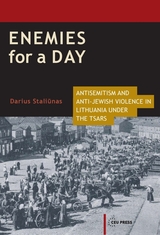
front cover of Enemies for a Day
Enemies for a Day
Antisemitism and Anti-Jewish Violence in Lithuania under the Tsars
Darius Staliunas
Central European University Press, 2015

It begins by illustrating how widespread anti-Jewish feelings were among the Christian population in 19 th century, focusing on blood libel accusations as well as describing the role of modern antisemitism. Secondly, it tries to identify the structural preconditions as well as specific triggers that turned anti-Jewish feelings into collective violence and analyzes the nature of this violence. Lastly, pogroms in Lithuania are compared to anti-Jewish violence in other regions of the Russian Empire and East Galicia.

This research is inspired by the cultural turn in social sciences, an approach that assumes that violence is filled with meaning, which is “culturally constructed, discursively mediated, symbolically saturated, and ritually regulated.” The author argues that pogroms in Lithuania instead followed a communal pattern of ethnic violence and was very different from deadly pogroms in other parts of the Russian Empire.

[more]

logo for Central European University Press
Suffragettes in the Land of the Tsars
Jessie Kenney’s Diary of Revolutionary Russia
Lee Farrow
Central European University Press, 2026
During Russia revolutionary year of 1917, Emmeline Pankhurst and her secretary Jessie Kenney, both well-known suffragettes, traveled to the beleaguered country to talk with Russian women about suffrage, but also to persuade Russia to remain in the war. While there, Pankhurst and Kenney met many leading figures in Russia: Felix Yusupov, the ringleader in the murder of Grigorii Rasputin; members of the Provisional Government, including its president, Alexander Kerensky; and Maria Bochkareva, the commander of the Women’s Death Battalion. They spoke with officials from the YMCA and the Red Cross and gave talks to small groups of women in private homes. Throughout, Kenney kept a diary, which she later turned into a manuscript, “The Price of Liberty.” This volume introduces Kenney’s Russian diary to a general audience, offering a new perspective on the Russian Revolution and facilitating awareness of this unique episode in the story of the British suffrage movement.
[more]


Send via email Share on Facebook Share on Twitter