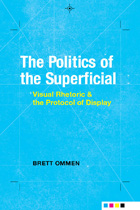
In The Politics of the Superficial: Visual Rhetoric and the Protocol of Display, Brett Ommen explores the increasing reliance on images as a mode of communication in contemporary life. He shows that graphic design is a layered experience of images and space. Before images, viewers engage in the personal experience of aesthetics and individual identity. In space, viewers engage in the negotiation of meaning and collective belonging. Graphic design, then, fits the consumerist present precisely because it prompts viewers to differentiate between our collective commitments and individual sense of self.
Ommen argues, for example, that on viewing a billboard, a driver isn’t merely being exposed to a set of commercial messages or exhortations, but rather responding in a self-aware way that differentiates her from her collective associations like Democrat, Republican, rich, poor, Catholic, or Jewish.
By examining graphic design—as a profession, practice, and academic field—as the nexus for understanding visual display in public culture, The Politics of the Superficial develops two arguments about contemporary visual communication practices: first, that the study of visual communication privileges visual content at the expense of other dynamics, such as context; and second, that interpretations focusing on content conceal the most persuasive and subversive dimensions of the visual.
Wide-ranging and stimulating, The Politics of the Superficial ultimately posits that, far from serving as a communal oasis for public imagination, contemporary visual culture offers the possibility for politically engaged communication and persuasion while simultaneously threatening the health of public discourse by atomizing its constituent parts. It will serve as a vital contribution to the field of visual rhetoric.