
 A SCHOLARLY BOOK REPOSITORY
Results by Title
4 books about Water use
4 books about Water use
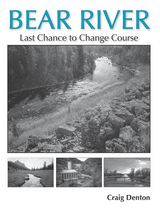
Bear River
Last Chance to Change Course
Craig Denton
Utah State University Press, 2007
Craig Denton notes, “Water will be the primary political, social, and economic issue in the Intermountain West in the twenty-first century.” Urban Utah thirsts for the Great Salt Lake principal source, the Bear River. Plans abound to divert it for a rapidly growing Wasatch Front, as the last good option for future water. But is it? Who now uses the river and how? Who are its stakeholders? What does the Bear mean to them? What is left for further use? How do we measure the Bear's own interest, give it a voice in decisions?
Craig Denton's documentary takes on these questions. He tells the story of the river and the people, of many sorts, with diverse purposes, who live and depend on it. Bear River begins in alpine snowfields, lakes, and creeks in the Uinta Mountains, flows north through Wyoming, loops south in Idaho, and enters the inland sea by way of the an environmentally critical bird refuge. Along the way it has many uses: habitat, farms, electricity, recreation, lawns and homes. Denton researches the natural and human history of the river, photographed it, interviewed many stakeholders, and tried to capture the river perspective. His photographs, printed as crisp duotones, carry us downstream, ultimately to big questions, begging to be answered soon, about what we should and can make of the Bear River. Denton writes,
Gravity my engine,
Water my soul.
I am the teller of life and deep time.
You would measure me.
Sever me.
Own me.
In your name.
Let me flow
In your imagination
That I may speak.
Craig Denton's documentary takes on these questions. He tells the story of the river and the people, of many sorts, with diverse purposes, who live and depend on it. Bear River begins in alpine snowfields, lakes, and creeks in the Uinta Mountains, flows north through Wyoming, loops south in Idaho, and enters the inland sea by way of the an environmentally critical bird refuge. Along the way it has many uses: habitat, farms, electricity, recreation, lawns and homes. Denton researches the natural and human history of the river, photographed it, interviewed many stakeholders, and tried to capture the river perspective. His photographs, printed as crisp duotones, carry us downstream, ultimately to big questions, begging to be answered soon, about what we should and can make of the Bear River. Denton writes,
Gravity my engine,
Water my soul.
I am the teller of life and deep time.
You would measure me.
Sever me.
Own me.
In your name.
Let me flow
In your imagination
That I may speak.
[more]
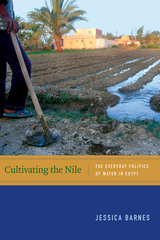
Cultivating the Nile
The Everyday Politics of Water in Egypt
Jessica Barnes
Duke University Press, 2014
The waters of the Nile are fundamental to life in Egypt. In this compelling ethnography, Jessica Barnes explores the everyday politics of water: a politics anchored in the mundane yet vital acts of blocking, releasing, channeling, and diverting water. She examines the quotidian practices of farmers, government engineers, and international donors as they interact with the waters of the Nile flowing into and through Egypt. Situating these local practices in relation to broader processes that affect Nile waters, Barnes moves back and forth from farmer to government ministry, from irrigation canal to international water conference. By showing how the waters of the Nile are constantly made and remade as a resource by people in and outside Egypt, she demonstrates the range of political dynamics, social relations, and technological interventions that must be incorporated into understandings of water and its management.
[more]
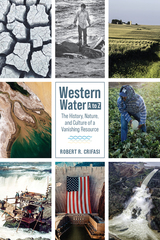
Western Water A to Z
The History, Nature, and Culture of a Vanishing Resource
by Robert R. Crifasi
University Press of Colorado, 2022
Western Water A to Z is the first ever field guide to Western water. Reinventing this twentieth-century genre for a twenty-first-century audience, Robert R. Crifasi answers questions about rivers, water projects, the culture of water, the ecosystems water projects have created or destroyed, and the reliance of cities, farms, and industries on this critical resource.
Organized as a collection of terms, the book addresses the most salient water issues and provides helpful background information regarding their origins and implications. Photographs serve a vital role in the cultural dialogue on water and stand as an equal partner to the text. Each subject is covered in about one page and is accompanied by one or two striking images from famous photographers like Margaret Bourke-White, Carleton E. Watkins, Arthur Rothstein, William Henry Jackson, and Dorothea Lang as well as Crifasi’s own work. Water often finds itself at the center of our cultural discourse in art, cinema, and literature, which play essential roles in shaping our understanding and experience of Western water. Crifasi also engages personalities that are nearly synonymous with Western water—John Wesley Powell, Elwood Mead, and Floyd Dominy, among others—to show how their lives intertwined with and often influenced the course of water development across the region.
Travelers, adventurers, students, and anyone interested in water will find Western Water A to Z a handy and entertaining reference guide.
Organized as a collection of terms, the book addresses the most salient water issues and provides helpful background information regarding their origins and implications. Photographs serve a vital role in the cultural dialogue on water and stand as an equal partner to the text. Each subject is covered in about one page and is accompanied by one or two striking images from famous photographers like Margaret Bourke-White, Carleton E. Watkins, Arthur Rothstein, William Henry Jackson, and Dorothea Lang as well as Crifasi’s own work. Water often finds itself at the center of our cultural discourse in art, cinema, and literature, which play essential roles in shaping our understanding and experience of Western water. Crifasi also engages personalities that are nearly synonymous with Western water—John Wesley Powell, Elwood Mead, and Floyd Dominy, among others—to show how their lives intertwined with and often influenced the course of water development across the region.
Travelers, adventurers, students, and anyone interested in water will find Western Water A to Z a handy and entertaining reference guide.
[more]
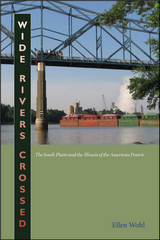
Wide Rivers Crossed
The South Platte and the Illinois of the American Prairie
Ellen E. Wohl
University Press of Colorado, 2013
In Wide Rivers Crossed, Ellen Wohl tells the stories of two rivers—the South Platte on the western plains and the Illinois on the eastern—to represent the environmental history and historical transformation of major rivers across the American prairie. Wohl begins with the rivers’ natural histories, including their geologic history, physical characteristics, ecological communities, and earliest human impacts, and follows a downstream and historical progression from the use of the rivers’ resources by European immigrants through increasing population density of the twentieth century to the present day.
During the past two centuries, these rivers changed dramatically, mostly due to human interaction. Crops replaced native vegetation; excess snowmelt and rainfall carried fertilizers and pesticides into streams; and levees, dams, and drainage altered distribution. These changes cascaded through networks, starting in small headwater tributaries, and reduced the ability of rivers to supply the clean water, fertile soil, and natural habitats they had provided for centuries. Understanding how these rivers, and rivers in general, function and how these functions have been altered over time will allow us to find innovative approaches to restoring river ecosystems.
The environmental changes in the South Platte and the Illinois reflect the relentless efforts by humans to control the distribution of water: to enhance surface water in the arid western prairie and to limit the spread of floods and drain the wetlands along the rivers in the water-abundant east. Wide Rivers Crossed looks at these historical changes and discusses opportunities for much-needed protection and restoration for the future.
During the past two centuries, these rivers changed dramatically, mostly due to human interaction. Crops replaced native vegetation; excess snowmelt and rainfall carried fertilizers and pesticides into streams; and levees, dams, and drainage altered distribution. These changes cascaded through networks, starting in small headwater tributaries, and reduced the ability of rivers to supply the clean water, fertile soil, and natural habitats they had provided for centuries. Understanding how these rivers, and rivers in general, function and how these functions have been altered over time will allow us to find innovative approaches to restoring river ecosystems.
The environmental changes in the South Platte and the Illinois reflect the relentless efforts by humans to control the distribution of water: to enhance surface water in the arid western prairie and to limit the spread of floods and drain the wetlands along the rivers in the water-abundant east. Wide Rivers Crossed looks at these historical changes and discusses opportunities for much-needed protection and restoration for the future.
[more]
READERS
Browse our collection.
PUBLISHERS
See BiblioVault's publisher services.
STUDENT SERVICES
Files for college accessibility offices.
RECENTLY PUBLISHED




UChicago Accessibility Resources
home | accessibility | search | about | contact us
BiblioVault ® 2001 - 2026
The University of Chicago Press