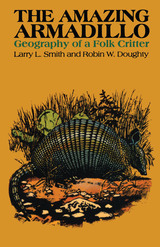
front cover of The Amazing Armadillo
The Amazing Armadillo
Geography of a Folk Critter
By Larry L. Smith and Robin W. Doughty
University of Texas Press, 1984

Perhaps no creature has so fired the imagination of a populace as the armadillo—that most ungainly, awkward, and timid little animal. Its detractors call it a varmint and wish it good speed from the Lone Star State and its other natural territories. But its supporters claim that it is the animal kingdom's representative of all that's truly Texan: tough, pioneering, adaptable, and generous in sharing its habitation with others. What is it that sets this quizzical little creature apart from the rest of the animal kingdom?

Larry L. Smith and Robin W. Doughty ably answer this question in The Amazing Armadillo: Geography of a Folk Critter. This informative book traces the spread of the nine-banded armadillo from its first notice in South Texas late in the 1840s to its current range east to Florida and north to Missouri. The authors look at the armadillo's natural history and habitat as well as the role of humans in promoting its spread, projecting that the animal is increasing in both range and number, continuing its ecological success in areas where habitat and climate are favorable.

The book also contributes to a long-standing research theme in geography—the relationship between humans and wildlife. It explores the armadillo's value to the medical community in current research in Hansen's Disease (leprosy) as well as commercial uses, and abuses, of the armadillo in recent times. Of particular note is the author's engaging look at the armadillo as a symbol of popular culture, the efforts now underway to make it a "totem animal" symbolizing the easy-going lifestyles of some Sunbelt cities, and the spread of the craze for armadilliana to other urban centers.
[more]

front cover of American Fish and Wildlife Policy
American Fish and Wildlife Policy
The Human Dimension
Edited by William R. Mangun
Southern Illinois University Press, 1992

These eleven original essays by leading wildlife management and public policy scholars deal with policy issues, management perspectives, and the public attitudes about wildlife that shape the world of the wildlife manager.

Part 1 contains William R. Mangun’s introductory essay "Fish and Wildlife Policy Issues" and Daniel J. Decker et al.’s "Toward a Comprehensive Paradigm of Wildlife."

Ann H. Harvey’s "Interagency Conflict and Coordination in Wildlife Management," Philip S. Cook and Ted T. Cable’s "Developing Policy for Public Access to Private Land," and Debra A. Rose’s "Implementing Endangered Species Policy" make up part 2.

Part 3 consists of Cliff Hamilton’s "Pursuing a New Paradigm in Funding State Fish and Wildlife Programs" and Trellis G. Green’s "Use of Economics in Federal and State Fishery Allocation Decisions."

The fourth part includes James J. Kennedy and Jack Ward Thomas’s "Exit, Voice, and Loyalty of Wildlife Biologists in Public Natural Resource/Environmental Agencies"; Jean C. Mangun et al.’s "Nonconsumptive Wildlife-Associated Recreation in the United States"; and Barbara A. Knuth’s "Natural Resource Hazards: Managing to Protect People from the Resource."

In part 5, Joseph F. Coates looks to the future in "Public Policy Actors and Futures."
[more]

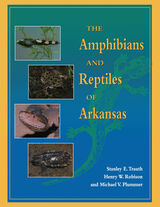
front cover of The Amphibians and Reptiles of Arkansas
The Amphibians and Reptiles of Arkansas
Stanley E. Trauth
University of Arkansas Press, 2004
The product of fifteen years of work by top herpetologists, this book is a comprehensive examination of the amphibians and reptiles of Arkansas, featuring over 136 species and subspecies. With over five hundred four-color photos, line drawings, and over one hundred maps, this user-friendly book will become the definitive text on the subject.
[more]

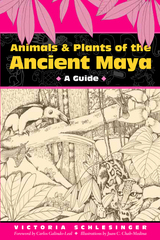
front cover of Animals and Plants of the Ancient Maya
Animals and Plants of the Ancient Maya
A Guide
By Victoria Schlesinger
University of Texas Press, 2002

A growing interest in all things Maya brings an increasing number of visitors to prehistoric Maya ruins and contemporary Maya communities in Guatemala, Belize, El Salvador, western Honduras, the Yucatán Peninsula, and the southern areas of Chiapas and Tabasco, Mexico. For these visitors and indeed everyone with an interest in the Maya, this field guide highlights nearly 100 species of plants and animals that were significant to the ancient Maya and that continue to inhabit the Maya region today.

Drawing from the disciplines of biology, ecology, and anthropology, Victoria Schlesinger describes each plant or animal's habitat and natural history, identifying characteristics (also shown in a black-and-white drawing), and cultural significance to the ancient and contemporary Maya. An introductory section explains how to use the book and offers a concise overview of the history, lifeways, and cosmology of the ancient Maya. The concluding section describes the collapse of ancient Maya society and briefly traces the history of the Maya region from colonial times to the present.

[more]

front cover of Big Game in Alaska
Big Game in Alaska
A History of Wildlife and People
Morgan Sherwood
University of Alaska Press, 2008
With the Klondike gold rush, a struggle erupted in Alaska between the protection of big game animals and man’s economic ambitions, a riveting story chronicled by Morgan Sherwood in Big Game in Alaska.

In concise and clear prose, Sherwood charts the history of this environmental and political conflict, examining the creation of the Alaska Game Commission in the early 1930s, the use of distorted science and menacing technologies, the antipathy of farmers and fishermen toward animals, and the prevailing belief in man’s right to shoot wild animals at will. An incisive historical study of the flawed attempts to govern big game predation, Big Game in Alaska will be essential reading for historians and environmentalists alike.
 
[more]

front cover of The Buffalo Book
The Buffalo Book
The Full Saga Of The American Animal
David A. Dary
Ohio University Press, 1989
The journals and memoirs of nineteeth-century explorers and travelers in the American West often told of viewing buffalo massed together as far as the eye could see. This book appropriately covers the subject of the buffalo as extensively as that animal covered the plains. Other recent accounts of the buffalo have focused on two or three aspects, emphasizing its natural history, the hunters and the hunted in prehistoric time, the relationship between the buffalo and the American Indian. David Dary’s treatment stretches from horizon to horizon. Of course he discusses the origin of the buffalo in North America, its locations and migrations, its habits, its significance and role in both Indian and white cultures, its near demise, its salvation. But more. Dary weaves throughout his fact-filled book fascinating threads of lore and legend of this animal that literally helped mold who and what America is. Further, in addition to detailing the extinction which almost befell this mythic beast and the attempts to give life again to the herds, Dary concentrates significant attention on the buffalo as part of America in terms of captivity, husbandry, and symbol.
[more]

front cover of The Cadottes
The Cadottes
A Fur Trade Family on Lake Superior
Robert Silbernagel
Wisconsin Historical Society Press, 2026
The Great Lakes fur trade spanned two centuries and thousands of miles, but the story of one particular family, the Cadottes, illuminates the history of trade and trapping while exploring under-researched stories of French-Ojibwe political, social, and economic relations. Multiple generations of Cadottes were involved in the trade, usually working as interpreters and peacemakers, as the region passed from French to British to American control. Focusing on the years 1760 to 1840—the heyday of the Great Lakes fur trade—Robert Silbernagel delves into the lives of the Cadottes, with particular emphasis on the Ojibwe–French Canadian Michel Cadotte and his Ojibwe wife, Equaysayway, who were traders and regional leaders on Madeline Island for nearly forty years. In The Cadottes: A Fur Trade Family on Lake Superior, Silbernagel deepens our understanding of this era with stories of resilient, remarkable people.
[more]

front cover of The Cadottes
The Cadottes
A Fur Trade Family on Lake Superior
Robert Silbernagel
Wisconsin Historical Society Press, 2023
The Great Lakes fur trade spanned two centuries and thousands of miles, but the story of one particular family, the Cadottes, illuminates the history of trade and trapping while exploring under-researched stories of French-Ojibwe political, social, and economic relations. Multiple generations of Cadottes were involved in the trade, usually working as interpreters and peacemakers, as the region passed from French to British to American control. Focusing on the years 1760 to 1840—the heyday of the Great Lakes fur trade—Robert Silbernagel delves into the lives of the Cadottes, with particular emphasis on the Ojibwe–French Canadian Michel Cadotte and his Ojibwe wife, Equaysayway, who were traders and regional leaders on Madeline Island for nearly forty years. In The Cadottes: A Fur Trade Family on Lake Superior, Silbernagel deepens our understanding of this era with stories of resilient, remarkable people.
[more]

front cover of Canoe Country Wildlife
Canoe Country Wildlife
A Field Guide to the North Woods and Boundary Waters
Mark Stensaas
University of Minnesota Press, 2004

Warblers, wolves, and whirligig beetles—the creatures of the canoe countrywilderness come alive in Canoe Country Wildlife. In this read-aloud treasure, “Sparky” Stensaas, naturalist and storyteller, intrigues you with his tales of encounters with the forest inhabitants—from tiny toads to majestic moose.

Canoe Country Wildlife, a friendly field guide, introduces you to the wildlife you are most likely to see as you travel in the North Woods. It describes these creatures and their habits accurately so you’ll know where and when to look for them. Detailed line drawings illustrate each animal clearly so you’ll recognize what you’re seeing.

The book is filled with fascinating little-known facts: Did you know that wood frogs can freeze solid, only to live again? That loons can fly a hundred miles an hour? That chipmunks can carry seventy sunflower seeds in their cheeks?

Canoe Country Wildlife includes handy checklists to help you keep track of the critters you encounter, a calendar for you to record the natural events you witness, and activities—one for each animal—that will help both adults and children learn by discovery.

Carry Canoe Country Wildlife in your pack. Your trip will be more enjoyable and your memories will last forever. It’s a great gift for anyone who loves the outdoors.

[more]

front cover of Christianity, Wilderness, and Wildlife
Christianity, Wilderness, and Wildlife
Susan Bratton
University of Scranton Press, 2009
In Christianity, Wilderness, and Wildlife, Susan Bratton brings to life the tradition of Christian wilderness spirituality, from Noah’s and Moses’ experiences in the Old Testament to Celtic monasteries and the Franciscan order. She traces a long history of divine encounters in biblical literature such as visions, providential protection, spiritual guidance and calls to leadership—all of which highlight the importance of nature in Christian thought. This book will command the attention of the growing audience for works at the intersection of environment and spirituality.
[more]

front cover of Cougar
Cougar
Ecology and Conservation
Edited by Maurice Hornocker and Sharon Negri
University of Chicago Press, 2009

The cougar is one of the most beautiful, enigmatic, and majestic animals in the Americas. Eliciting reverence for its grace and independent nature, it also triggers fear when it comes into contact with people, pets, and livestock or competes for hunters’ game. Mystery, myth, and misunderstanding surround this remarkable creature.

The cougar’s range once extended from northern Canada to the tip of South America, and from the Pacific to the Atlantic, making it the most widespread animal in the western hemisphere. But overhunting and loss of habitat vastly reduced cougar numbers by the early twentieth century across much of its historical range, and today the cougar faces numerous threats as burgeoning human development encroaches on its remaining habitat.

When Maurice Hornocker began the first long-term study of cougars in the Idaho wilderness in 1964, little was known about this large cat. Its secretive nature and rarity in the landscape made it difficult to study. But his groundbreaking research yielded major insights and was the prelude to further research on this controversial species.

The capstone to Hornocker’s long career studying big cats, Cougar is a powerful and practical resource for scientists, conservationists, and anyone with an interest in large carnivores.  He and conservationist Sharon Negri bring together the diverse perspectives of twenty-two distinguished scientists to provide the fullest account of the cougar’s ecology, behavior, and genetics, its role as a top predator, and its conservation needs. This compilation of recent findings, stunning photographs, and firsthand accounts of field research unravels the mysteries of this magnificent animal and emphasizes its importance in healthy ecosystem processes and in our lives.

[more]

front cover of A Country So Full of Game
A Country So Full of Game
The Story of Wildlife in Iowa
James J. Dinsmore
University of Iowa Press, 1994
Indian agent Joseph Street said it well in 1833 when he described his trip across Iowa: “I had never rode through a country so full of game.” In the early 1800s Iowa's deep soil, free-flowing rivers and streams, and favorable climate had combined to produce the welcoming habitats that supported a surprising variety of animals. In his engaging, intelligent book, James Dinsmore has created the first comprehensive history of this abounding wildlife from the arrival of Euro-American explorers to the present day.

Based on a thorough search of hundreds of primary sources ranging from chronicles of military expeditions to field reports by early naturalists, first-person accounts by fur traders and hunters to up-to-date county checklists, A Country So Full of Game examines the dramatic encounters of humans with elk, black bears, passenger pigeons, bobcats, prairie-chickens, otters, and many more. Each chapter discusses the animal's status and distribution when explorers first arrived in Iowa, how it was hunted or trapped, how this exploitation affected its population, and what its current status is both in Iowa and nationally. Enhanced by Mark Müller's distinctive drawings, commissioned for this book, the anecdotes evoke a sense of loss and wonder at the magic abundance of Iowa's wildlife.

Iowa has been changed more than, perhaps, any other state. We can mourn the disappearance of the bison and mountain lion while we marvel at the recent success of the wild turkey and white-tailed deer. Listening to James Dinsmore tell the story of wildlife in Iowa can open a window onto the future as other areas of our planet are increasingly altered by humans. A Country So Full of Game will allow all naturalists, both amateur and professional, hunter and biologist, to appreciate and learn from Iowa's diverse wild heritage.
[more]

front cover of Creatures Of Habitat
Creatures Of Habitat
The Changing Nature of Wildlife and Wild Places in Utah and the Intermountain West
Mark Gerard Hengesbaugh
Utah State University Press, 2001

From flying squirrels on high wooded plateaus to hanging gardens in redrock canyons, the Intermountain West is home to some of the world's rarest and most fascinating animals and plants. Creatures of Habitat details many unique but little-known talents of this region's strange and wonderful wild inhabitants and descibes their connections with native environments. For example, readers will learn about the pronghorn antelope's supercharged cardiovascular system, a brine shrimp-powered shorebird that each year flies nonstop from the Great Salt Lake to Central Argentina, and a rare mustard plant recently discovered on Mount Ogden. Emphasizing how increasing loss and degradation of habitat hinders native species' survival, Mark Gerard Hengesbaugh discusses what is happening to wildlife and wild places and what is being done about it.

Well illustrated, this book has habitat maps, pen-and-ink illustrations, and fifty photos of wildlife and wild places selected by photo editor Dan Miller. Also included are guides to wildlife viewing and lists of Utah species, including those considered sensitive, threatened, or endangered.

[more]

logo for University of Minnesota Press
Developing Animals
Wildlife and Early American Photography
Matthew Brower
University of Minnesota Press, 2010
Pictures of animals are now ubiquitous, but the ability to capture animals on film was a significant challenge in the early era of photography. In Developing Animals, Matthew Brower takes us back to the time when Americans started taking pictures of the animal kingdom, at the beginning of the twentieth century, the moment when photography became a mass medium and wildlife photography an increasingly popular genre.

Developing Animals compellingly investigates the way photography changed our perception of animals. Brower analyzes how photographers created new ideas about animals as they moved from taking pictures of taxidermic specimens in so-called natural settings to the emergence of practices such as camera hunting, which made it possible to capture images of creatures in the wild.

By combining approaches in visual cultural studies and the history of photography, Developing Animals goes further to argue that photography has been essential not only to the understanding of wildlife but also to the conceptual separation of humans and animals.
[more]

front cover of Electric Animal
Electric Animal
Toward a Rhetoric of Wildlife
Akira Mizuta Lippit
University of Minnesota Press, 2000

A fascinating exploration of the symbolic place animals hold within our culture.

Differentiation from animals helped to establish the notion of a human being, but the disappearance of animals now threatens that identity. This is the argument underlying Electric Animal, a probing exploration of the figure of the animal in modern culture. Akira Mizuta Lippit shows us the animal as a crucial figure in the definition of modernity—essential to developments in the natural sciences and technology, radical transformations in modern philosophy and literature, and the advent of psychoanalysis and the cinema.

Moving beyond the dialectical framework that has traditionally bound animal and human being, Electric Animal raises a series of questions regarding the idea of animality in Western thought. Can animals communicate? Do they have consciousness? Are they aware of death? By tracing questions such as these through a wide range of texts by writers ranging from Friedrich Nietzsche to Jacques Derrida, Sigmund Freud to Vicki Hearne, Lewis Carroll to Franz Kafka, and Sergei Eisenstein to Gilles Deleuze, Lippit arrives at a remarkable thesis, revealing an extraordinary logical consensus in Western thought: animals do not have language and hence cannot die. The animal has, accordingly, haunted thought as a form of spectral and undead being. Lippit demonstrates how, in the late nineteenth century, this phantasmic concept of animal being reached the proportions of an epistemological crisis, engendering the disciplines and media of psychoanalysis, modern literature, and cinema, among others. Against the prohibitive logic of Western philosophy, these fields opened a space for rethinking animality. Technology, usually thought of in opposition to nature, came to serve as the repository for an unmournable animality-a kind of vast wildlife museum. A highly original work that charts new territory in current debates over language and mortality, subjectivity and technology, Electric Animal brings to light fundamental questions about the status of representation—of the animal and of ourselves—in the age of biomechanical reproduction.
[more]

front cover of Exploiting the Wilderness
Exploiting the Wilderness
An Analysis of Wildlife Crime
Greg L. Warchol
Temple University Press, 2017

Illegally harvested ivory and endangered plants, mammals, reptiles, birds, and even insects are easily found for sale throughout East and Southern Africa. And this is just one part of the multi-billion-dollar illegal global trade in wildlife. 

Wildlife is an important and even vital asset for both intrinsic and economic reasons. Yet it is illegally exploited on a massive scale to the point where some species now risk extinction. Exploiting the Wilderness provides a concise overview of this shameful business, describing some of the main species being exploited and examining select wildlife whose survival is imperiled due to heavy pressure from poachers to meet consumer demand. 

Greg Warchol draws on his firsthand experience and research in Africa to examine the structure and operation of the illegal trade in wildlife. He identifies the participants as well as their motivations and operations, and explains the behavior of poachers, traffickers, and consumers of illegally obtained goods. He concludes with a description of legislative and law enforcement efforts to control and prevent wildlife exploitation along with a number of contemporary conservation initiatives designed to improve the ability of rangers to protect wildlife.

[more]

front cover of Game Management
Game Management
Aldo Leopold
University of Wisconsin Press, 1986

With this book, published more than a half-century ago, Aldo Leopold created the discipline of wildlife management. Although A Sand Country Almanac is doubtless Leopold’s most popular book, Game Management may well be his most important. In this book he revolutionized the field of conservation.

[more]

front cover of In Search of the Rain Forest
In Search of the Rain Forest
Candace Slater, ed.
Duke University Press, 2004
The essays collected here offer important new reflections on the multiple images of and rhetoric surrounding the rain forest. The slogan “Save the Rain Forest!”—emblazoned on glossy posters of tall trees wreathed in vines and studded with monkeys and parrots—promotes the popular image of a marvelously wild and vulnerable rain forest. Although representations like these have fueled laudable rescue efforts, in many ways they have done more harm than good, as these essays show. Such icons tend to conceal both the biological variety of rain forests and the diversity of their human inhabitants. They also frequently obscure the specific local and global interactions that are as much a part of today’s rain forests as are the array of plants and animals. In attending to these complexities, this volume focuses on specific portrayals of rain forests and the consequences of these characterizations for both forest inhabitants and outsiders.

From diverse disciplines—history, archaeology, sociology, literature, law, and cultural anthropology—the contributors provide case studies from Latin America, Asia, and Africa. They point the way toward a search for a rain forest that is both a natural entity and a social history, an inhabited place and a shifting set of ideas. The essayists demonstrate how the single image of a wild and yet fragile forest became fixed in the popular mind in the late twentieth century, thereby influencing the policies of corporations, environmental groups, and governments. Such simplistic conceptions, In Search of the Rain Forest shows, might lead companies to tout their “green” technologies even as they try to downplay the dissenting voices of native populations. Or they might cause a government to create a tiger reserve that displaces peaceful peasants while opening the doors to poachers and bandits. By encouraging a nuanced understanding of distinctive, constantly evolving forests with different social and natural histories, this volume provides an important impetus for protection efforts that take into account the rain forest in all of its complexity.

Contributors. Scott Fedick, Alex Greene, Paul Greenough, Nancy Peluso, Suzana Sawyer, Candace Slater, Charles Zerner

[more]

front cover of Into Africa
Into Africa
Craig Packer
University of Chicago Press, 1994
Craig Packer takes us into Africa for a journey of fifty-two days in the fall of 1991. But this is more than a tour of magnificent animals in an exotic, faraway place. A field biologist since 1972, Packer began his work studying primates at Gombe and then the lions of the Serengeti and the Ngorongoro Crater with his wife and colleague Anne Pusey. Here, he introduces us to the real world of fieldwork—initiating assistants to lion research in the Serengeti, helping a doctoral student collect data, collaborating with Jane Goodall on primate research.

As in the works of George Schaller and Cynthia Moss, Packer transports us to life in the field. He is addicted to this land—to the beauty of a male lion striding across the Serengeti plains, to the calls of a baboon troop through the rain forests of Gombe—and to understanding the animals that inhabit it. Through his vivid narration, we feel the dust and the bumps of the Arusha Road, smell the rosemary in the air at lunchtime on a Serengeti verandah, and hear the lyrics of the Grateful Dead playing off bootlegged tapes.

Into Africa also explores the social lives of the animals and the threats to their survival. Packer grapples with questions he has passionately tried to answer for more than two decades. Why do female lions raise their young in crèches? Why do male baboons move from troop to troop while male chimps band together? How can humans and animals continue to coexist in a world of diminishing resources? Immediate demands—logistical nightmares, political upheavals, physical exhaustion—yield to the larger inescapable issues of the interdependence of the land, the animals, and the people who inhabit it.
[more]

front cover of Iowa's Changing Wildlife
Iowa's Changing Wildlife
Three Decades of Gain and Loss
James J. Dinsmore
University of Iowa Press, 2023
Much has changed with Iowa’s wildlife in the years 1990 to 2020. Some species such as Canada goose, wild turkey, and white-tailed deer that once were rare in Iowa are now common, and others like sandhill crane, river otter, and trumpeter swan are becoming increasingly abundant. Iowa’s Changing Wildlife provides an up-to-date, scientifically based summary of changes in the distribution, status, conservation needs, and future prospects of about sixty species of Iowa’s birds and mammals whose populations have increased or decreased in the past three decades. Readers will learn more about familiar species, become acquainted with the status of less familiar species, and find out how many of the species around them have fared during this era of transformation.
 
[more]

front cover of The Last Panda
The Last Panda
George B. Schaller
University of Chicago Press, 1993
Dependent on a shrinking supply of bamboo, hunted mercilessly for its pelt, and hostage to profiteering schemes once in captivity, the panda is on the brink of extinction. Here, acclaimed naturalist George Schaller uses his great evocative powers, and the insight gained by four and a half years in the forests of the Wolong and Tangjiahe panda reserves, to document the plight of these mysterious creatures and to awaken the human compassion urgently needed to save them.

"No scientist is better at letting the rest of us in on just how the natural world works; no poet sees the world with greater clarity or writes about it with more grace. . . . Anyone who genuinely cares for wildlife cannot help being grateful to Schaller—both for his efforts to understand the panda and for the candor with which he reports what has gone so badly wrong in the struggle to save it from extinction."—Geoffrey C. Ward, New York Times Book Review


"Schaller's book is a unique mix of natural history and the politics of conservation, and it makes for compelling reading. . . . Having been in giant panda country myself, I found some of the descriptions of the animals and habitats breathtaking. Schaller describes the daily routines and personalities of the giant pandas he studied (as well as their fates thereafter) as though they were his blood relatives. . . . Schaller's brilliant presentation of the complexities of conservation makes his book a milestone for the conservation movement."—Devra G. Kleiman, Washington Post Book World


"George Schaller's most soulful work, written in journal style with many asides about a creature who evolved only two to three million years ago (about the same time as humans). . . . Here, conservation biology confronts an evil that grinds against hope and shatters the planet's diversity. Written with hope."—Whole Earth Catalog


"A nicely crafted blend of wildlife observation and political-cultural analysis. . . . The Last Panda is a sad chronicle of our failure, so far, to stem the decline of the animal that may be the most beloved on the planet."—Donald Dale Jackson, Smithsonian
[more]

front cover of Listening to Cougar
Listening to Cougar
Marc Bekoff
University Press of Colorado, 2007
This spellbinding tribute to Puma concolor honors the big cat's presence on the land and in our psyches. In some essays, the puma appears front and center: a lion leaps over Rick Bass's feet, hurtles off a cliff in front of J. Frank Dobie, gazes at Julia Corbett when she opens her eyes after an outdoor meditation, emerges from the fog close enough for poet Gary Gildner to touch. Marc Bekoff opens his car door for a dog that turns out to be a lion. Other works evoke lions indirectly. Biologists describe aspects of cougar ecology, such as its rugged habitat and how males struggle to claim territory. Conservationists relate the political history of America's greatest cat. Short stories and essays consider lions' significance to people, reflecting on accidental encounters, dreams, Navajo beliefs, guided hunts, and how vital mountain lions are to people as symbols of power and wildness.

Contributors include: Rick Bass, Marc Bekoff, Janay Brun, Julia B. Corbett, Deanna Dawn, J. Frank Dobie, Suzanne Duarte, Steve Edwards, Joan Fox, Gary Gildner, Wendy Keefover-Ring, Ted Kerasote, Christina Kohlruss, Barry Lopez, BK Loren, Cara Blessley Lowe, Steve Pavlik, David Stoner, and Linda Sweanor.

Marc Bekoff has published twenty books, including The Emotional Lives of Animals, and is a professor emeritus of ecology and evolutionary biology at the University of Colorado at Boulder. Writer and photographer Cara Blessley Lowe is author of Spirit of the Rockies and co-founder of The Cougar Fund.

BK Loren, in Listening to Cougar: "If the lion, in all its dark, nocturnal otherness, in all its light, internal sameness, does not exist for future generations, if we destroy its habitat, or call open season on it, what could we possibly find to replace it? It is precisely because we fear large predators that we need them. They hold within them so many things that we have lost, or are on the verge of losing, personally and collectively, permanently and forever. If we sacrifice the fear, we also sacrifice the strength, the wildness, the beauty, the awe." Foreword by Jane Goodall

[more]

front cover of The Lone Wolverine
The Lone Wolverine
Tracking Michigan's Most Elusive Animal
Elizabeth Philips Shaw and Jeff Ford
University of Michigan Press, 2012

It began in late winter of 2004. Almost 100 years had passed since the last spotting of a wild wolverine in Michigan when coyote hunters caught a glimpse of one of the animals in a frozen farm field in the northern thumb region. For the next six years, Jeff Ford, a local science teacher and amateur naturalist, devoted himself to locating and filming the wolverine that had unexpectedly and inexplicably appeared in the Wolverine State. By the time hikers found the animal dead in early 2010, Ford had taken hundreds of rare live action photos and shot numerous hours of video, with the story of the "Wolverine Guy" attracting national attention through countless newspaper and magazine articles and appearances on Animal Planet and PBS Nature.

This is the tale of Ford's quest as he uncovered answers to mysteries surrounding the animal's territory and movement patterns, while sparking a flurry of controversy surrounding the elusive predator's origin, much of which remains unresolved today. It's an intimate look at research in the raw, from DNA samples stuck on barbed wire to a sophisticated, motion-sensing infrared camera unit strategically placed to observe nocturnal behavior.

The Lone Wolverine brings to vivid life this unforgettable piece of American wildlife lore, using candid interviews, public records, and Ford's own vast storehouse of notes, personal writings, correspondence, and images, offering an extraordinary chronicle of a wild wolverine in its natural habitat, at play and in fierce competition for food and survival. This is a wildlife detective story, recounting years of study and fierce debate as researchers pondered the riddles of Michigan's last wolverine---her origins, habits, and ultimately the cause of her untimely death.

[more]

front cover of Mammals of the Southeastern United States
Mammals of the Southeastern United States
Troy L. Best and John L. Hunt
University of Alabama Press, 2020

First comprehensive account of the mammals of the entire southeastern US

The southeastern United States is home to a remarkable and diverse mammalian fauna that is a significant part of the region’s rich natural heritage. Mammals of the Southeastern United States presents accounts of 137 species that currently or previously occurred in the Southeast. Although accessible and useful for the generalist, this book provides an up-to-date compilation of basic knowledge about native and nonnative mammals of the region that is suitable for students of all ages and for professional mammalogists and biologists alike.
 
This volume profiles common species like the eastern gray squirrel, the white-tailed deer, and the Virginia opossum, but also includes among its accounts many extant species, such as the jaguar and porcupine, that once occurred in the region; native species, like the Caribbean monk seal, that are now extinct; native species that have been extirpated, or wiped out, from all or part of the region, such as the red wolf, cougar, American bison, and elk; and many introduced species, including the Mexican mouse opossum, common squirrel monkey, and capybara.
 
Each species account includes full-color images of the animal, plates featuring at least three views of its skull, color distribution maps of its approximate geographic range in the Southeast and in North America, and an up-to-date synthesis of several aspects of its biology, including habitat, diet, predators, parasites, diseases, and behaviors. An introductory chapter on conservation summarizes the current status of mammalian populations in the region and provides insight into some of the threats mammals now encounter in the Southeast.
 

[more]

front cover of Mexican Wilderness and Wildlife
Mexican Wilderness and Wildlife
By Ben Tinker
University of Texas Press, 1978

From the mountainous area bordering Arizona and New Mexico, the western range of the Sierra Madres reaches south into Mexico to the state of Jalisco. The eastern range stretches from the Texas border down to Morelia and the Valley of Mexico. Ben Tinker spent years exploring this rugged wilderness and the vast deserts of Sonora and Baja California. Mexican Wilderness and Wildlife condenses a lifetime of outdoor lore and learning.

Tinker provides detailed life sketches of Mexico's Desert Bighorn Sheep, Pronghorn Antelope, Mule Deer, Whitetail Deer, Peccary, Grizzly and Black Bears, Wild Turkey, Jaguar, Mountain Lion, Timber Wolf, Coyote, and Bobcat. Each is illustrated by wildlife artist Doris Tischler, and Tinker describes their habitats, habits, reproduction, and peculiarities. Information is supplied on the physical measurements of several species of major wildlife. Tinker's observations are laced with anecdotes about his experiences in Mexico's remote backcountry—encounters with bandits, survival in the desert mountains, and the chance discovery of archaeological ruins.

The book describes the terrain and flora of the four life zones inhabited by major game and predatory animals. The section on desert water is a fascinating account of how animals thrive among cacti, thorn trees, and creosote bush remote from streams and waterholes. There is also a brief discussion of conservation efforts in Mexico, chapters on trout fishing in the Sierra Madre Occidental and Baja California, and a guide to big game habitats. This volume will be valuable to hunters, conservationists, naturalists, and others interested in the wilderness and wildlife of Mexico.

Ben Tinker collected much of the material for this book during the years he roamed northern Mexico as Federal Game Guardian. Though an American, Tinker had long been familiar with Mexican wildlife through his Sonoran ranching operation and was known for his interest in conservation when he was appointed by Alvaro Obregón in 1922.

[more]

front cover of Mule Deer
Mule Deer
A Handbook for Utah Hunters and Landowners
Dennis D. Austin
Utah State University Press, 2010

A complete guide to the history, biology, hunting, and management of mule deer in Utah. The author, Dennis D. Austin, is a retired research scientist with more than thirty years of experience working as a wildlife biologist for the Utah Division of Wildlife Resources.

[more]

front cover of Prairie Ghost
Prairie Ghost
Pronghorn and Human Interaction in Early America
Richard E. McCabe
University Press of Colorado, 2010

A Wildlife Management Institute Book

In this lavishly illustrated volume Richard E. McCabe, Bart W. O'Gara and Henry M. Reeves explore the fascinating relationship of pronghorn with people in early America, from prehistoric evidence through the Battle of Little Bighorn in 1876. The only one of fourteen pronghorn-like genera to survive the great extinction brought on by human migration into North America, the pronghorn has a long and unique history of interaction with humans on the continent, a history that until now has largely remained unwritten.

 With nearly 150 black-and-white photographs, 16 pages of color illustrations, plus original artwork by Daniel P. Metz, Prairie Ghost: Pronghorn and Human Interaction in Early America tells the intriguing story of humans and these elusive big game mammals in an informative and entertaining fashion that will appeal to historians, biologists, sportsmen and the general reader alike.

Winner of the Wildlife Society's Outstanding Book Award for 2005

[more]

front cover of Rocky Mountain Mammals
Rocky Mountain Mammals
A Handbook of Mammals of Rocky Mountain National Park and Vicinity, Third Edition
David M. Armstrong
University Press of Colorado, 2008
Revised, updated, and with more than 80 new color photographs, Rocky Mountain Mammals, Third Edition is a nontechnical guide to the mammals of the Southern Rocky Mountains and their foothills, with special emphasis on Rocky Mountain National Park and vicinity.

Designed for quick reference and enjoyable reading, Rocky Mountain Mammals offers what most field guides don't - a wealth of fascinating information about each species. In seventy-two species accounts, David M. Armstrong describes each animal and its signs, habits, habitat, and natural history, noting times when seasonal events such as elk sparring occur.

Introductory materials and appendices offer rich context and wildlife-watching support, including a checklist with page numbers for quick field reference, an identification key, a glossary, derivations of scientific names, and advice on how, when, and where to watch mammals. Armstrong introduces mammalian evolution, anatomy, and distribution and offers perspective on how the local fauna fits into its geographical setting and into past and potential future faunas of the region.

This lavishly illustrated new edition will delight those who live in and visit the high country and foothills of the Southern Rockies and want to identify mammals and learn about their lives. Published in association with the Rocky Mountain Nature Association.

[more]

front cover of Snake Day
Snake Day
A Story of 24 Hours and 24 Serpentine Lives
Marty Crump
University of Chicago Press, 2026
An hourly guide that follows twenty-four snakes as they find mates, hunt, and survive a changing world.

Does a snake crossing your path trigger delight or dread? The answer is clear for celebrated biologist Marty Crump, who shows us that snakes deserve our respect, admiration, and protection. In her short book Snake Day, each chapter introduces a single snake during a single hour, highlighting twenty-four different species from around the globe. 

In the dark morning of a Brazilian forest, we avoid stepping on a jararaca, a nocturnal viper. If she bites, her venom will make our blood pressure—and us—drop. A synthetic version of this venom is now a lifesaving drug, used to treat hypertension and heart failure. Later in the morning, in the Zagros Mountains that trace Iran’s northwest border, what appears to be a tiny arachnid wiggles on the ground. When a hungry warbler approaches for a meal, realizes too late that the spider is actually a snake’s tail, and an Iranian spider-tailed viper makes a meal of the bird. In the early afternoon, in a pine forest outside Atlanta, Georgia, an eastern hognose snake strikes at us—a bluff—and then rolls over and plays dead. By the end of our snake day, we’ll have glimpsed the diversity of this unique group of reptiles, met serpentine friends who frighten and fascinate, and learned how humans can protect these amazing species.

For each hour, celebrated artist Stuart Patience has depicted serpentine scenes in stunning pen-and-ink drawings. Working together to narrate and illustrate these unique moments in time, Crump and Patience have created an engaging read that is a perfect way to spend an hour or two—and a true gift for amateur scientists or anyone who recoils at or relishes the sight of a snake.
[more]

front cover of So Great Was the Slaughter
So Great Was the Slaughter
Market Hunters, Sportsmen, and Wildlife Conservation in Arkansas
Buckley T. Foster
University of Alabama Press, 2025

Winner of the 2026 J.G. Ragsdale Book Award

So Great Was the Slaughter reveals the untold story of Arkansas conservation pioneers who saved the state’s game and fish populations. As Arkansas entered the twentieth century, the national demand for meat combined with the ability to ship millions of animals to hungry cities like New Orleans, Memphis, and Chicago had driven many species, including bison and passenger pigeons, to extinction in Arkansas. Many others, including deer, bear, turkey, quail, and fish, were in danger of disappearing.

In response, an unlikely coalition of Arkansas sportsmen, hunters, and conservationists created a vision for conservation legislation, game laws, and the establishment of fish hatcheries and wildlife refuges. With support from influential outsiders like E. A. McIlhenny and the United States Biological Survey, they waged a long battle against entrenched political and commercial interests.

Buckley Foster’s meticulous research reveals how these pioneers fought to save the state’s wildlife resources from destruction and laid the foundations for sustainable, modern wildlife management in Arkansas. So Great Was the Slaughter will fascinate hunters, conservationists, historians, and those interested in the history of wildlife conservation and conflicts between market hunters and sportsmen in the United States and the American South.

[more]

front cover of Through a Naturalist's Eyes
Through a Naturalist's Eyes
Exploring the Nature of New England
Michael J. Caduto
University Press of New England, 2016
For native and visitor alike, the New England landscape has a rich allure. This grand sweep of land is a living tapestry woven of interconnected bioregions and natural communities whose compositions of plants and animals have evolved over time. In more than fifty essays, Michael J. Caduto brings readers into the complex stories to be found in nature. Drawing on first-hand experiences and reflections on the relationship between the natural world and humans, Caduto explores some of the plants, animals, natural places, and environmental issues of New England—from dragonflies, cuckoos, and chipmunks to circumpolar constellations and climate change. Stunning illustrations by Adelaide Murphy Tyrol illuminate these elegant and humorous essays.
[more]

front cover of Travel Wild Wisconsin
Travel Wild Wisconsin
A Seasonal Guide to Wildlife Encounters in Natural Places
Candice Gaukel Andrews
University of Wisconsin Press, 2013
Have you ever heard a wolf howl in Wisconsin's Northwoods, watched thousands of ancient sturgeon roil the waters of one of the largest inland lakes in the United States, or tagged a monarch butterfly before it begins one of the world's great migrations to its winter habitat in Mexico? Travel Wild Wisconsin is your seasonal guide to genuine wildlife encounters with an amazing array of birds, mammals, fish, and insects in Wisconsin's most beautiful natural settings: state wildlife areas, rivers, lakes, flowages, and preserves as well as national wildlife refuges and forests.
            Wisconsin native Candice Gaukel Andrews shares natural history and lore, accounts of her own experiences with Wisconsin wildlife, and insights from biologists, environmental educators, and citizen scientists, so that you can seek a wildlife encounter of your own.
            So come spy on the spring courtship dance of the greater prairie chicken, search for elusive and elegant white-tailed deer in summer, touch a tiny saw-whet owl on one special day in autumn, and thrill to the sound of thousands of tundra swans as they migrate through the Mississippi Flyway just before the first snow falls. Make this the year you Travel Wild Wisconsin.
[more]

front cover of Turtles of Alabama
Turtles of Alabama
Craig Guyer, Mark A. Bailey, and Robert H. Mount
University of Alabama Press, 2015

From Riverbeds to Coastlines: The Ultimate Guide to Alabama’s Turtles.

For nearly 200 million years, Earth has been occupied by reptiles—a lineage of terrestrial vertebrates that includes some, like birds, that have invaded the aerial environment, and others, like turtles, that have invaded aquatic environments. With thirty-nine known species, Alabama harbors more turtle species than any other state in the nation, and its Mobile River basin is the center of the world's greatest biodiversity in turtles, surpassing all other river systems around the globe, including the Amazon and the Nile. Turtles of Alabama documents that extraordinary wealth and presents each species in full, describing its physical appearance, habitat and range, behavior, conservation and management, and taxonomy.

In addition to providing sixty-five full-color photographs of juveniles and adults along with forty-two colorfully detailed distribution maps, this volume features an introductory section explaining the physiography, climate, and habitats of the state, and offers illustrated taxonomic keys for all the species considered, including the oceanic behemoths that lay their eggs on Alabama's gulf beaches and the lumbering gopher tortoise that provides safe haven for countless other animals and arthropods in its underground burrows of the Coastal Plain. With fine line drawings to highlight various distinguishing attributes of the animals, this volume is the definitive guide to the state’s fascinating and diverse turtle populations—freshwater, marine, and terrestrial.

Although they are notoriously slow-moving, turtles still survive on Earth because of their remarkable adaptations—an exterior shell for body protection, long lives, high reproductive output, stamina, and a capacity for doing without. Turtles are cold-blooded reptiles that were here long before mammals, and they're still around, continuing to adapt to many different habitats and ecological niches, still interbreeding, evolving, and speciating. Turtles of Alabama is a fitting celebration of that phenomenal variety and strength.
 

[more]

front cover of Up on the River
Up on the River
People and Wildlife of the Upper Mississippi
Madson, John
University of Iowa Press, 1985

@font-face { font-family: "Times";}@font-face { font-family: "Verdana";}@font-face { font-family: "Palatino";}p.MsoNormal, li.MsoNormal, div.MsoNormal { margin: 0in 0in 0.0001pt; font-size: 12pt; font-family: "Times New Roman"; }div.Section1 { page: Section1; }

Up on the River is John Madson’s loving and often hilarious tribute to the people, animal life, and places of the Upper Mississippi. Madson’s Upper Mississippi is the part “between the saints,” from St. Louis to St. Paul, where for thirty years he explored the bright waters of the upper reaches of the mighty river itself as well as the tangled multitude of sloughs, cuts, and side channels that wander through its wooded islands and floodplain forests.

“Some of my best time on the River has been in the company of game wardens, biologists, commercial fishermen, clammers, trappers, hunters, and a smelly, mud-smeared coterie of river rats in general, and my views of the River are far more likely to reflect theirs than those of the transportation industry,” Madson writes of his thirty-year acquaintance with the Mississippi. Traveling mainly by canoe and johnboat, he tells of encounters between archetypal commercial fishermen and archetypal game wardens over hot fish chowder, fishing for crappies in the tops of submerged trees and for walleyes amid gale force winds, nesting and migrating herons and ducks and eagles, the histories of river logging and pearling and button making, and towboats and barges and the lives of the “ramstugenous” people who move freight on the river.

Learning about the Upper Mississippi via the wry tutelage of John Madson, who discovered that “whenever I am out on a river some of its freeness rubs off on me,” readers of this classic book will also come under the spell of this freeness.

[more]

logo for University of Minnesota Press
Urban Wildlife Habitats
A Landscape Perspective
Lowell W. Adams
University of Minnesota Press, 1994

Urban Wildlife Habitats was first published in 1994. Minnesota Archive Editions uses digital technology to make long-unavailable books once again accessible, and are published unaltered from the original University of Minnesota Press editions.

In cities, towns, and villages, between buildings and parking lots, streets and sidewalks, and polluted streams and rivers, there is ever less space for the "natural," the plants and animals that once were at home across North America. In this first book-length study of the subject, Lowell W. Adams reviews the impact of urban and suburban growth on natural plant and animal communities and reveals how, with appropriate landscape planning and urban development, cities and towns can be made more accommodating for a wide diversity of species, including our own.

Soils and ground surface, air, water, and noise pollution, space and demographics are among the urban characteristics Adams considers in relation to wildlife. He describes changes in the composition and structure of vegetation, as native species are replaced by exotic ones, and shows how, with spreading urbanization of natural habitats, the diversity of species of plants and animals almost always declines, although the density of a few species increases. Adams contends, however, that it is possible for a wide variety of species to coexist in the metropolitan environment, and he cites a growing interest in the practice of "natural landscaping," which emphasizes the use of native species and considers the structure, pattern, and species composition of vegetation as it relates to wildlife needs. Urban habitats vary from small city parks in densely built downtowns to suburbs with large yards and considerable open space. Adams discusses the opportunities these areas—along with school yards, hospital grounds, cemeteries, individual residences, and vacant lots—provide for judicious wildlife management and for the salutary interaction of people with nature.

Lowell W. Adams is vice president of the National Institute for Urban Wildlife in Columbia, Maryland.

[more]

front cover of The Vanishing Present
The Vanishing Present
Wisconsin's Changing Lands, Waters, and Wildlife
Edited by Donald M. Waller and Thomas P. Rooney
University of Chicago Press, 2008
Straddling temperate forests and grassland biomes and stretching along the coastline of two Great Lakes, Wisconsin contains tallgrass prairie and oak savanna, broadleaf and coniferous forests, wetlands, natural lakes, and rivers. But, like the rest of the world, the Badger State has been transformed by urbanization and sprawl, population growth, and land-use change. For decades, industry and environment have attempted to coexist in Wisconsin—and the dynamic tensions between economic progress and environmental protection makes the state a fascinating microcosm for studying global environmental change.
The Vanishing Present brings together a distinguished set of contributors—including scientists, naturalists, and policy experts—to examine how human pressures on Wisconsin’s changing lands, waters, and wildlife have redefined the state’s ecology. Though they focus on just one state, the authors draw conclusions about changes in temperate habitats that can be applied elsewhere, and offer useful insights into future of the ecology, conservation, and sustainability of Wisconsin and beyond.
A fitting tribute to the home state of Aldo Leopold and John Muir, The Vanishing Present is an accessible and timely case study of a significant ecosystem and its response to environmental change.
[more]

front cover of The War Against The Beavers
The War Against The Beavers
Learning to Be Wild in the North Woods
Verena Andermatt Conley
University of Minnesota Press, 2005
A lifelong city dweller, Verena Andermatt Conley had long harbored romantic ideals about the natural world and dreamed of a wilderness retreat for herself and her husband, Tom. When a sizable tract of land along the Vermillion River on the edge of Minnesota's Boundary Waters - complete with two primitive log cabins - became available, they jumped at the chance to own a piece of paradise.The War against the Beavers is a wry and funny account of two people's ten-year apprenticeship in backwoods living, from their arrival as literal babes in the woods to their education in the ways of nature as they face plagues of insects, fungus, storms, and droughts, and embark on a lengthy campaign to eradicate a colony of beavers that threatens the peace and beauty of their forest refuge. It is only the coming of a mechanized and much more menacing threat - bulldozers and other heavy machinery clear-cutting the woods - that restores perspective to the obsessed cabin dwellers.
[more]

front cover of Watching Wildlife
Watching Wildlife
Cynthia Chris
University of Minnesota Press, 2006
You and me baby ain't nothin' but mammalsSo let's do it like they do on the Discovery Channel.—Bloodhound GangIt has never been easier for Americans to observe wild and exotic animals from the comfort and safety of their couches. Several cable channels—Animal Planet, the Discovery Channel, the National Geographic Channel—provide around-the-clock wildlife programming while the traditional networks regularly broadcast animal documentaries, late-night appearances by zoologists and their animal charges, and sensationalistic specials about animals attacking hapless humans. Though the ubiquity of animals on television is new, the genre of the wildlife documentary is as old as cinema itself.In Watching Wildlife, Cynthia Chris traces the history of the wildlife genre from its origins in precinematic, colonial visual culture to its contemporary status as flagship programming on global television and explores evolving beliefs about, and attitudes toward, animal subjects. Nature programming and films are consistently presented as real and unmediated reflections of nature. But in Chris's analysis of specific shows (Mutual of Omaha's Wild Kingdom and cable television's Crocodile Hunter) and film and television history (the colonial cinema, the launch of Animal Planet), she points out how—particularly in the genre's preoccupation with mating and the favoritism bestowed on certain species—documentary images of animals are and always have been about prevailing ideologies about human gender, sexuality, and race.Ultimately, Chris's sweeping and cogent account of the wildlife documentary incorporates this frequently overlooked genre into broader debates about media globalization, human-animal relations, and popular scientific discourse.Cynthia Chris is assistant professor of media culture at the City University of New York's College of Staten Island.
[more]

front cover of The Well-Connected Animal
The Well-Connected Animal
Social Networks and the Wondrous Complexity of Animal Societies
Lee Alan Dugatkin
University of Chicago Press, 2024
“Combines accessible prose with solid science.”—Wall Street Journal • Demonstrates that whatever creature you are—from a giraffe to a Tasmanian devil—life is all about who you know.”—New Scientist • “Fascinating. . . . Easily the most intriguing, thorough explanation of animal behavior ever produced.”—Library Journal (starred review) • “This book makes a fitting companion to Ed Yong’s An Immense World. An entertaining tour of what we learn as we eavesdrop on the non-human conversations all around us.”—Kirkus Reviews • “Terrific.”—Booklist

An engaging exploration of the wondrous social webs that permeate life in animal societies around the world.

 
It’s all about who you know. Whether vampire bats sharing blood meals for survival, field crickets remembering champion fighters, macaque monkeys forming grooming pacts after a deadly hurricane, or great tit birds learning the best way to steal milk—it pays to be well connected.

In this tour of the animal kingdom, evolutionary biologist Lee Alan Dugatkin reveals a new field of study, uncovering social networks that existed long before the dawn of human social media. He accessibly describes the latest findings from animal behavior, evolution, computer science, psychology, anthropology, genetics, and neurobiology, and incorporates interviews and insights from researchers he finds swimming with manta rays, avoiding pigeon poop, and stopping monkeys from stealing iPads. With Dugatkin as our guide, we investigate social networks in giraffes, elephants, kangaroos, Tasmanian devils, whales, bats, and more. From animal networks in Australia and Asia to Africa, Europe, and the Americas, The Well-Connected Animal is an eye-opening exposé of wild friends, enemies, and everything in between.
[more]

logo for University of North Texas Press
When Raccoons Fall through Your Ceiling
The Handbook for Coexisting with Wildlife
Andrea Dawn Lopez
University of North Texas Press, 2002

front cover of Where the Buffalo Roam
Where the Buffalo Roam
Restoring America's Great Plains
Anne Matthews
University of Chicago Press, 2002
In 1987 Frank and Deborah Popper proposed a bold solution to the decline of America's Great Plains: create a vast nature preserve by returning 139,000 square miles in ten states to prairie and reintroducing the buffalo that once roamed there. In Where the Buffalo Roam, Anne Matthews follows the Poppers from Montana to Texas as they try to sell their idea called the Buffalo Commons; in the process, she introduces us to the people who love these arid windswept lands.

This edition includes a new foreword by environmental historian Donald Worster. Matthews's new afterword describes how with growing support from Native Americans and private groups like the Nature Conservancy, the Poppers' dream of a Buffalo Commons is becoming a reality.

"An admirably crafted book, as poignant and entertaining as it is informative."—Seattle Times

"A priceless piece of Americana."—The Boston Globe

"Matthew's delightful account of the Poppers, their proposal and the controversy surrounding it does focus new attention on the region and its problems."—The Philadelphia Inquirer

"Bright, active, effective journalism. . . . An extremely savvy overlook of the dilemmas of the Great Plains."—Wallace Stegner

[more]

front cover of The White River Chronicles of S. C. Turnbo
The White River Chronicles of S. C. Turnbo
Man and Wildlife on the Ozarks Frontier
James Keefe
University of Arkansas Press, 1999

This highly readable folklore collection highlights the most representative and evocative tales in the twenty-five hundred pages of backwoods stories collected by Silas Tunbo toward the end of the last century. Turnbo and his informants, antebellum Ozarks natives, believed that the legends of the hunt were, as William Faulkner would write, “the best of all breathing and forever the best of all listening.”

With no apology, the first settlers on the southern frontiers became predators in their own environment. They embraced blood sport and sought its rewards at every turn. The chase promised them a sureness of profit more predictable than land speculation, timbering, or commercial agriculture.

These early opportunists believed that the greatest natural resource along the lush White River drainages in Missouri and Arkansas was large game. Although surrounded by  living waters, climax forests, and luxuriant grasses, the tellers of Turnbo’s stories only incidentally made mention of flora. Silas Turnbo and his  informants were fascinated by animals and the settlers’ ongoing relationship with them—a relationship often defined by contents for supremacy.

Significantly, Tunbo’s education included only a few years in subscription schools of the 1850s. His writing is direct and in the idiom of hte Ozarks, including spellings that are occasionally whimsical, perfectly befitting these “fireside stories” of the great outdoor drama of the southern frontiers.

[more]

front cover of Wild Delicate Seconds
Wild Delicate Seconds
29 Wildlife Encounters
Charles Finn
Oregon State University Press, 2012

In Wild Delicate Seconds, Charles Finn captures twenty-nine chance encounters with the everyday—and not so everyday—animals, birds, and insects of North America.

There are no maulings or fantastic escapes in Finn's narratives—only stillness and attentiveness to beauty. With profundity, humor,  and compassion, Finn pays homage to the creatures we share our  world with —from black bears to bumble bees, mountain lions to muskrats—and, in doing so, touches on what it means to be human.
 

[more]

logo for University of Illinois Press
Wildlife and People
THE HUMAN DIMENSIONS OF WILDLIFE ECOLOGY
Gary G. Gray
University of Illinois Press, 1993

front cover of Wildlife as Property Owners
Wildlife as Property Owners
A New Conception of Animal Rights
Karen Bradshaw
University of Chicago Press, 2020
Humankind coexists with every other living thing. People drink the same water, breathe the same air, and share the same land as other animals. Yet, property law reflects a general assumption that only people can own land. The effects of this presumption are disastrous for wildlife and humans alike. The alarm bells ringing about biodiversity loss are growing louder, and the possibility of mass extinction is real. Anthropocentric property is a key driver of biodiversity loss, a silent killer of species worldwide. But as law and sustainability scholar Karen Bradshaw shows, if excluding animals from a legal right to own land is causing their destruction, extending the legal right to own property to wildlife may prove its salvation. Wildlife as Property Owners advocates for folding animals into our existing system of property law, giving them the opportunity to own land just as humans do—to the betterment of all.
[more]

front cover of Wildlife Crime
Wildlife Crime
From Theory to Practice
William D.Moreto
Temple University Press, 2018

The editors and contributors to Wildlife Crime examine topical issues from extinction to trafficking in order to understand the ecological, economic, political, and social costs and consequences of these crimes. Drawing from diverse theoretical perspectives, empirical and methodological developments, and on-the-ground experiences of practitioners, this comprehensive volume looks at how conservationists and law enforcement grapple with and combat environmental crimes and the profitable market for illegal trade. 

Chapters cover criminological perspectives on species poaching, unregulated fishing, the trading of ivory and rhino horns, the adoption of conservation technologies, and ranger workplaces and conditions. The book includes firsthand experiences and research from China, Indonesia, Kenya, Madagascar, Morocco, Peru, Russia, South Africa, Tanzania, and the United States. The result is a significant book about the causes of and response to wildlife crime. 

Contributors include: Johan Bergenas, Avi Brisman, Craig Forsyth, Meredith Gore, Georg Jaster, Alex Killion, Kasey Kinnard, Antony C. Leberatto, Barney Long, Nerea Marteache, Gohar Petrossian, Jonah Ratsimbazafy, Gary Roloff, Viviane Seyranian, Louise Shelley, Rohit Singh, Nicole Sintov, Nigel South, Milind Tambe, Daan van Uhm, Greg Warchol, Rodger Watson, Rob White, Madelon Willemsen, and the editor.

[more]

front cover of Wildlife in the Anthropocene
Wildlife in the Anthropocene
Conservation after Nature
Jamie Lorimer
University of Minnesota Press, 2015

Elephants rarely breed in captivity and are not considered domesticated, yet they interact with people regularly and adapt to various environments. Too social and sagacious to be objects, too strange to be human, too captive to truly be wild, but too wild to be domesticated—where do elephants fall in our understanding of nature?

In Wildlife in the Anthropocene, Jamie Lorimer argues that the idea of nature as a pure and timeless place characterized by the absence of humans has come to an end. But life goes on. Wildlife inhabits everywhere and is on the move; Lorimer proposes the concept of wildlife as a replacement for nature. Offering a thorough appraisal of the Anthropocene—an era in which human actions affect and influence all life and all systems on our planet— Lorimer unpacks its implications for changing definitions of nature and the politics of wildlife conservation. Wildlife in the Anthropocene examines rewilding, the impacts of wildlife films, human relationships with charismatic species, and urban wildlife. Analyzing scientific papers, policy documents, and popular media, as well as a decade of fieldwork, Lorimer explores the new interconnections between science, politics, and neoliberal capitalism that the Anthropocene demands of wildlife conservation.

Imagining conservation in a world where humans are geological actors entangled within and responsible for powerful, unstable, and unpredictable planetary forces, this work nurtures a future environmentalism that is more hopeful and democratic.

[more]

front cover of The Wildlife of New England
The Wildlife of New England
A Viewer's Guide
John S. Burk
University of New Hampshire Press, 2011

With practical guidance, helpful tips, and informative overviews of each location, The Wildlife of New England invites you to discover more than 80 wildlife-viewing areas around New England.

• Where are you most likely to spot a moose, black bear, or otter in the wild? 
• On what hilltop can you see thousands of migrating hawks in a single day? 
• Where might you see a basking shark, seal, or sea star?

Experienced nature writer and photographer John S. Burk answers these questions and more in this unique guidebook. Organized by state, each viewing location is discussed in detail, including its natural habitats and their unique features, characteristic species to watch for and when to see them, and recommended trails, auto roads, and driving directions. The Wildlife of New England also offers informative introductions to 60 of the region's iconic animals organized by their natural habitats and shown in stunning photographs, many in color.

[more]

front cover of Wildlife of the Tibetan Steppe
Wildlife of the Tibetan Steppe
George B. Schaller
University of Chicago Press, 1998
The Chang Tang, the vast, remote Tibetan steppe, is home to a unique assemblage of large mammals, including Tibetan antelope, gazelle, argali sheep, wild ass, wild yak, wolves, snow leopards, and others. Since 1985, George B. Schaller and his Chinese and Tibetan co-workers have surveyed the flora and fauna of the Chang Tang. Their research provides the first detailed look at the natural history of one of the world's least known ecosystems.

The plains ungulates are the main focus of this book—especially the Tibetan antelope, or chiru, whose migrations define this ecosystem much as those of the wildebeest define the Serengeti. Schaller's descriptions of mammal numbers and distribution, behavior, and ecology provide baseline information that may allow wildlife, grasslands, and pastoralists to continue to coexist harmoniously in this region.

This project led to the creation of the 130,000-square-mile Chang Tang Reserve by the Tibetan government in 1993, and Wildlife of the Tibetan Steppe should help promote future studies as well as conservation and management efforts.

"Schaller makes significant contributions to an understanding of the origins and ecology of Tibetan wildlife that will thrill specialists. . . . Schaller's book is much more than an ecological synthesis. It is a quest for conservation, a case history by a very brave and capable man, driven by no small passion to prevent the tragedy of extinction that looms over Tibet's fauna. His book touches not only the mind but also the heart, and in the context of conservation and the future it raises questions to torture the soul. . . . Wildlife of the Tibetan Steppe will long remain a unique, important source of biological, but also sociological, insights and challenges. I found it well written and difficult to put down."—Valerius Geist, Nature

"The topics in Wildlife of the Tibetan Steppe are at least as diverse as the topography; they range from geology and paleoecology to descriptions of ungulates and carnivores unknown to most of the non-Chinese speaking world. Individual chapters focus on kiangs, Bactrian camels, yaks, chirus, blue sheep, and Tibetan argalis and gazelles. Not only is much of the biological information new, but subsumed within these chapters are current and past estimates of population sizes both in the Chang Tang Reserve and in protected and nonprotected areas of 'the' plateau. Insights are provided into social structure, and speculations about the evolution and adaptive bases of behavior are carefully offered. Subsequent chapters involve discussions of carnivore communities and interactions between people and wildlife, including the localized but devastating effects of poachers. . . . This book has something for all audiences. . . . [A]n exciting testimony to the past and present status of a biologically spectacular region."—Joel Berger, Conservation Biology
[more]

front cover of Wildlife on the Wind
Wildlife on the Wind
A Field Biologist's Journey and an Indian Reservation's Renewal
Bruce L Smith
Utah State University Press, 2010

In the heart of Wyoming sprawls the ancient homeland of the Eastern Shoshone Indians, who were forced by the U.S. government to share a reservation in the Wind River basin and flanking mountain ranges with their historical enemy, the Northern Arapahos. Both tribes lost their sovereign, wide-ranging ways of life and economic dependence on decimated buffalo. Tribal members subsisted on increasingly depleted numbers of other big game—deer, elk, moose, pronghorn, and bighorn sheep. In 1978, the tribal councils petitioned the U.S. Fish and Wildlife Service to help them recover their wildlife heritage. Bruce Smith became the first wildlife biologist to work on the reservation. Wildlife on the Wind recounts how he helped Native Americans change the course of conservation for some of America's most charismatic wildlife.

[more]

front cover of Year of the Pig
Year of the Pig
Hunting Feral Hogs
Mark J. Hainds
University of Alabama Press, 2011

What happens when a conservation-minded forester decides to spend an entire year hunting feral hogs across ten states? You get a book that’s equal parts adventure, ecology, and laugh-out-loud grit. In Year of the Pig, Mark J. Hainds straps on rifles, bows, and even a knife (yes, really) to tackle one of North America’s most destructive invasive species. Along the way, he delivers unforgettable stories from Alabama swamps to Hawaiian volcanoes, mixing adrenaline with insight into why pigs are an ecological nightmare and a hunter’s dream.

In it real-world and armchair hunters will find: 
• Authentic Adventures: Belly-crawling through privet thickets, stalking pigs in palmetto jungles, and chasing razorbacks in the Ozarks. 
• Ecological Wisdom: Learn how hogs impact forests, farms, and fragile ecosystems—and why hunting them matters. 
• Humor & Humanity: From near-misses to triumphs, Hainds’ candid storytelling will keep you grinning (and maybe craving barbecue).

Hunters seeking real-world thrills, conservationists fighting invasive species, outdoor enthusiasts who savor gritty tales, and anyone who enjoys a good laugh with their environmental education. Perfect for reading—or gifting to that friend who thinks “hog hunting” is just a Southern stereotype. Spoiler: It’s not.

[more]

front cover of Zoo World
Zoo World
Essays
Mary Quade
The Ohio State University Press, 2023
“A pocket adventure for environmentalists and those who enjoy meditative writing.” —Kirkus We contain the elements of our world in archives, boxes, collections, mausoleums, history books, and museums, trying to stave off their eventual disappearance from our memory and from the earth in a futile attempt at redemption for our violence against them. In Zoo World, Mary Quade examines our propensity for damage, our relationships with other species, our troubling belief in our own dominion, and the reality that when you put something in a cage, it becomes your responsibility. Her subjects are as eclectic as mallard ducks, ancient churches, monarch butterflies, classrooms, tourism, street markets, zoos, and dairy cows and as global as migration, war, language, and climate change. Whatever the topic at hand, Zoo World considers how our stewardship of the earth and one another falls short, hoping that a more humble understanding of our place on the planet might lead not only to our mutual survival but also to the extinction of our hubris as human beings. Replete with Quade’s lyrical and observational gifts and refusing to let any of us off the hook in the name of inspiration or comfort, these essays are a fresh take on travel and nature writing, pushing both in thrilling new directions.
[more]


Send via email Share on Facebook Share on Twitter