
 A SCHOLARLY BOOK REPOSITORY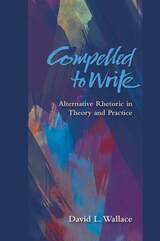
David Wallace argues that any understanding of writing studies must include the conception of discourse as an embodied force with real consequences for real people. Informed in important ways by queer theory, Wallace calls to account users of dominant discourses and at the same time articulates a theory base from which to interpret "alternative rhetoric."
To examine the practice of writing from varied margins of society, Compelled to Write offers careful readings of four exemplar American writers, each of whom felt compelled within their own time and place to write in response to systemic injustices in American society.
Sarah Grimké, a privileged white woman advocating for abolition, is forced to defend her right to speak as a woman; Frederick Douglass begins his public career almost as a curiosity (the articulate ex-slave) and ends it as one of the most important rhetors in American history; Gloria Anzaldúa writes not only in multiple languages and dialects but from marginalized positions related to gender, race, class, sexual identity, and physical abled-ness; David Sedaris uses his privileged position as a middle-class white male humorist to speak unabashedly of his sexuality, his addictions, and obsessive-compulsive personality disorder.
Through these writers, Wallace explores a range of strategies that comprise alternative rhetorical practice, and demonstrates how such practice is inflected by social constraints on rhetorical agency and by how writers employ alternative discourses to resist those constraints. Grounding and personalizing Compelled to Write with rich material from his own teaching and his own experience, Wallace considers a number of implications for teachers of writing.
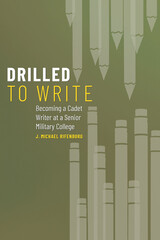
Drilled to Write offers a rich account of US Army cadets navigating the unique demands of Army writing at a senior military college. In this longitudinal case study, J. Michael Rifenburg follows one cadet, Logan Blackwell, for four years and traces how he conceptualizes Army writing and Army genres through immersion in military science classes, tactical exercises in the Appalachian Mountains, and specialized programs like Airborne School.
Drawing from research on rhetorical genre studies, writing transfer, and materiality, Drilled to Write speaks to scholars in writing studies committed to capturing how students understand their own writing development. Collectively, these chapters articulate four ways Blackwell leveraged resources through ROTC to become a cadet writer at this military college. Each chapter is dedicated to one year of his undergraduate experience with focus on curricular writing for his business management major and military science classes as well as his extracurricular writing, like his Ballroom Dance Club bylaws and a three-thousand-word short story.
In Drilled to Write, Rifenburg invites readers to see how cadets are positioned between civilian and military life—a curiously liminal space where they develop as writers. Using Army ROTC as an entry into genre theory and larger conversations about the role higher education plays in developing Army officers, he shows how writing students develop genre awareness and flexibility while forging a personal identity.
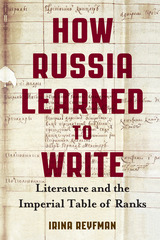
Irina Reyfman illuminates the surprisingly diverse effects of the Table of Ranks on writers, their work, and literary culture in Russia. From Sumarokov and Derzhavin in the eighteenth century through Pushkin, Gogol, Dostoevsky, and poets serving in the military in the nineteenth, state service affected the self-images of writers and the themes of their creative output. Reyfman also notes its effects on Russia’s atypical course in the professionalization and social status of literary work.
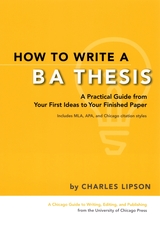
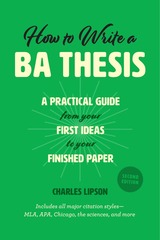
This book offers step-by-step advice on how to turn a vague idea into a clearly defined proposal, then a draft paper, and, ultimately, a polished thesis. Lipson also tackles issues beyond the classroom-from good work habits to coping with personal problems that interfere with research and writing.
Filled with examples and easy-to-use highlighted tips, the book also includes handy time schedules that show when to begin various tasks and how much time to spend on each. Convenient checklists remind students which steps need special attention, and a detailed appendix, filled with examples, shows how to use the three main citation systems in the humanities and social sciences: MLA, APA, and Chicago.
How to Write a BA Thesis will help students work more comfortably and effectively-on their own and with their advisers. Its clear guidelines and sensible advice make it the perfect text for thesis workshops. Students and their advisers will refer again and again to this invaluable resource. From choosing a topic to preparing the final paper, How to Write a BA Thesis helps students turn a daunting prospect into a remarkable achievement.
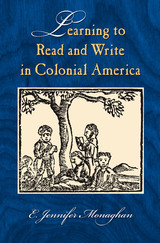
An experienced teacher of reading and writing and an award-winning historian, E. Jennifer Monaghan brings to vibrant life the process of learning to read and write in colonial America. Ranging throughout the colonies from New Hampshire to Georgia, she examines the instruction of girls and boys, Native Americans and enslaved Africans, the privileged and the poor, revealing the sometimes wrenching impact of literacy acquisition on the lives of learners.
For the most part, religious motives underlay reading instruction in colonial America, while secular motives led to writing instruction. Monaghan illuminates the history of these activities through a series of deeply researched and readable case studies. An Anglican missionary battles mosquitoes and loneliness to teach the New York Mohawks to write in their own tongue. Puritan fathers model scriptural reading for their children as they struggle with bereavement. Boys in writing schools, preparing for careers in counting houses, wield their quill pens in the difficult task of mastering a “good hand.” Benjamin Franklin learns how to compose essays with no teacher but himself. Young orphans in Georgia write precocious letters to their benefactor, George Whitefield, while schools in South Carolina teach enslaved black children to read but never to write.
As she tells these stories, Monaghan clears new pathways in the analysis of colonial literacy. She pioneers in exploring the implications of the separation of reading and writing instruction, a topic that still resonates in today's classrooms.
Monaghan argues that major improvements occurred in literacy instruction and acquisition after about 1750, visible in rising rates of signature literacy. Spelling books were widely adopted as they key text for teaching young children to read; prosperity, commercialism, and a parental urge for gentility aided writing instruction, benefiting girls in particular. And a gentler vision of childhood arose, portraying children as more malleable than sinful. It promoted and even commercialized a new kind of children's book designed to amuse instead of convert, laying the groundwork for the “reading revolution” of the new republic.

—New Yorker
“A collection of formative fiction from a writer whose work has earned comparison with Joyce and Beckett. . . . Early work from a writer who merits a larger readership.”
—Kirkus Reviews
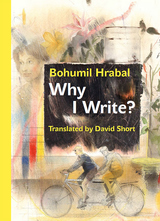
This collection of the earliest prose by one of literature’s greatest stylists captures, as scholar Arnault Maréchal put it, “the moment when Hrabal discovered the magic of writing.” Taken from the period when Bohumil Hrabal shifted his focus from poetry to prose, these stories—many written in school notebooks, typed and read aloud to friends, or published in samizdat—often showcase raw experiments in style that would define his later works. Others intriguingly utilize forms the author would never pursue again. Featuring the first appearance of key figures from Hrabal’s later writings, such as his real-life Uncle Pepin, who would become a character in his later fiction and is credited here as a coauthor of one piece, the book also contains stories that Hrabal would go on to cannibalize for some of his most famous novels. All together, Why I Write? offers readers the chance to explore this important nascent phase of Hrabal’s writing.
Expertly interpreted by award-winning Hrabal translator David Short, this collection comprises some of the last remaining prose works by Hrabal to be translated into English. A treasure trove for Hrabal devotees, Why I Write? allows us to see clearly why this great prose master was, as described by Czech writer and publisher Josef Škvorecký, “fundamentally a lyrical poet.”
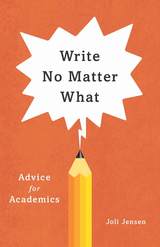
Jensen begins by busting the myth that universities are supportive writing environments. She points out that academia, an arena dedicated to scholarship, offers pressures that actually prevent scholarly writing. She shows how to acknowledge these less-than-ideal conditions, and how to keep these circumstances from draining writing time and energy. Jensen introduces tools and techniques that encourage frequent, low-stress writing. She points out common ways writers stall and offers workarounds that maintain productivity. Her focus is not on content, but on how to overcome whatever stands in the way of academic writing.
Write No Matter What draws on popular and scholarly insights into the writing process and stems from Jensen’s experience designing and directing a faculty writing program. With more than three decades as an academic writer, Jensen knows what really helps and hinders the scholarly writing process for scholars in the humanities, social sciences,and sciences.
Cut down the academic sword of Damocles, Jensen advises. Learn how to write often and effectively, without pressure or shame. With her encouragement, writers of all levels will find ways to create the writing support they need and deserve.
READERS
Browse our collection.
PUBLISHERS
See BiblioVault's publisher services.
STUDENT SERVICES
Files for college accessibility offices.
RECENTLY PUBLISHED


UChicago Accessibility Resources
home | accessibility | search | about | contact us
BiblioVault ® 2001 - 2026
The University of Chicago Press