Results by title
171 books match the query 'Books & Reading' and 4 start with a non-letter
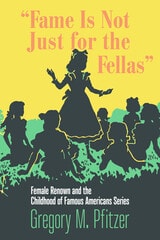
"Fame Is Not Just for the Fellas"
Female Renown and the Childhood of Famous Americans SeriesGregory M. Pfitzer
University of Massachusetts Press, 2022
Finalist of the 2023 SHARP History of the Book Prize
Between 1932 and 1958, thousands of children read volumes in the book series Childhood of Famous Americans. With colorful cover art and compelling—and often highly fictionalized—narrative storylines, these biographies celebrated the national virtues and achievements of famous women like Betsy Ross, Louisa May Alcott, and Amelia Earhart. Employing deep archival research, Gregory M. Pfitzer examines the editorial and production choices of the publisher and considers the influence of the series on readers and American culture more broadly.
In telling the story of how female subjects were chosen and what went into writing these histories for young female readers of the time, Pfitzer illustrates how these books shaped children’s thinking and historical imaginations around girlhood using tales from the past. Utilizing documented conversations and disagreements among authors, editors, readers, reviewers, and sales agents at Bobbs-Merrill, “Fame Is Not Just for the Fellas” places the series in the context of national debates around fame, gender, historical memory, and portrayals of children and childhood for a young reading public—charged debates that continue to this day.
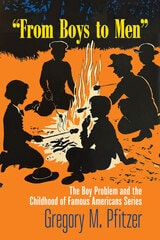
"From Boys to Men"
The Boy Problem and the Childhood of Famous Americans SeriesGregory M. Pfitzer
University of Massachusetts Press, 2024
While adult concern about gender in children’s books has made recent headlines, this discussion is far from new. As Gregory M. Pfitzer reveals, the writers and editors at Bobbs-Merrill, the publisher of the Childhood of Famous Americans book series published between 1932 and 1958, thought carefully about how their books would influence the development of their male readers. These books emphasized inspiring tales over historical accuracy and were written in simple language, with characters, dialogue, and stories that were intended to teach boys how to be successful men.
But this was a specific image of American manhood. Published in an era when sociologists, psychologists, and other experts worried about male delinquency, the men envisioned in these books were steeped in Cold War racial and gender stereotypes, and questions about citizenship and responsibility. Based on deep archival research into the publication history of the series, “From Boys to Men” sheds light on current controversies on children’s books and presentations of gender diversity.
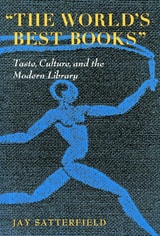
"The World's Best Books"
Taste, Culture, and the Modern LibraryJay Satterfield
University of Massachusetts Press, 2002
In October 1930, Macy's department store in New York City used the inexpensive book series “The Modern Library of the World's Best Books” as a loss-leader to draw customers into the store. Selling for only nine cents a copy, the small-format, modern classics attracted crowds of buyers. Businessmen, housewives, students, bohemian intellectuals, and others waited in long lines to purchase affordable hard-bound copies of works by the likes of Tolstoy, Wilde, Joyce, and Woolf. It was a significant moment in American cultural history, demonstrating that a series of books respected and praised by the nation's self-appointed arbiters of taste could attract a throng of middle-class consumers without damaging its reputation as a vehicle of “serious culture.”
The Modern Library's reputation stands in sharp contrast to that of similar publishing ventures dismissed by critics as agents of “middlebrow culture,” such as the Book of-the-Month Club. Writers for the New Republic, the Nation, and the Bookman expressed their fears that mass-production and new distribution schemes would commodify literature and deny the promise of American culture. Yet although the Modern Library offered the public a uniformly packaged, preselected set of “the World's Best Books,” it earned the praise of these self-consciously intellectual critics.
Focusing on the Modern Library's marketing strategies, editorial decisions, and close attention to book design, Jay Satterfield explores the interwar cultural dynamics that allowed the publisher of the series to exploit the forces of mass production and treat books as commodities while still positioning the series as a revered cultural entity. So successful was this approach that the modern publishing colossus Random House was built on the reputation, methods, and profits of the Modern Library.
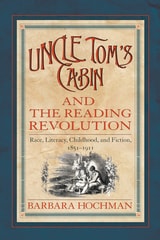
"Uncle Tom's Cabin" and the Reading Revolution
Race, Literacy, Childhood, and Fiction, 1851-1911Barbara Hochman
University of Massachusetts Press, 2011
"Uncle Tom's Cabin" and the Reading Revolution explores a transformation in the cultural meaning of Stowe's influential book by addressing changes in reading practices and a shift in widely shared cultural assumptions. These changes reshaped interpretive conventions and generated new meanings for Stowe's text in the wake of the Civil War.
During the 1850s, men, women, and children avidly devoured Stowe's novel. White adults wept and could not put the book down, neglecting work and other obligations to complete it. African Americans both celebrated and denounced the book. By the 1890s, readers understood Uncle Tom's Cabin in new ways. Prefaces and retrospectives celebrated Stowe's novel as a historical event that led directly to emancipation and national unity. Commentaries played down the evangelical and polemical messages of the book.
Illustrations and children's editions projected images of entertaining and devoted servants into an open-ended future. In the course of the 1890s, Uncle Tom's Cabin became both a more viciously racialized book than it had been and a less compelling one. White readers no longer consumed the book at one sitting; Uncle Tom's Cabin was now more widely known than read. However, in the growing silence surrounding slavery at the turn of the century, Stowe's book became an increasingly important source of ideas, facts, and images that the children of ex-slaves and other free-black readers could use to make sense of their position in U.S. culture.