Results by title
401 books match the query 'Civil War, 1861-1865' and 9 start with a non-letter
"Our Aim Was Man"
Andrew's Sharpshooters in the American Civil WarRoberta Senechal de la Roche
University of Massachusetts Press, 2016
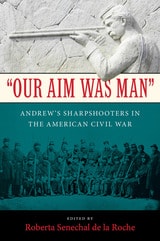
One was a father who worried about his fellow soldiers' swearing. Another hoped to enter Harvard College. The third was a farmer whose letters home depict the later stages of the war. The fourth had turned to boot making when he did not inherit land. Based on the letters, diaries, and memoirs of four members of the First Company Massachusetts Sharpshooters, known as Andrew's Sharpshooters, this book provides a rare glimpse into the experiences of Union Army snipers. The company was one of the first units in American military history to be equipped with telescope-sighted rifles to enable long-distance targeting. Despite complaints that snipers violated codes of honorable combat, the members of Andrew's Sharpshooters generally expressed quiet pride in being an elite unit of highly skilled soldiers—"cool blooded sharpshooters," as one of them said.
Introduced and edited by Roberta Senechal de la Roche, these primary accounts include new details about the equipment, training, and deployment of snipers in the Army of the Potomac. They also reveal the challenges of covert warfare and include rich detail on the everyday problems of Civil War soldiers, including bad food, disease, punishing marches, and homesickness. The collected documents also convey the trials of those left on the home front.
"The Million Dead, Too, Summ'd Up"
Walt Whitman's Civil War WritingsWalt Whitman
University of Iowa Press, 2021
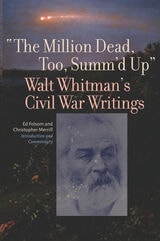
The real democratic reader, Whitman said, “must himself or herself construct indeed the poem, argument, history, metaphysical essay—the text furnishing the hints, the clue, the start or frame-work,” because what is needed for democracy to flourish is “a nation of supple and athletic minds.” Folsom and Merrill model this kind of active reading and encourage both seasoned and new readers of Whitman’s war writings to enter into the challenging and exhilarating mode of talking back to Whitman, arguing with him, and learning from him.
"There Is a North"
Fugitive Slaves, Political Crisis, and Cultural Transformation in the Coming of the Civil WarJohn L. Brooke
University of Massachusetts Press, 2019
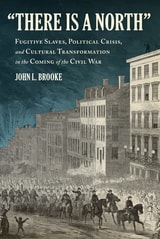
How does political change take hold? In the 1850s, politicians and abolitionists despaired, complaining that the "North, the poor timid, mercenary, driveling North" offered no forceful opposition to the power of the slaveholding South. And yet, as John L. Brooke proves, the North did change. Inspired by brave fugitives who escaped slavery and the cultural craze that was Uncle Tom's Cabin, the North rose up to battle slavery, ultimately waging the bloody Civil War.
While Lincoln's alleged quip about the little woman who started the big war has been oft-repeated, scholars have not fully explained the dynamics between politics and culture in the decades leading up to 1861. Rather than simply viewing the events of the 1850s through the lens of party politics, “There Is a North” is the first book to explore how cultural action—including minstrelsy, theater, and popular literature—transformed public opinion and political structures. Taking the North's rallying cry as his title, Brooke shows how the course of history was forever changed.
"They'll Do to Tie To!"
The Story of Hood's Arkansas ToothpicksCalvin C. Collier
Butler Center for Arkansas Studies, 2015
"This Day We Marched Again"
A Union Soldier's Account of War in Arkansas and the Trans-MississippiMark K. Christ
Butler Center for Arkansas Studies, 2014
"This Mighty Convulsion"
Whitman and Melville Write the Civil WarChristopher Sten and Tyler Hoffman
University of Iowa Press, 2019
This is the first book exclusively devoted to the Civil War writings of Walt Whitman and Herman Melville, arguably the most important poets of the war. The essays brought together in this volume add significantly to recent critical appreciation of the skill and sophistication of these poets; growing recognition of the complexity of their views of the war; and heightened appreciation for the anxieties they harbored about its aftermath. Both in the ways they come together and seem mutually influenced, and in the ways they disagree, Whitman and Melville grapple with the casualties, complications, and anxieties of the war while highlighting its irresolution. This collection makes clear that rather than simply and straightforwardly memorializing the events of the war, the poetry of Whitman and Melville weighs carefully all sorts of vexing questions and considerations, even as it engages a cultural politics that is never pat.
Contributors: Kyle Barton, Peter Bellis, Adam Bradford, Jonathan A. Cook, Ian Faith, Ed Folsom, Timothy Marr, Cody Marrs, Christopher Ohge, Vanessa Steinroetter, Sarah L. Thwaites, Brian Yothers
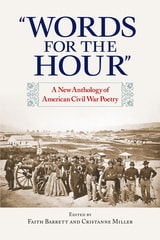
"Words for the Hour"
A New Anthology of American Civil War PoetryFaith Barrett
University of Massachusetts Press, 2005
“Words for the Hour” presents a readable and illuminating account of the Civil War, told through the words of poets North and South. From bathos to profound philosophical meditation and sorrow, the range of these poems illuminates the complexity of their era while also revealing the continuing power of this turning point in American history to speak to readers in the present day.
The volume is divided into three parts, each offering a different perspective on the poetry generated by the war. Part I samples the extraordinary range of poems written immediately preceding and during the war and published in popular periodicals, providing a kind of poetic newspaper account as one might have read it then—from the early days of optimistically heralded victory on both sides, through the mounting casualties and brutal deaths of the long middle years, to the war's conclusion and President Lincoln's assassination. Viewing the struggle from many different vantage points gives the reader access to the ways that people from various backgrounds experienced the trajectory of the war. Civilians and soldiers, free blacks and proponents of slavery, women and men from Massachusetts and Virginia and from recently admitted states and barely developed territories, writers with their eyes on the national political stage and those focused on personal domestic issues: these are the multiple voices of America responding to the war.
Part II includes substantial selections of poems by writers who published extensively in response to the conflict, providing more complex and comprehensive perceptions of the war. These poets include not just well-known figures such as Walt Whitman, Herman Melville, and John Greenleaf Whittier, but also African American poets George Moses Horton and Frances Ellen Watkins Harper and Southern poets Henry Timrod and Sarah Piatt.
Part III offers poems by two poets who did not publish during their lifetimes, but had strong imaginative responses to the conflict, thus giving a sense of the long reach of the war as a defining national experience. One of these two poets (Emily Dickinson) is now renowned while the other (Obadiah Ethelbert Baker) is first published in this volume.
“Words for the Hour” is indeed “new” among anthologies of Civil War poetry not only in its wide range of poems by popular, anonymous, and now canonical poets but also in its informational apparatus. A historical timeline listing major battles and events of the war begins the volume, and historical photographs or lithographs introduce each section of poems. The book also includes a substantial introduction, a glossary of important names and terminology relevant to understanding the poems, and biographical sketches for all the poets whose work is included.
1863
Lincoln's Pivotal YearEdited by Harold Holzer and Sara Vaughn Gabbard
Southern Illinois University Press, 2013
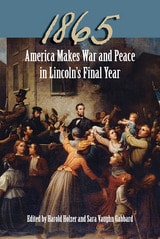
1865
America Makes War and Peace in Lincoln’s Final YearEdited by Harold Holzer and Sara Vaughn Gabbard
Southern Illinois University Press, 2015
In 1865 Americans faced some of the most important issues in the nation’s history: the final battles of the Civil War, the struggle to pass the Thirteenth Amendment, the peace process, reconstruction, the role of freed slaves, the tragedy of Abraham Lincoln's assassination, and the trials of the conspirators. In this illuminating collection, prominent historians of nineteenth-century America offer insightful overviews of the individuals, events, and issues on 1865 that shaped the future of the United States.
Following an introduction by renowned Lincoln scholar Harold Holzer, nine new essays explore the end of the Civil War, Lincoln’s death, and the start of the tentative peace in 1865. Michael Vorenberg discusses how Lincoln shepherded through the House of Representatives the resolution sending the Thirteenth Amendment to the states for ratification, John F. Marszalek and Michael B. Ballard examine the partnership of Lincoln’s war management and General Ulysses S. Grant’s crucial last thrusts against Robert E. Lee, and Richard Striner recounts how Lincoln faced down Confederate emissaries who proposed immediate armistice if Lincoln were to reverse the Emancipation Proclamation. Ronald C. White Jr. offers a fresh look at Lincoln’s second inaugural address, and Richard Wightman Fox provides a vivid narrative of Lincoln’s dramatic walk through Richmond after the Confederates abandoned their capital.
Turning to Lincoln’s assassination, Edward Steers Jr. relates the story of Booth’s organizational efforts that resulted in the events of that fateful day, and Frank J. Williams explains the conspirators’ trial and whether they should have faced military or civilian tribunals. Addressing the issue of black suffrage, Edna Greene Medford focuses on the African American experience in the final year of the war. Finally, Holzer examines the use of visual arts to preserve the life and legacy of the martyred president.
Rounding out the volume are a chronology of national and international events during 1865, a close look at Lincoln’s activities and writings from January 1 through April 14, and other pertinent materials. This thoughtful collection provides an engaging evaluation of one of the most crucial years in America’s evolution.