Results by title
1441 books match the query 'Great Britain' and 8 start with a non-letter
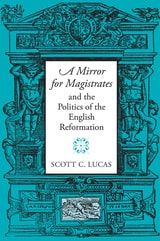
"A Mirror for Magistrates" and the Politics of the English Reformation
Scott Lucas
University of Massachusetts Press, 2009
In a striking departure from previous scholarship, Scott Lucas shows that modern critics have misconstrued the purpose of the tragic verse narratives of the Mirror, approaching them primarily as uncontroversial meditations on abstract political and philosophical doctrines. Lucas revises this view, revealing many of the Mirror tragedies to be works topically applicable in form and politically contentious in nature.
Lucas returns the earliest poems of A Mirror for Magistrates to the troubled context of their production, the tumultuous reign of the Catholic Queen Mary (1553–1558). As Protestants suffering from the traumatic collapse of King Edward VI's "godly" rule (1547–1553) and from the current policies of Mary's government, the Mirror authors radically reshaped their poems' historical sources in order to craft emotionally moving narratives designed to provide models for interpreting the political failures of Edward VI's reign and to offer urgent warnings to Marian magistrates.
Lucas's study also reveals how, in later poems, the Mirror authors issued oblique appeals to Queen Elizabeth's officers, boldly demanding that they allow the realm of "the literary" to stand as an unfettered discursive arena of public controversy. Lucas thus provides a provocative new approach to this seminal but long-misunderstood collection, one that restores the Mirror to its rightful place as one of the greatest works of sixteenth-century English political literature.
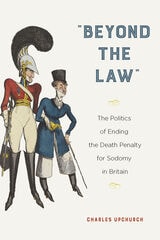
"Beyond the Law"
The Politics of Ending the Death Penalty for Sodomy in BritainCharles Upchurch
Temple University Press, 2021
In nineteenth-century England, sodomy was punishable by death; even an accusation could damage a man’s reputation for life. The last executions for this private, consensual act were in 1835, but the effort to change the law that allowed for those executions was intense and precarious, and not successful until 1861. In this groundbreaking book, “Beyond the Law,” noted historian Charles Upchurch pieces together fragments from history and uses a queer history methodology to recount the untold story of the political process through which the law allowing for the death penalty for sodomy was almost ended in 1841.
Upchurch recounts the legal and political efforts of reformers like Jeremy Bentham and Lord John Russell—the latter of whom argued that the death penalty for sodomy was “beyond the law and above the law.” He also reveals that a same-sex relationship linked the families of the two men responsible for co-sponsoring the key legislation. By recovering the various ethical, religious, and humanitarian arguments against punishing sodomy, “Beyond the Law” overturns longstanding assumptions of nineteenth-century British history. Upchurch demonstrates that social change came from an amalgam of reformist momentum, family affection, elitist politics, class privilege, enlightenment philosophy, and personal desires.
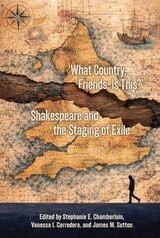
"What Country, Friends, is This?"
Shakespeare and the Staging of ExileEdited by Vanessa I. Corredera, Stephanie E. Chamberlain, and James M. Sutton
Arizona Center for Medieval and Renaissance Studies, 2026
This compelling collection of fourteen essays explores the enduring theme of exile in Shakespeare’s works and their global afterlives, offering a timely and thought-provoking response to the modern age of displacement. Building on Edward Said’s observation that exile today is marked by its unprecedented scale—driven by war, imperialism, totalitarianism, climate change, and systemic injustice—this volume traces the ideological and cultural forces that shape experiences of exile across time and geography.
Shakespeare’s plays, deeply haunted by exile in its many guises—political, religious, cultural, and gendered—serve as a rich site for interrogating identity, belonging, and otherness.
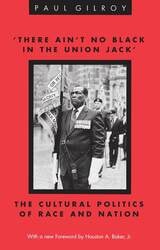
'There Ain't no Black in the Union Jack'
The Cultural Politics of Race and NationPaul Gilroy
University of Chicago Press, 1991
"Gilroy demonstrates effectively that cultural traditions are not static, but develop, grow and indeed mutate, as they influence and are influenced by the other changing traditions around them."—David Edgar, Listener Review of Books.
"A fascinating analysis of the discourses that have accompanied black settlement in Britain. . . . An important addition to the stock of critical works on race and culture."—David Okuefuna, Chicago Tribune
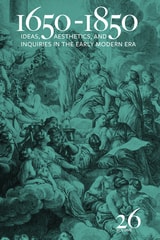
1650-1850
Ideas, Aesthetics, and Inquiries in the Early Modern Era (Volume 26)Kevin L. Cope
Bucknell University Press, 2021
Volume 26 of 1650–1850: Ideas, Aesthetics, and Inquiries in the Early Modern Era travels beyond the usual discussions of power, identity, and cultural production to visit the purlieus and provinces of Britain’s literary empire. Bulging at its bindings are essays investigating out-of-the-way but influential ensembles, whether female religious enthusiasts, annotators of Maria Edgeworth’s underappreciated works, or modern video-based Islamic super-heroines energized by Mary Wollstonecraft’s irreverance. The global impact of the local is celebrated in studies of the personal pronoun in Samuel Johnson’s political writings and of the outsize role of a difficult old codger in catalyzing the literary career of Charlotte Smith. Headlining a volume that peers into minute details in order to see the outer limits of Enlightenment culture is a special feature on metaphor in long-eighteenth-century poetry and criticism. Five interdisciplinary essays investigate the deep Enlightenment origins of a trope usually associated with the rise of Romanticism. Volume 26 culminates in a rich review section containing fourteen responses to current books on Enlightenment religion, science, literature, philosophy, political science, music, history, and art.
About the annual journal 1650-1850
1650-1850 publishes essays and reviews from and about a wide range of academic disciplines: literature (both in English and other languages), philosophy, art history, history, religion, and science. Interdisciplinary in scope and approach, 1650-1850 emphasizes aesthetic manifestations and applications of ideas, and encourages studies that move between the arts and the sciences—between the “hard” and the “humane” disciplines. The editors encourage proposals for special features that bring together five to seven essays on focused themes within its historical range, from the Interregnum to the end of the first generation of Romantic writers. While also being open to more specialized or particular studies that match up with the general themes and goals of the journal, 1650-1850 is in the first instance a journal about the artful presentation of ideas that welcomes good writing from its contributors.
ISSN 1065-3112.
Published by Bucknell University Press. Distributed worldwide by Rutgers University Press.
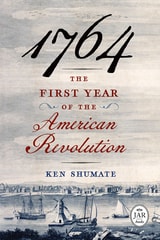
1764—The First Year of the American Revolution
Ken Shumate
Westholme Publishing, 2021
The year 1764 is of extraordinary importance to the history of the American Revolution. It was a watershed year in the relationship between Great Britain and its North American colonies.
In 1763, the British began to strictly enforce the laws of trade in order to advance a newly formulated colonial policy that included use of customs duties as a means of drawing revenue from the colonies. Americans early in 1764 protested that the laws being enforced were economically unsound and would be destructive to the trade of the colonies. Despite knowing of the American discontent, British officials moved forward with their new colonial policy. Resolutions made by the House of Commons in March 1764 not only codified a more restrictive trade policy, but revealed a plan to impose direct parliamentary taxation. A resolution to levy stamp duties brought forth a storm of American petitions and essays in late 1764 that constitute the beginning of what has become known as the Stamp Act Crisis.
In 1764: The First Year of the American Revolution, Ken Shumate presents the American arguments against the new British policy. The most prominent protests against direct parliamentary taxation were made by New York, Massachusetts, Virginia, Connecticut, and Rhode Island. Supporting the petitions were thoughtful essays by James Otis, Oxenbridge Thacher, Richard Bland, Thomas Fitch, and Stephen Hopkins. Shumate demonstrates the importance of these petitions and essays, written before the passage of the Stamp Act in 1765, as establishing the constitutional basis for the heated protests of that year and the following decade. The British interpretation of these writings as rejecting the supremacy of Parliament—even the sovereignty of Great Britain—further motivated the need for the Stamp Act as a demonstration of the fundamental right of Parliament to levy such taxes.
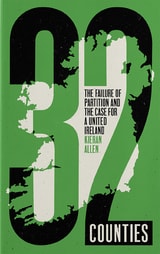
32 Counties
The Failure of Partition and the Case for a United IrelandKieran Allen
Pluto Press, 2021
'This is Irish history seen anew, from below, bristling with practical lessons for working-class struggle today' - Eamonn McCann
The 32 counties of Ireland were divided through imperial terror and gerrymandering. Partition was borne from a Tory strategy to defend the British Empire and has spawned a 'carnival of reaction' in Irish politics ever since. Over the last 100 years, conservative forces have dominated both states offering religious identity as a diversion from economic failures and inequality.
Through a sharp analysis of the history of partition, Kieran Allen rejects the view that the 'two cultures' of Catholic and Protestant communities lock people into permanent antagonism. Instead, the sectarian states have kept its citizens divided through political and economic measures like austerity, competition for reduced services and low wages.
Overturning conventional narratives, 32 Counties evokes the tradition of James Connolly and calls for an Irish unity movement from below to forge the North and the Republic into a secular, socialist and united Ireland.

7/7
The London Bombings, Islam and the Iraq WarMilan Rai
Pluto Press, 2006
This is the book Tony Blair doesn't want you to read about 7/7.
In February 2003, Tony Blair was warned by British intelligence that the invasion of Iraq would 'heighten' the risk of terrorism in Britain.
In July 2005, al-Qaeda struck in the heart of London. Despite the British Government's increasingly desperate attempts at denial, polls show that an overwhelming majority of people in Britain are convinced that there is a connection between the London bombings and the war on Iraq. A majority of Britons fault Tony Blair himself.
Using secret government documents declassified since the bombings, and leaks from British intelligence, Milan Rai exposes official deceit at the highest levels, and establishes the crucial role of British foreign policy in generating a home-grown version of al-Qaeda. Rai shows how an official report drawn up by the Home Office and Foreign Office in early 2004 identified 'foreign policy' - and the war in Iraq in particular - as a major cause of alienation among young British Muslims.
Examining the backgrounds of the 7/7 bombers, Milan Rai demonstrates that Islam is not to blame. Most importantly, the book shows us how to make sure that this never happens again -- and offers brief obituaries for the 52 people who lost their lives that day.