Results by title
28164 books match the query 'History' and 150 start with a non-letter
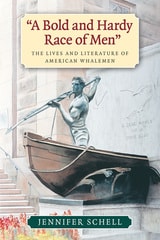
"A Bold and Hardy Race of Men"
The Lives and Literature of American WhalemenJennifer Schell
University of Massachusetts Press, 2013
In his novel Miriam Coffin, or The Whale-Fishermen (1834), Joseph C. Hart proclaimed that his characters were “a bold and hardy race of men,” who deserved the “expressive title of American Whale-Fishermen.” Hart was not the only American author to applaud these physical laborers as the embodiment of national manhood. Heroic portraits of whalers first appeared in American literature during the 1780s, and they proliferated across time. Writers as various as Lydia Howard Huntley Sigourney, Frederick Douglass, and Walt Whitman celebrated the talents of the seafarers who transformed the New England whale fishery into a globally dominant industry. But these images did not go unchallenged. Alternative visions—some of which undermined the iconic status of the trade and its workers—began to proliferate. Even so, these depictions did very little to dismantle the notion that whaling men were prime exemplars of a proud American work ethic.
To explain why this industry had such a widespread and enduring impact on American literature, Jennifer Schell juxtaposes and analyzes a wide array of eighteenth- and nineteenth-century whaling narratives. Drawing on various studies of masculinity, labor history, and transnationalism, Schell shows how this particular type of maritime work, and the traits and values associated with it, helped to shape the American literary, cultural, and historical imagination. In the process, she reveals the diverse, flexible, and often contradictory meanings of gender, class, and nation in nineteenth-century America.
"A Fully Accredited Ocean"
Essays on the Great LakesVictoria Brehm, Editor
University of Michigan Press, 1998
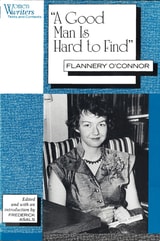
"A Good Man is Hard to Find"
Flannery O'ConnorAsals, Frederick
Rutgers University Press, 1993
"A Good Man Is Hard to Find" is Flannery O'Connor's most famous and most discussed story. O'Connor herself singled it out by making it the title piece of her first collection and the story she most often chose for readings or talks to students. It is an unforgettable tale, both riveting and comic, of the confrontation of a family with violence and sudden death. More than anything else O'Connor ever wrote, this story mixes the comedy, violence, and religious concerns that characterize her fiction.
This casebook for the story includes an introduction by the editor, a chronology of the author's life, the authoritative text of the story itself, comments and letters by O'Connor about the story, critical essays, and a bibliography. The critical essays span more than twenty years of commentary and suggest several approaches to the story--formalistic, thematic, deconstructionist-- all within the grasp of the undergraduate, while the introduction also points interested students toward still other resources. Useful for both beginning and advanced students, this casebook provides an in-depth introduction to one of America's most gifted modern writers.
"A Marvelous Work"
Reading Mormonism in West AfricaLaurie F. Maffly-Kipp
Utah State University Press, 2022
The Arrington Lecture series, established by one of the twentieth-century West's most distinguished historians, Leonard Arrington, has become a leading forum for prominent historians to address topics related to Mormon history. Utah State University hosts the Leonard J. Arrington Mormon History Lecture Series through the Merrill-Cazier Library Special Collections and Archives department.
"A Mirror for Magistrates" and the Politics of the English Reformation
Scott Lucas
University of Massachusetts Press, 2009
In a striking departure from previous scholarship, Scott Lucas shows that modern critics have misconstrued the purpose of the tragic verse narratives of the Mirror, approaching them primarily as uncontroversial meditations on abstract political and philosophical doctrines. Lucas revises this view, revealing many of the Mirror tragedies to be works topically applicable in form and politically contentious in nature.
Lucas returns the earliest poems of A Mirror for Magistrates to the troubled context of their production, the tumultuous reign of the Catholic Queen Mary (1553–1558). As Protestants suffering from the traumatic collapse of King Edward VI's "godly" rule (1547–1553) and from the current policies of Mary's government, the Mirror authors radically reshaped their poems' historical sources in order to craft emotionally moving narratives designed to provide models for interpreting the political failures of Edward VI's reign and to offer urgent warnings to Marian magistrates.
Lucas's study also reveals how, in later poems, the Mirror authors issued oblique appeals to Queen Elizabeth's officers, boldly demanding that they allow the realm of "the literary" to stand as an unfettered discursive arena of public controversy. Lucas thus provides a provocative new approach to this seminal but long-misunderstood collection, one that restores the Mirror to its rightful place as one of the greatest works of sixteenth-century English political literature.
"A Road to Peace and Freedom"
The International Workers Order and the Struggle for Economic Justice and Civil Rights, 1930-1954Robert M. Zecker
Temple University Press, 2017
Mining extensive primary sources, Robert Zecker gives voice to the workers in “A Road to Peace and Freedom.” He describes the group's economic goals, commitment to racial justice, and activism, from lobbying to end segregation and lynching in America to defeating fascism abroad. Zecker also illustrates the panoply of entertainment, sports, and educational activities designed to cultivate the minds and bodies of members.
However, the IWO was led by Communists, and the Order was targeted for red-baiting during the Cold War, subject to government surveillance, and ultimately "liquidated." Zecker explains how the dismantling of the IWO and the general suppression of left-wing dissenting views on economic egalitarianism and racial equality had deleterious effects for the entire country. Moreover, Zecker shows why the sobering lesson of the IWO remains prescient today.
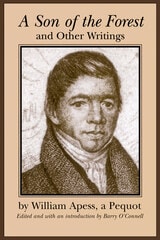
"A Son of the Forest" and Other Writings
William Apess
University of Massachusetts Press, 1997

"A Truthful Impression of the Country"
British and American Travel Writing in China, 1880-1949Nicholas R. Clifford
University of Michigan Press, 2001
Nicholas R. Clifford argues that, for a variety of reasons, travel accounts during this time claimed a particular kind of veracity that distinguished them from the work of other writers--scholars, journalists, diplomats, policymakers, or memoir-writing expatriates--who also sought to represent an unfamiliar China to the West. Yet even as the genre claims to be a "truthful impression," it contains an implicit warning that the traveler's own sensibility enters into the account and into the representation of the unfamiliar and the exotic.
"A Truthful Impression of the Country" will appeal not only to those interested in the broad phenomenon of imperialism but also to those interested in cultural studies and post-colonialism. It will likewise prove accessible to the general reader exploring Sino-Western interactions or in travel writing as a particular genre.
Nicholas R. Clifford is College Professor Emeritus, Middlebury College. He is also the author of the novel The House of Memory and of the monographs Shanghai, 1925: Urban Nationalism and the Defense of Foreign Privilege and Spoilt Children of Empire: Westerners in Shanghai and the Chinese Revolution of 1925--1927.
"After Mecca"
Women Poets and the Black Arts MovementClarke, Cheryl
Rutgers University Press, 2004
In "After Mecca," Cheryl Clarke explores the relationship between the Black Arts Movement and black women writers of the period. Poems by Gwendolyn Brooks, Ntozake Shange, Audre Lorde, Nikki Giovanni, Sonia Sanchez, Jayne Cortez, Alice Walker, and others chart the emergence of a new and distinct black poetry and its relationship to the black community's struggle for rights and liberation. Clarke also traces the contributions of these poets to the development of feminism and lesbian-feminism, and the legacy they left for others to build on.
She argues that whether black women poets of the time were writing from within the movement or writing against it, virtually all were responding to it. Using the trope of "Mecca," she explores the ways in which these writers were turning away from white, western society to create a new literacy of blackness.

"Almost a Man of Genius"
Clémence Royer, Feminism, and Nineteenth-Century ScienceHarvey, Joy
Rutgers University Press, 1997
A feminist who made lifelong enemies almost as readily as she made friends, Royer was never able to undertake formal, advanced education and was a product of her own self-study efforts. Only in her last few years was she formally recognized by several professional societies and awarded the French Legion of Honor. Harvey includes an overview of earlier biographical treatments, the text of an 1874 communication on "Women, Science, and the Birth Rate," and extensive notes.
"Beyond This Narrow Now"
Or, Delimitations, of W. E. B. Du BoisNadhum Dimitri Chandler
Duke University Press, 2022
"Beyond the Law"
The Politics of Ending the Death Penalty for Sodomy in BritainCharles Upchurch
Temple University Press, 2021
In nineteenth-century England, sodomy was punishable by death; even an accusation could damage a man’s reputation for life. The last executions for this private, consensual act were in 1835, but the effort to change the law that allowed for those executions was intense and precarious, and not successful until 1861. In this groundbreaking book, “Beyond the Law,” noted historian Charles Upchurch pieces together fragments from history and uses a queer history methodology to recount the untold story of the political process through which the law allowing for the death penalty for sodomy was almost ended in 1841.
Upchurch recounts the legal and political efforts of reformers like Jeremy Bentham and Lord John Russell—the latter of whom argued that the death penalty for sodomy was “beyond the law and above the law.” He also reveals that a same-sex relationship linked the families of the two men responsible for co-sponsoring the key legislation. By recovering the various ethical, religious, and humanitarian arguments against punishing sodomy, “Beyond the Law” overturns longstanding assumptions of nineteenth-century British history. Upchurch demonstrates that social change came from an amalgam of reformist momentum, family affection, elitist politics, class privilege, enlightenment philosophy, and personal desires.
"Chaotic Freedom" in Civil War Louisiana
The Origins of an Iconic ImageBruce Laurie
University of Massachusetts Press, 2021
Bruce Laurie uncovers the people and events that created this seminal image, telling the tale of three men, two Yankee soldiers from western Massachusetts who were serving the Union Army in Louisiana and a man named Peter whose scarred back horrified all who saw it. The two soldiers were so shocked by what had been done to Peter, they sought to capture the image and document slavery's cruelty, the likes of which was all too common among those fleeing bondage in Louisiana. Meticulously researched and briskly told, this short volume unearths the story behind an iconic image.
"Come, Lord Jesus!"
Two Devotional Poems. A Bilingual EditionAnna Maria van Schurman
Iter Press, 2026
The life and reputation of Anna Maria van Schurman (1607–78) swung dramatically from her early fame as a prodigy and femme savante to the infamy she bore in the wake of her late affiliation with Jean de Labadie. From her late adolescence on, van Schurman was widely known for her intellectual gifts, her mastery of languages, and her skillful portraiture and embroidery. Described by some as a femme savante and “the Star of Utrecht,” she gained an international reputation with the publication of her defense of women’s education. Her later years, however, were marked by a growing disillusionment with her own fame and intellectual achievements, and her reputation was dramatically marred in the eyes of her contemporaries when, in her final decade, she repudiated the Dutch Reformed Church to affiliate with Jean de Labadie. With him and his spiritual community, she lived out her last years in peace while also composing a two-volume defense of her actions and convictions, entitled Eukleria or The Better Choice.
The years between her withdrawal from public life and her supposedly scandalous return are not easily mapped. Drawing on two long devotional poems that she wrote during this period (and that remained unpublished during her lifetime), this bilingual edition introduces readers to van Schurman’s private piety, as well as to her theological acumen, her artistry as a vernacular poet, and her participation in the leadership of a conventicle of like-minded friends and acquaintances. The English translation closely approximates the rhyme, meter, and cadence of the Dutch original and thus facilitates an appreciation not only of the poet’s meaning but also of the auditory aesthetics of each text.

"Destined to Fail"
Carl Seashore’s World of Eugenics, Psychology, Education, and MusicJulia Eklund Koza
University of Michigan Press, 2021
A little-known fact about the prominent US psychologist and educator Carl E. Seashore (1866–1949) is that he was deeply involved in the American eugenics movement. He was among the US academics to support eugenics long before German Nazis embraced it. A titan in a host of disciplines and a proponent of radical education reform, Seashore used his positional power to promote a constellation of education reforms consistent with central precepts of eugenics. Many of these reforms, including tracking, gifted and talented programs, and high-stakes standardized testing, were adopted and remain standard practice in the United States today. He promulgated the idea that musical talent is biologically inheritable, and he developed the first standardized tests of musical talent; these tests were used by early-twentieth-century researchers in their attempts to determine whether there are race differences in musical talent. Seashore’s ideas and work profoundly shaped music education’s research trajectory, as well as enduring “commonsense” beliefs about musical ability. An intersectional analysis, “Destined to Fail” focuses on the relationship between eugenics and Seashore’s views on ability, race, and gender. Koza concludes that Seashore promoted eugenics and its companion, euthenics, because he was a true believer. She also discusses the longstanding silences surrounding Seashore’s participation in eugenics. As a diagnosis and critique of the present, “Destined to Fail” identifies resemblances and connections between past and present that illustrate the continuing influence of eugenics—and the systems of reasoning that made early-twentieth-century eugenics imaginable and seem reasonable—on education discourse and practice today. It maps out discursive, citational, and funding connections between eugenicists of the early twentieth-century and contemporary White supremacists; this mapping leads to some of Donald Trump’s supporters and appointees.
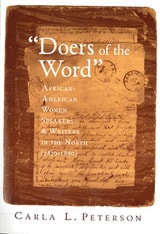
"Doers of the Word"
African-American Women Speakers and Writers in the North (1830-1880)Peterson, Carla L
Rutgers University Press, 1998
In situating these women within the emerging African-American urban communities of the free North, Doers of the Word provides an important counterweight to the vast scholarship on Southern slavery and argues that black "Civil Rights movements" cannot be seen as a purely modern phenomenon. In particular, the book examines the ways in which this Northern black population, despite its heterogeneity, came together and established social organizations that would facilitate community empowerment; yet Peterson's analysis also acknowledges, and seeks to explain, the highly complex relationship of black women to these institutions, a relationship that rendered their stance as public intellectuals all the more bold and defiant.
Peterson begins her study in the 1830s, when a substantial body of oratory and writing by black women first emerged, and traces the development of this writing through the shifting political climate up to the end of Reconstruction. She builds her analyses upon Foucault's interdisciplinary model of discourse with an explicitly feminist approach, drawing upon sermons, spiritual autobiographies, travel and slave narratives, journalism, essays, poetry, speeches, and fiction. From these, Peterson is able to answer several key questions. First, what empowered these women to act, to speak out, and to write? Why, and in what ways, were they marginalized within both the African-American and larger American communities? Where did they act, speak, and write from?
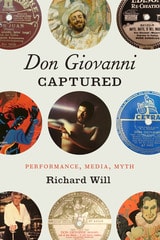
"Don Giovanni" Captured
Performance, Media, MythRichard Will
University of Chicago Press, 2022
Mozart’s opera Don Giovanni has long inspired myths about eros and masculinity. Over time, its performance history has revealed a growing trend toward critique—an increasing effort on the part of performers and directors to highlight the violence and predatoriness of the libertine central character, alongside the suffering and resilience of his female victims.
In “Don Giovanni” Captured, Richard Will sets out to analyze more than a century’s worth of recorded performances of the opera, tracing the ways it has changed from one performance to another and from one generation to the next. Will consults audio recordings, starting with wax cylinders and 78s, as well as video recordings, including DVDs, films, and streaming videos. As Will argues, recordings and other media shape our experience of opera as much as live performance does. Seen as a historical record, opera recordings are also a potent reminder of the refusal of works such as Don Giovanni to sit still. By choosing a work with such a rich and complex tradition of interpretation, Will helps us see Don Giovanni as a standard-bearer for evolving ideas about desire and power, both on and off the stage.
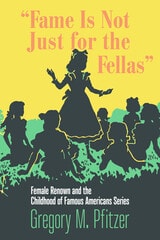
"Fame Is Not Just for the Fellas"
Female Renown and the Childhood of Famous Americans SeriesGregory M. Pfitzer
University of Massachusetts Press, 2022
Finalist of the 2023 SHARP History of the Book Prize
Between 1932 and 1958, thousands of children read volumes in the book series Childhood of Famous Americans. With colorful cover art and compelling—and often highly fictionalized—narrative storylines, these biographies celebrated the national virtues and achievements of famous women like Betsy Ross, Louisa May Alcott, and Amelia Earhart. Employing deep archival research, Gregory M. Pfitzer examines the editorial and production choices of the publisher and considers the influence of the series on readers and American culture more broadly.
In telling the story of how female subjects were chosen and what went into writing these histories for young female readers of the time, Pfitzer illustrates how these books shaped children’s thinking and historical imaginations around girlhood using tales from the past. Utilizing documented conversations and disagreements among authors, editors, readers, reviewers, and sales agents at Bobbs-Merrill, “Fame Is Not Just for the Fellas” places the series in the context of national debates around fame, gender, historical memory, and portrayals of children and childhood for a young reading public—charged debates that continue to this day.
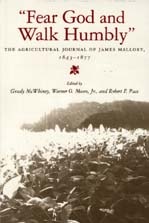
"Fear God and Walk Humbly"
The Agricultural Journal of James Mallory, 1843-1877James Mallory
University of Alabama Press, 1997
Most inhabitants of the Old South, especially the plain folk, devoted more time to leisurely activities—drinking, gambling, hunting, fishing, and just loafing—than did James Mallory, a workaholic agriculturalist, who experimented with new plants, orchards, and manures, as well as the latest farming equipment and techniques. A Whig and a Unionist, a temperance man and a peace lover, ambitious yet caring, business-minded and progressive, he supported railroad construction as well as formal education, even for girls. His cotton production—four bales per field hand in 1850, nearly twice the average for the best cotton lands in southern Alabama and Georgia--tells more about Mallory's steady work habits than about his class status.
But his most obvious eccentricity—what gave him reason to be remembered—was that nearly every day from 1843 until his death in 1877, Mallory kept a detailed journal of local, national, and often foreign news, agricultural activities, the weather, and especially events involving his family, relatives, slaves, and neighbors in Talladega County, Alabama. Mallory's journal spans three major periods of the South's history--the boom years before the Civil War, the rise and collapse of the Confederacy, and the period of Reconstruction after the Civil War. He owned slaves and raised cotton, but Mallory was never more than a hardworking farmer, who described agriculture in poetical language as “the greatest [interest] of all.”
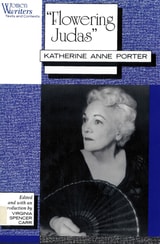
"Flowering Judas"
Katherine Anne PorterCarr, Virginia S
Rutgers University Press, 1993
Katherine Anne Porter often spoke of her story "Flowering Judas" as the tale she liked best of all her stories because it came the nearest to what she meant it to be. It is the story of Laura, an idealistic woman, who travels to Mexico from Arizona at the age of twenty-two to assist the Obreg-n Revolution.
This casebook on "Flowering Judas" addresses Porter's ambivalence surrounding her roles as woman and artist and also attests to the profound influence of Mexico upon her work. Readers of this early tale will not be surprised to learn that although Porter was a practicing feminist in her life and her work, she actually eschewed the feminist label.
Virginia Spencer Carr brings her own sharply focused biographer's eye to the introduction, further illuminating the story and the superb critical essays that it provokes. The casebook includes the authoritative text of the story itself, Porter's own statement regarding the genesis of this highly acclaimed work, an important interview, a collection of significant essays on "Flowering Judas" and the historical, cultural, and personal milieu from which the tale evolved, a bibliography, and a chronology of Porter's life and work.
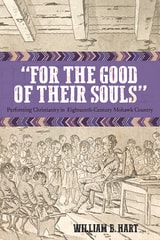
"For the Good of Their Souls"
Performing Christianity in Eighteenth-Century Mohawk CountryWilliam B. Hart
University of Massachusetts Press, 2020
Using the lens of performance theory to explain the ways in which the Mohawks considered converting and participating in Christian rituals, historian William B. Hart contends that Mohawks who prayed, sang hymns, submitted to baptism, took communion, and acquired literacy did so to protect their nation's sovereignty, fulfill their responsibility of reciprocity, serve their communities, and reinvent themselves. Performing Christianity was a means of "survivance," a strategy for sustaining Mohawk life and culture on their terms in a changing world.
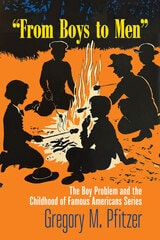
"From Boys to Men"
The Boy Problem and the Childhood of Famous Americans SeriesGregory M. Pfitzer
University of Massachusetts Press, 2024
While adult concern about gender in children’s books has made recent headlines, this discussion is far from new. As Gregory M. Pfitzer reveals, the writers and editors at Bobbs-Merrill, the publisher of the Childhood of Famous Americans book series published between 1932 and 1958, thought carefully about how their books would influence the development of their male readers. These books emphasized inspiring tales over historical accuracy and were written in simple language, with characters, dialogue, and stories that were intended to teach boys how to be successful men.
But this was a specific image of American manhood. Published in an era when sociologists, psychologists, and other experts worried about male delinquency, the men envisioned in these books were steeped in Cold War racial and gender stereotypes, and questions about citizenship and responsibility. Based on deep archival research into the publication history of the series, “From Boys to Men” sheds light on current controversies on children’s books and presentations of gender diversity.
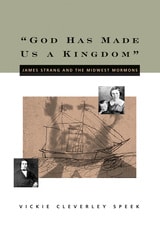
"God Has Made Us a Kingdom"
James Strang and the Midwest MormonsVickie Cleverley Speek
Signature Books, 2006
Strang was considered the prophetic successor to Joseph Smith for the Mormons of the Midwest who later formed the nucleus for the membership of what is now the Community of Christ. Today, 150 years after Strang’s death, about 100 faithful followers in the United States still await the emergence of another prophet to succeed Strang. In the prophetic tradition of Joseph Smith, Strang similarly excavated ancient metallic plates and translated them into the Book of the Law of the Lord and the Rajah Manchou of Vorito. Like Joseph Smith, Strang instigated polygamy, secret ceremonies, baptism for the dead, and communal living. He also introduced a bloomer-like fashion for women, as well as other innovations. Like Joseph Smith, he had himself crowned king of the world.
Where previous treatments of Strang have relied either on inside or outside sources to show either a prophet or charlatan, Speek utilizes all sources, updates the record, corrects previous errors, and shows diverse perspectives. She recounts the turbulent and dramatic events of the 1840s-50s, including the plot to murder Strang and the heartbreaking exile of the Saints from Beaver Island. She traces the dispersion of this once formidable colony of Mormons to the forests of northwest Wisconsin, the far-flung outposts of southwest New Mexico, the hills of Lamoni, Iowa, and to Salt Lake City, Utah.
"Good News from New England" by Edward Winslow
A Scholarly EditionKelly Wisecup
University of Massachusetts Press, 2014
It was in the context of all of these roles that Winslow wrote Good News in an attempt to convince supporters in England that the colonists had established friendly relations with Native groups and, as a result, gained access to trade goods. Although clearly a work of diplomacy, masking as it did incidents of brutal violence against Indians as well as evidence of mutual mistrust, the work nevertheless offers, according to Kelly Wisecup, a more complicated and nuanced representation of the Pilgrims' first years in New England and of their relationship with Native Americans than other primary documents of the period.
In this scholarly edition, Wisecup supplements Good News with an introduction, additional primary texts, and annotations to bring to light multiple perspectives, including those of the first European travelers to the area, Native captives who traveled to London and shaped Algonquian responses to colonists, the survivors of epidemics that struck New England between 1616 and 1619, and the witnesses of the colonists' attack on the Massachusetts.
"Hear O Israel"
The History of American Jewish Preaching, 1654-1970Robert V. Friedenberg
University of Alabama Press, 1989
The only examination of the history of American Jewish preaching, from the settlement of the first Jews in the United States until 1970
"History Is Bunk"
Assembling the Past at Henry Ford's Greenfield VillageJessie Swigger
University of Massachusetts Press, 2014
In 1916 a clearly agitated Henry Ford famously proclaimed that “history is more or less bunk.” Thirteen years later, however, he opened the outdoor history museum Greenfield Village in Dearborn, Michigan. It was written history's focus on politicians and military heroes that was bunk, he explained. Greenfield Village would correct this error by celebrating farmers and inventors.
The village eventually included a replica of Thomas Edison's Menlo Park, New Jersey, laboratory, the Wright brothers' cycle shop and home from Dayton, Ohio, and Ford's own Michigan birthplace. But not all of the structures were associated with famous men. Craft and artisan shops, a Cotswold cottage from England, and two brick slave cabins also populated the village landscape. Ford mixed replicas, preserved buildings, and whole-cloth constructions that together celebrated his personal worldview.
Greenfield Village was immediately popular. But that only ensured that the history it portrayed would be interpreted not only by Ford but also by throngs of visitors and the guides and publicity materials they encountered. After Ford's death in 1947, administrators altered the village in response to shifts in the museum profession at large, demographic changes in the Detroit metropolitan area, and the demands of their customers.
Jessie Swigger analyzes the dialogue between museum administrators and their audiences by considering the many contexts that have shaped Greenfield Village. The result is a book that simultaneously provides the most complete extant history of the site and an intimate look at how the past is assembled and constructed at history museums.

"I Bring My Whole Self
" The Life and Legacy of Sister Thea BowmanAngela McRae
Catholic University of America Press, 2027
"I Hear America Singing"
Folk Music and National IdentityRachel Clare Donaldson
Temple University Press, 2014
In "I Hear America Singing," Rachel Donaldson traces the vibrant history of the twentieth-century folk music revival from its origins in the 1930s through its end in the late 1960s. She investigates the relationship between the revival and concepts of nationalism, showing how key figures in the revival--including Pete Seeger , Alan Lomax, Moses Asch, and Ralph Rinzler--used songs to influence the ways in which Americans understood the values, the culture, and the people of their own nation.
As Donaldson chronicles how cultural norms were shaped over the course of the mid-twentieth century, she underscores how various groups within the revival and their views shifted over time. "I Hear America Singing" provides a stirring account of how and why the revivalists sustained their culturally pluralist and politically democratic Americanism over this tumultuous period in American history.
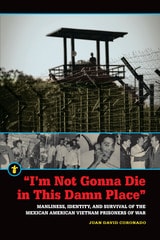
"I'm Not Gonna Die in This Damn Place"
Manliness, Identity, and Survival of the Mexican American Vietnam Prisoners of WarJuan David Coronado
Michigan State University Press, 2018
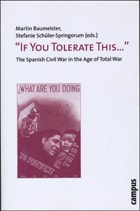
"If You Tolerate This . . . "
The Spanish Civil War in the Age of Total WarEdited by Martin Baumeister and Stefanie Schüler-Springorum
Campus Verlag, 2008
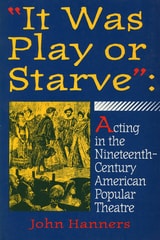
"It Was Play or Starve"
Acting in the Nineteenth-Century American Popular TheatreJohn Hanners
University of Wisconsin Press, 1993
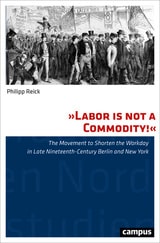
"Labor Is Not a Commodity!"
The Movement to Shorten the Workday in Late Nineteenth-Century Berlin and New YorkPhilipp Reick
Campus Verlag, 2016
As Reick demonstrates, while on both sides of the Atlantic workers opposed the unchecked commodification of labor power as a violation of their political, social, and economic rights, the emerging movements for protection from commodification did not promote a universalist concept of rights. By showing that American and German workers drew upon a strikingly similar rationality when formulating demands, this book reveals that we cannot label either the US labor movement as a deviation from the supposed norm of industrial contestation or its German counterpart as the embodiment of that norm.
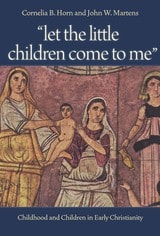
"Let the Little Children Come to Me"
Childhood and Children in Early Christianity"Cornelia B. Horn
Catholic University of America Press, 2009
"Like the Hajis of Meccah and Jerusalem"
Orientalism and the Mormon ExperienceRichard Francaviglia
Utah State University Press, 2012
The series, established by one of the twentieth-century West's most distinguished historians, Leonard Arrington, has become a leading forum for prominent historians to address topics related to Mormon history. The first lecturer was Arrington himself. He was followed by Richard Lyman Bushman, Richard E. Bennett, Howard R. Lamar, Claudia L. Bushman, Kenneth W. Godfrey, Jan Shipps, Donald Worster, Laurel Thatcher Ulrich, and F. Ross Peterson. Utah State University hosts the Leonard J. Arrington Mormon History Lecture Series. The University Libraries' Special Collections and Archives houses the Arrington collection. The state's land grant university began collecting records very early, and in the 1960s became a major depository for Utah and Mormon records. Leonard and his wife Grace joined the USU faculty and family in 1946, and the Arringtons and their colleagues worked to collect original diaries, journals, letters, and photographs.
Although trained as an economist at the University of North Carolina, Arrington became a Mormon historian of international repute. Working with numerous colleagues, the Twin Falls, Idaho, native produced the classic Great Basin Kingdom: An Economic History of the Latter-day Saints in 1958. Utilizing available collections at USU, Arrington embarked on a prolific publishing and editing career. He and his close ally, Dr. S. George Ellsworth helped organize the Western History Association, and they created the Western Historical Quarterly as the scholarly voice of the WHA. While serving with Ellsworth as editor of the new journal, Arr ington also helped both the Mormon History Association and the independent journal Dialogue get established.
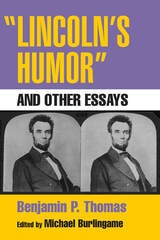
"Lincoln's Humor" and Other Essays
Benjamin P. Thomas. Edited by Michael Burlingame
University of Illinois Press, 2006
A skilled historian and a masterful storyteller himself, Thomas was widely regarded as the greatest Lincoln historian of his generation. With these essays, he combines historical depth with narrative grace in delineating Lincoln's qualities as a humorist, lawyer, and politician. From colorful tall tales to clever barbs aimed at political opponents, Lincoln clothed a shrewd wit in a homespun, backwoods vernacular. He used humor to defuse tension, illuminate a point, put others at ease--and sometimes for sheer fun. From an early reliance on broad humor and ridicule in speeches and on the stump, Lincoln's style shifted in 1854 to a more serious vein in which humor came primarily to elucidate an argument. "If I did not laugh occasionally I should die," he is said to have told his cabinet, "and you need this medicine as much as I do." Thomas brings his deep knowledge of Lincoln to essays on the great man's tumultuous career in Congress, his work as a lawyer, his experiences in the Courts, and his opinions of the South. A gracious survey of Lincoln's early biographers, particularly Ida Tarbell, stands alongside an appreciation of Harry Edward Pratt, a key figure in the early days of the Abraham Lincoln Association. Thomas also assesses Lincoln's use of language and the ongoing significance of the Gettysburg Address.
This diverse collection is enhanced by an introduction by Michael Burlingame, himself a leading biographer of Lincoln. Burlingame provides a balanced portrait of Thomas and his circuitous path toward writing history.

"Mr. Taxpayer versus Mr. Tax Spender"
Taxpayers' Associations, Pocketbook Politics, and the Law during the Great DepressionLinda Upham-Bornstein
Temple University Press, 2023
“Mr. Taxpayer versus Mr. Tax Spender” presents a comprehensive overview of these grassroots taxpayers’ leagues beginning in the 1860s and shows how they evolved during their heyday in the 1930s. Linda Upham-Bornstein chronicles the ways these taxpayers associations organized as well as the tools they used—constructive economy, political efforts, tax strikes, and tax revolt through litigation—to achieve their objectives.
Taxpayer activity was a direct consequence of—and a response to—the economic crisis of the Great Depression and the expansion of the size and scope of government. “Mr. Taxpayer versus Mr. Tax Spender” connects collective tax resistance in the 1930s to the populist tradition in American politics and to other broad impulses in American political and legal history.
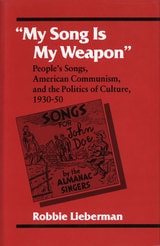
"My Song Is My Weapon"
People's Songs, American Communism, and the Politics of Culture, 1930-50Robbie Lieberman
University of Illinois Press, 1989

"Negro and White, Unite and Fight!"
A Social History of Industrial Unionism in Meatpacking, 1930-90Roger Horowitz
University of Illinois Press, 1997
This pathbreaking study traces the rise--and subsequent fall--of the United Packinghouse Workers of America (UPWA). Roger Horowitz looks at local leaders and meatpacking workers in Chicago, Kansas City, Sioux City, and Austin, Minnesota, closely examining the unionizing of the workplace and the prominent role of black workers and women in UPWA.
Horowitz shows how three major firms in U.S. meat production and distribution became dominant by virtually eliminating union power. The union's decline, he argues, reflected massive pressure by capital for lower labor costs and greater control over the work process. In the end, the victorious firms were those that had been most successful at increasing the rate of exploitation of their workers, who now labor in conditions as bad as those of a century ago.
"No Legs, No Jokes, No Chance"
A History of the American Musical TheaterSheldon Patinkin
Northwestern University Press, 2008
Patinkin writes about the infancy of the musical--the revues, operettas, and early musical comedies, as well as the groundbreaking shows like Oklahoma!, and Show Boat that brought the form to its "golden age" during World War II. With insightful references to how history, literature, theater, fashion, popular music, and movies influenced musical theater generally and certain shows in particular, he traces a direct lineage from older forms to contemporary musicals. The result is a broad, clear, and detailed picture of American musicals within both an aesthetic and a historical context. Patinkin conveys the pleasure of the ever-changing forms of musical theater even as he gives readers the analytical tools and terms to understand and better appreciate this uniquely American art. The book features a selection of black and white photographs from historical musical productions, and each chapter includes suggestions for materials to watch and listen to at home or in the classroom.
"Not Altogether Human"
Pantheism and the Dark Nature of the American RenaissanceRichard Hardack
University of Massachusetts Press, 2012
Many leading American thinkers in the nineteenth century, who accepted the premises of Emersonian transcendentalism, valued the basic concept of pantheism: that God inheres in nature and in all things, and that a person could achieve a sense of belonging she or he lacked in society by seeking a oneness with all of nature. As Richard Hardack shows, however, writers such as Ralph Waldo Emerson, Nathaniel Hawthorne, and Herman Melville conceived of nature as everything “Other”—other than the white male Protestant culture of which they were a part. This conception of nature, then, became racialized, and the divine became associated with African American and Native American identities, as well as with femininity.
In "Not Altogether Human," Hardack reevaluates transcendentalism in the context of nineteenth-century concerns about individual and national racial identity. Elucidating the influence of pantheism, Hardack draws on an array of canonical and unfamiliar materials to remap the boundaries of what has long been viewed as white male transcendental discourse.
This book significantly revises notions of what transcendentalism and pantheism mean and how they relate to each other. Hardack's close analysis of pantheism and its influence on major works and lesser known writing of the nineteenth century opens up a new perspective on American culture during this key moment in the country's history.
"Of Our New Day Begun"
A Memoir of the Origins and Early Years of the National Council for Black StudiesWilliam M. King
University Press of Colorado, 2027
A primary source–rich account of the founding of the National Council for Black Studies, "Of Our New Day Begun" is both a personal and institutional story. Through a composite of personal recollection and historical research, author William M. King recounts the story of the people, events, and processes involved in the prelude, formation, and initiation of the council through the first five years of its existence.
In "Of Our New Day Begun" King fuses two separate and distinct stories: the story of the creation and evolution of the Black Studies program at the University of North Carolina, Charlotte, and the story of how the specific needs of that program—especially accreditation—led to the creation of the NCBS. For the first part of the story, King relies on Bertha Maxwell-Roddey's 1974 doctoral dissertation, supplemented with additional archival documents and conversations. The second part of the story is based primarily on King’s memories, files, and research as one of the founders of NCBS, supplemented by interviews; materials from the NCBS archives; local, regional, and national newspaper accounts; and additional secondary materials.
Part memoir and part institutional history, "Of Our New Day Begun" is also a story about how to build an institution during times of social change. A reconstruction of the sights, sounds, ideas, and birth pangs King witnessed and experienced and the meanings he has come to make of them, this work is a significant contribution to the story of race and race relations in the United States during the mid to late twentieth century.

"Other Sheep I Have" The Autobiography of Father Paul M. Washington
Paul Washington
Temple University Press, 1994
Father Paul M. Washington rose to local and nation prominence as an unflagging supporter of civil and women's rights. One of a handful of black priests in a traditionally white church, he fought for understanding among all people, eventually serving twenty-five years as the Rector of the Episcopal Church of the Advocate in an inner-city Philadelphia neighborhood. Though his ideas about equality often went against the views of the Episcopal church leadership, he rejected threats of withdrawn funding or retaliation to follow his heart and his theology.
Father Washington's story is a window of insight into the struggles for justice and dignity in the latter half of the twentieth century. In the tumultuous 1960s he supported the Black Power movement, the Black Panther Party, and many other groups working for peace and justice, providing meeting places and guidance. He often found himself in the midst of racial disturbances—the riots on Susquehanna Avenue in 1963 and on Columbia Avenue in 1964, in front of the Board of Education where high school students protested the Eurocentric curriculum, and outside the walls of Girard College where citizens and civic leaders demonstrated against the school's exclusion of black children. In the 1980s, he helped Philadelphia city officials negotiate with MOVE members and was a vocal supporter of Ramona Africa, fighting for her release from prison. It was in his church on the corner of 18th and Diamond Streets that women were first ordained a priests in the Episcopal church. And it was one of his congregation, Barbara Harris, who became the first female Episcopal bishop.
In his evocative voice, Father Washington describes the pivotal events of his life and how each impacted upon his evolving ideas of the relationship between religion and justice. Spanning seven decades, his account is at once an insightful and unique historical account of political action, of the reformation of the church, of the changing urban landscape, and of a life graced by leadership and spiritual enlightenment.
"Our Aim Was Man"
Andrew's Sharpshooters in the American Civil WarRoberta Senechal de la Roche
University of Massachusetts Press, 2016
One was a father who worried about his fellow soldiers' swearing. Another hoped to enter Harvard College. The third was a farmer whose letters home depict the later stages of the war. The fourth had turned to boot making when he did not inherit land. Based on the letters, diaries, and memoirs of four members of the First Company Massachusetts Sharpshooters, known as Andrew's Sharpshooters, this book provides a rare glimpse into the experiences of Union Army snipers. The company was one of the first units in American military history to be equipped with telescope-sighted rifles to enable long-distance targeting. Despite complaints that snipers violated codes of honorable combat, the members of Andrew's Sharpshooters generally expressed quiet pride in being an elite unit of highly skilled soldiers—"cool blooded sharpshooters," as one of them said.
Introduced and edited by Roberta Senechal de la Roche, these primary accounts include new details about the equipment, training, and deployment of snipers in the Army of the Potomac. They also reveal the challenges of covert warfare and include rich detail on the everyday problems of Civil War soldiers, including bad food, disease, punishing marches, and homesickness. The collected documents also convey the trials of those left on the home front.
"Rights, Not Roses"
Unions and the Rise of Working-Class Feminism, 1945-80Dennis A. Deslippe
University of Illinois Press, 2000
Educated, white collar professional women carried the most visible banners of feminism. But working class women were a powerful force in the campaign for gender equality. Dennis A. Deslippe explores how unionized wage-earning women led the struggle to place women's employment rights on the national agenda, decisively influencing both the contemporary labor movement and second-wave feminism.
Deslippe's account unravels a complex history of how labor leaders accommodated and resisted working women's demands for change. Through case studies of unions representing packinghouse and electrical workers, Deslippe explains why gender equality emerged as an issue in the 1960s and how the activities of wage-earning women in and outside of their unions shaped the content of the debate. He also traces the fault lines separating working-class women--who sought gender equality within the parameters of unionist principles such as seniority--from middle-class women--who sought an equal rights amendment that would guarantee an abstract equality for all women.
Thoughtful and detailed, "Rights, Not Roses" offers a new look at the complexities of working-class feminism.
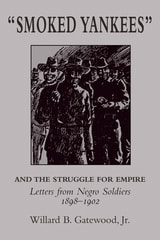
"Smoked Yankees" and the Struggle for Empire
Letters from Negro Soldiers, 1898–1902Willard Gatewood
University of Arkansas Press, 1987
Called upon for the first time to render military service outside the States, Negro soldiers (called Smoked Yankees by the Spaniards) were eager to improve their status at home by fighting for the white man in the Spanish-American War. Their story is told through countless letters sent to black U.S. newspapers that lacked resources to field their own reporters. The collection constitutes a remarkably complete and otherwise undisclosed amount of the black man’s role in—and attitude toward—America’s struggle for empire.
In first-hand reports of battles in the Philippine Islands and Cuba, Negro soldiers wrote from the perspective of dispossessed citizens struggling to obtain a larger share of the rights and privileges of Americans.
These letters provide a fuller understanding of the exploits of black troops through their reports of military activities and accounts of foreign peoples and its cultures.
"Songes of Rechelesnesse"
Langland and the FranciscansLawrence M. Clopper
University of Michigan Press, 1997
In the late Middle Ages, Franciscan friars had a significant impact on all levels of society.
But because of the apparent discrepancy between the poverty the Franciscans claimed and the life they lived, a large body of antifraternal literature arose, including, supposedly, Piers Plowman. Since the sixteenth century, when it was first put into print, Piers Plowman has been understood to be a proto-Protestant work that revealed the failures of the medieval clergy, but especially of the mendicant orders. In "Songes of Rechelesnesse," Clopper establishes the presence of a Franciscan reformist position in Piers Plowman.
Clopper maintains that the poem articulates a reformist agenda, presenting the internal Franciscan debate, in a bid to return the order to its initial foundation. Clopper believes that Langland is deeply imbued with a Franciscan mentality that reaches deep into the structure of the poem. It manifests itself at the level of the alliterative long line in his exemplarist poetics and is the source of his imagery and politics. In short Clopper identifies Franciscanism as holding the poem together.
"Songes of Rechelesnesse" is a historical, political, and religious history of late fourteenth-century England. It will be of interest to literary scholars, historians of the late Middle Ages, and scholars in religious studies.
Lawrence M. Clopper is Director, Medieval Studies Institute, and Professor of English, Indiana University.
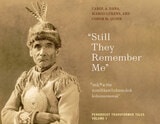
"Still They Remember Me"
Penobscot Transformer Tales, Volume 1Carol A. Dana, Margo Lukens, and Conor M. Quinn
University of Massachusetts Press, 2021
In "Still They Remember Me," stories are presented in the Penobscot language and English side-by-side, coupled with illustrations from members of the tribal community. For the first time, these stories are accessible to a young generation of Penobscot language learners and scholars of Native American literatures at all levels, from grade school to graduate school.
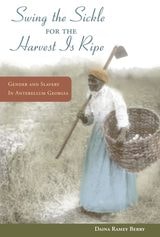
"Swing the Sickle for the Harvest is Ripe"
Gender and Slavery in Antebellum GeorgiaDaina Ramey Berry
University of Illinois Press, 2010
"Swing the Sickle for the Harvest Is Ripe" compares the work, family, and economic experiences of enslaved women and men in upcountry and lowland Georgia during the nineteenth century. Mining planters' daybooks, plantation records, and a wealth of other sources, Daina Ramey Berry shows how slaves' experiences on large plantations, which were essentially self-contained, closed communities, contrasted with those on small plantations, where planters' interests in sharing their workforce allowed slaves more open, fluid communications. By inviting readers into slaves' internal lives through her detailed examination of domestic violence, separation and sale, and forced breeding, Berry also reveals important new ways of understanding what it meant to be a female or male slave, as well as how public and private aspects of slave life influenced each other on the plantation.
A volume in the series Women in American History, edited by Anne Firor Scott, Susan Armitage, Susan K. Cahn, and Deborah Gray White
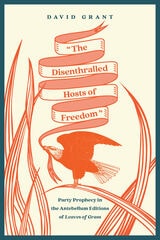
"The Disenthralled Hosts of Freedom"
Party Prophecy in the Antebellum Editions of Leaves of GrassDavid Grant
University of Iowa Press, 2021
Anti-slavery party discourse set itself the task of curing an ailing people who had grown compliant, inert, and numb; it fashioned a complete fictional world where the people could be reactivated into assuming their true role in the republic. Both as a cause and a result of this rejuvenation, they would come into their own and spread their energies over the land and over the body politic, thereby rescuing their country at the last minute from what would otherwise be the permanent dominion of slavery. Party discourse had long hinged its success on such magical transformations of the people individually and collectively, and Whitman’s celebrations of his nation’s potential need to be seen in this context: like his party, Whitman calls on the people to reject their own subordination and take command of the future, and redeem themselves as they also redeem the nation.
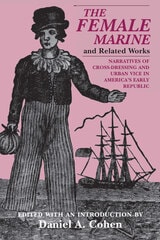
"The Female Marine" and Related Works
Narratives of Cross-Dressing and Urban Vice in America's Early RepublicDaniel A. Cohen
University of Massachusetts Press, 1997
The alternately racy and moralistic narrative recounts the adventures of a young woman from rural Massachusetts who is seduced by a false-hearted lover, flees to Boston, and is entrapped in a brothel. She eventually escapes by disguising herself as a man and serves with distinction on board the U.S. frigate Constitution during the War of 1812. After subsequent onshore adventures in and out of male dress, she is happily married to a wealthy New York gentleman.
In his introduction, Daniel A. Cohen situates the story in both its literary and historical contexts. He explains how the tale draws upon a number of popular Anglo-American literary genres, including the female warrior narrative, the sentimental novel, and the urban exposé. He then explores how The Female Marine reflects early-nineteenth-century anxieties concerning changing gender norms, the expansion of urban prostitution, the growth of Boston's African American community, and feelings of guilt aroused by New England's notoriously unpatriotic activities during the War of 1812.