Results by title
1488 books match the query 'Media Studies' and 7 start with a non-letter
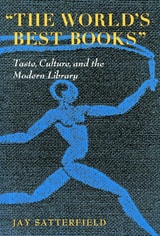
"The World's Best Books"
Taste, Culture, and the Modern LibraryJay Satterfield
University of Massachusetts Press, 2002
In October 1930, Macy's department store in New York City used the inexpensive book series “The Modern Library of the World's Best Books” as a loss-leader to draw customers into the store. Selling for only nine cents a copy, the small-format, modern classics attracted crowds of buyers. Businessmen, housewives, students, bohemian intellectuals, and others waited in long lines to purchase affordable hard-bound copies of works by the likes of Tolstoy, Wilde, Joyce, and Woolf. It was a significant moment in American cultural history, demonstrating that a series of books respected and praised by the nation's self-appointed arbiters of taste could attract a throng of middle-class consumers without damaging its reputation as a vehicle of “serious culture.”
The Modern Library's reputation stands in sharp contrast to that of similar publishing ventures dismissed by critics as agents of “middlebrow culture,” such as the Book of-the-Month Club. Writers for the New Republic, the Nation, and the Bookman expressed their fears that mass-production and new distribution schemes would commodify literature and deny the promise of American culture. Yet although the Modern Library offered the public a uniformly packaged, preselected set of “the World's Best Books,” it earned the praise of these self-consciously intellectual critics.
Focusing on the Modern Library's marketing strategies, editorial decisions, and close attention to book design, Jay Satterfield explores the interwar cultural dynamics that allowed the publisher of the series to exploit the forces of mass production and treat books as commodities while still positioning the series as a revered cultural entity. So successful was this approach that the modern publishing colossus Random House was built on the reputation, methods, and profits of the Modern Library.
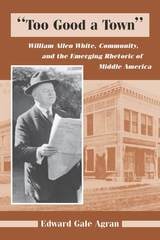
"Too Good a Town"
William Allen White, Community, and the Emerging Rhetoric of Middle AmericaEdward G. Agran
University of Arkansas Press, 1999
For fifty years, William Allen White, first as a reporter and later as the long-time editor of the Emporia Gazette, wrote of his small town and its Mid-American values. By tailoring his writing to the emerging urban middle class of the early twentieth century, he won his “gospel of Emporia” a nationwide audience and left a lasting impact on he way America defines itself.
Investigating White’s life and his extensive writings, Edward Gale Agran explores the dynamic thought of one of America’s best-read and most-respected social commentators. Agran shows clearly how White honed his style and transformed the myth of conquering the western frontier into what became the twentieth-century ideal of community building.
Once a confidante of and advisor to Theodore Roosevelt, White addressed, and reflected in his work, all the great social and political oscillations of his time—urbanization and industrialism, populism, and progressivism, isolationism internationalism, Prohibition, and New Deal reform. Again and again, he asked the question “What’s the matter?” about his times and townspeople, then found the middle ground. With great care and discernment, Agran gathers the man strains of White’s messages, demonstrating one writer’s pivotal contribution to our idea of what it means to be an American.
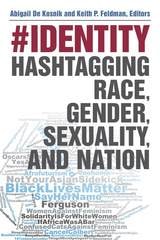
#identity
Hashtagging Race, Gender, Sexuality, and NationAbigail De Kosnik and Keith P. Feldman, editors
University of Michigan Press, 2019
#identity is among the first scholarly books to address the positive and negative effects of Twitter on our contemporary world. Hailing from diverse scholarly fields, all contributors are affiliated with The Color of New Media, a scholarly collective based at the University of California, Berkeley. The Color of New Media explores the intersections of new media studies, critical race theory, gender and women’s studies, and postcolonial studies. The essays in #identity consider topics such as the social justice movements organized through #BlackLivesMatter, #Ferguson, and #SayHerName; the controversies around #WhyIStayed and #CancelColbert; Twitter use in India and Africa; the integration of hashtags such as #nohomo and #onfleek that have become part of everyday online vernacular; and other ways in which Twitter has been used by, for, and against women, people of color, LGBTQ, and Global South communities. Collectively, the essays in this volume offer a critically interdisciplinary view of how and why social media has been at the heart of US and global political discourse for over a decade.

'I am an American'
Filming the Fear of DifferenceCynthia Weber
Intellect Books, 2011
Far more than a mere remembrance book about September 11, ‘I am an American’ offers precisely the kind of ground-level empathy needed to reignite a meaningful national debate about who we are and who we might become as a people and a nation.
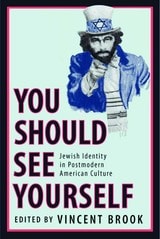
'You Should See Yourself'
Jewish Identity in Postmodern American CultureBrook, Vincent
Rutgers University Press, 2006
The past few decades have seen a remarkable surge in Jewish influences on American culture. Entertainers and artists such as Jerry Seinfeld, Adam Sandler, Allegra Goodman, and Tony Kushner have heralded new waves of television, film, literature, and theater; a major klezmer revival is under way; bagels are now as commonplace as pizza; and kabbalah has become as cool as crystals. Does this broad range of cultural expression accurately reflect what it means to be Jewish in America today?
Bringing together fourteen new essays by leading scholars, You Should See Yourself examines the fluctuating representations of Jewishness in a variety of areas of popular culture and high art, including literature, the media, film, theater, music, dance, painting, photography, and comedy. Contributors explore the evolution that has taken place within these cultural forms and how we can best explain these changes. Are variations in our understanding of Jewishness the result of general phenomena such as multiculturalism, politics, and postmodernism, or are they the product of more specifically Jewish concerns such as the intermarriage/continuity crisis, religious renewal, and relations between the United States and Israel?
Accessible to students and general readers alike, this volume takes an important step toward advancing the discussion of Jewish cultural influences in this country.
6+1 Proposals for Journalism
Navigating Converging PressuresEdited by Chrysi Dagoula and Sofia Iordanidou
Intellect Books, 2022
In 2003, Shayne Bowman and Chris Willis wrote that “journalism is in the process of redefining itself, adjusting to the disruptive forces surrounding it.” Almost two decades later, discussions surrounding journalism and its future have not shifted as much as one would expect. The ensuing years have seen massive changes in the media landscape, great leaps in technological developments, financial crises, and the emergence of social media platforms, to name a few examples. It could be argued that we still share the same concerns.
This book is a dialogue, with each chapter highlighting threats to journalism’s future and pointing to direct proposals, indicating the steps needed to safeguard and enhance journalism. Issues in the industry that need to be addressed include current employment conditions, the dominance of web giants over crowdfunding, the lack of collaboration between professionals and academia, subpar media literacy, and elements of media regulation.
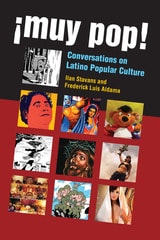
¡Muy Pop!
Conversations on Latino Popular CultureIlan Stavans and Frederick Luis Aldama
University of Michigan Press, 2013
Although investigations of Hispanic popular culture were approached for decades as part of folklore studies, in recent years scholarly explorations—of lucha libre, telenovelas, comic strips, comedy, baseball, the novela rosa and the detective novel, sci-fi, even advertising—have multiplied. What has been lacking is an overarching canvas that offers context for these studies, focusing on the crucial, framing questions: What is Hispanic pop culture? How does it change over time and from region to region? What is the relationship between highbrow and popular culture in the Hispanic world? Does it make sense to approach the whole Hispanic world as homogenized when understanding Hispanic popular culture? What are the differences between nations, classes, ethnic groups, religious communities, and so on? And what distinguishes Hispanic popular culture in the United States?
In ¡Muy Pop!, Ilan Stavans and Frederick Luis Aldama carry on a sustained, free-flowing, book-length conversation about these questions and more, concentrating on a wide range of pop manifestations and analyzing them at length. In addition to making Hispanic popular culture visible to the first-time reader, ¡Muy Pop! sheds new light on the making and consuming of Hispanic pop culture for academics, specialists, and mainstream critics.