Results by title
4917 books match the query 'Philosophy' and 20 start with a non-letter
"A Marvelous Work"
Reading Mormonism in West AfricaLaurie F. Maffly-Kipp
Utah State University Press, 2022
The Arrington Lecture series, established by one of the twentieth-century West's most distinguished historians, Leonard Arrington, has become a leading forum for prominent historians to address topics related to Mormon history. Utah State University hosts the Leonard J. Arrington Mormon History Lecture Series through the Merrill-Cazier Library Special Collections and Archives department.
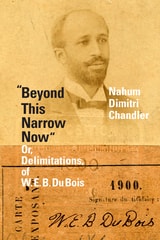
"Beyond This Narrow Now"
Or, Delimitations, of W. E. B. Du BoisNadhum Dimitri Chandler
Duke University Press, 2022
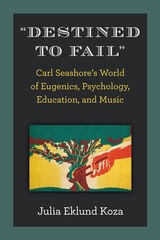
"Destined to Fail"
Carl Seashore’s World of Eugenics, Psychology, Education, and MusicJulia Eklund Koza
University of Michigan Press, 2021
A little-known fact about the prominent US psychologist and educator Carl E. Seashore (1866–1949) is that he was deeply involved in the American eugenics movement. He was among the US academics to support eugenics long before German Nazis embraced it. A titan in a host of disciplines and a proponent of radical education reform, Seashore used his positional power to promote a constellation of education reforms consistent with central precepts of eugenics. Many of these reforms, including tracking, gifted and talented programs, and high-stakes standardized testing, were adopted and remain standard practice in the United States today. He promulgated the idea that musical talent is biologically inheritable, and he developed the first standardized tests of musical talent; these tests were used by early-twentieth-century researchers in their attempts to determine whether there are race differences in musical talent. Seashore’s ideas and work profoundly shaped music education’s research trajectory, as well as enduring “commonsense” beliefs about musical ability. An intersectional analysis, “Destined to Fail” focuses on the relationship between eugenics and Seashore’s views on ability, race, and gender. Koza concludes that Seashore promoted eugenics and its companion, euthenics, because he was a true believer. She also discusses the longstanding silences surrounding Seashore’s participation in eugenics. As a diagnosis and critique of the present, “Destined to Fail” identifies resemblances and connections between past and present that illustrate the continuing influence of eugenics—and the systems of reasoning that made early-twentieth-century eugenics imaginable and seem reasonable—on education discourse and practice today. It maps out discursive, citational, and funding connections between eugenicists of the early twentieth-century and contemporary White supremacists; this mapping leads to some of Donald Trump’s supporters and appointees.
"Discourse and Truth" and "Parresia"
Michel Foucault
University of Chicago Press, 2019
These lectures—carefully edited and including notes and introductory material to fully illuminate Foucault’s insights—are a major addition to Foucault’s English language corpus.
"Not Altogether Human"
Pantheism and the Dark Nature of the American RenaissanceRichard Hardack
University of Massachusetts Press, 2012
Many leading American thinkers in the nineteenth century, who accepted the premises of Emersonian transcendentalism, valued the basic concept of pantheism: that God inheres in nature and in all things, and that a person could achieve a sense of belonging she or he lacked in society by seeking a oneness with all of nature. As Richard Hardack shows, however, writers such as Ralph Waldo Emerson, Nathaniel Hawthorne, and Herman Melville conceived of nature as everything “Other”—other than the white male Protestant culture of which they were a part. This conception of nature, then, became racialized, and the divine became associated with African American and Native American identities, as well as with femininity.
In "Not Altogether Human," Hardack reevaluates transcendentalism in the context of nineteenth-century concerns about individual and national racial identity. Elucidating the influence of pantheism, Hardack draws on an array of canonical and unfamiliar materials to remap the boundaries of what has long been viewed as white male transcendental discourse.
This book significantly revises notions of what transcendentalism and pantheism mean and how they relate to each other. Hardack's close analysis of pantheism and its influence on major works and lesser known writing of the nineteenth century opens up a new perspective on American culture during this key moment in the country's history.
"The Useless Mouths" and Other Literary Writings
Simone de Beauvoir; Edited by Margaret A. Simons and Marybeth Timmermann; Foreword by Sylvie Le Bon de Beauvoir
University of Illinois Press, 2021
The volume begins with a new translation of the 1945 play The Useless Mouths, written in Paris during the Nazi occupation. Other pieces were discovered after Beauvoir's death in 1986, such as the 1965 short novel "Misunderstanding in Moscow," involving an elderly French couple who confront their fears of aging. Two additional previously unknown texts include the fragmentary "Notes for a Novel," which contains the seed of what she later would call "the problem of the Other," and a lecture on postwar French theater titled Existentialist Theater. The collection notably includes the eagerly awaited translation of Beauvoir's contribution to a 1965 debate among Jean-Paul Sartre and other French writers and intellectuals, "What Can Literature Do?"
Prefaces to well-known works such as Bluebeard and Other Fairy Tales,La Bâtarde, and James Joyce in Paris: His Final Years are also available in English for the first time, alongside essays and other short articles. A landmark contribution to Beauvoir studies and French literary studies, the volume includes informative and engaging introductory essays by prominent and rising scholars.
Contributors are Meryl Altman, Elizabeth Fallaize, Alison S. Fell, Sarah Gendron, Dennis A. Gilbert, Laura Hengehold, Eleanore Holveck, Terry Keefe, J. Debbie Mann, Frederick M. Morrison, Catherine Naji, Justine Sarrot, Liz Stanley, Ursula Tidd, and Veronique Zaytzeff.
"What Is Critique?" and "The Culture of the Self"
Michel Foucault
University of Chicago Press, 2024
Newly published lectures by Foucault on critique, Enlightenment, and the care of the self—now in paperback.
On May 27, 1978, Michel Foucault gave a lecture to the French Society of Philosophy where he redefined his entire philosophical project in light of Immanuel Kant’s 1784 text “What Is Enlightenment?” Foucault strikingly characterizes critique as the political and moral attitude consisting in the “art of not being governed like this,” one that performs the function of destabilizing power relations and creating the space for a new formation of the self within the “politics of truth.”
This volume presents the first critical edition of this crucial lecture alongside a previously unpublished lecture about the culture of the self and three public debates with Foucault at the University of California, Berkeley, in April 1983. There, for the first time, Foucault establishes a direct connection between his reflections on the Enlightenment and his analyses of Greco-Roman antiquity. However, far from suggesting a return to the ancient culture of the self, Foucault invites his audience to build a “new ethics” that bypasses the traditional references to religion, law, and science.
"Work Hard, Study . . . and Keep Out of Politics!"
James A. Baker III with Steve Fiffer
Northwestern University Press, 2008
Beginning in 1975 with the Ford administration, in a job procured for him by friend and tennis partner George H. W. Bush, Baker was in the thick of American politics. He recounts the inside story of Ford’s rejection of Reagan as a running mate in 1976 with the same insight he has into Reagan’s rejection of Ford four years later. When the White House was plunged into turmoil after the Reagan assassination attempt, he was there, and his stories take readers deeper into those chaotic days. Baker was on hand for the George H. W. Bush campaign’s battle over running mate Dan Quayle and, more recently, he was again on the front row as George W. Bush fought it out in Florida. Spellbinding and frank, his stories are the ones between the lines of our history books.
In this new edition, Baker also responds for the first time in print to the George W. Bush administration’s reaction to the Iraq Study Group Report, written with his input. Baker is very qualified to comment on the political operation of the current administration, and his new writing for this paperback brings the full weight of his experience to bear.
"Work on Oneself"
Wittgenstein's Philosophical Psychology (Institute for the Psychological Sciences Monograph Series, Volume 1)Fergus Kerr
Catholic University of America Press, 2008

#Triggered
Social Media, Subjectivity, and the Struggle for Safe SpaceSean Johnson Andrews
University of Michigan Press, 2027
In this time of social crisis and revolutionary change, words have become one of the key sites of social struggle. Using a framework informed by trans studies, critical race theory, and digital media studies, #Triggered looks at the peak period of progressive social media activism in the U.S. and argues that it is primarily a struggle over whether it is safe for each of us to be ourselves, openly, publicly, proudly, and without permission from the dominant culture.
The term “triggered” and the concept of the trigger warning are just two of many emergent sites of struggle. This book provides a contextual, theoretical history to consider them alongside movements like #BlackLivesMatter, #MeToo, and #TimesUp and concepts like cultural appropriation, “cancel culture,” and safe spaces. These on- and offline struggles have transformed the way we talk, the words we use, and the dominant cultural conversation of race, gender, sexuality, police violence, trauma, and equity. And yet the status quo is still one where marginalized individuals are made to fear for their lives if they do not exhibit the appropriate care and deference. #Triggered invites readers to consider the legitimate complaints about oppressive systems underlying this social crisis, the hierarchy of traumas and subjectivity these movements are opposing, and the opportunity to develop a more open and less repressive society and culture.
(New) Fascism
Contagion, Community, MythNidesh Lawtoo
Michigan State University Press, 2019
10 Geographic Ideas That Changed the World
Hanson, Susan
Rutgers University Press, 1997
The contributors, who include several past presidents of the Association of American Geographers, members of the National Academy of Sciences, and authors of major works in the discipline, are: Elizabeth K. Burns, Patricia Gober, Anne Godlewska, Michael F. Goodchild, Susan Hanson, Robert W. Kates, John R. Mather, William B. Meyer, Mark Monmonier, Edward Relph, Edward J. Taaffe, and B. L. Turner, II.
1650-1850
Ideas, Aesthetics, and Inquiries in the Early Modern Era (Volume 25)Kevin L. Cope
Bucknell University Press, 2020
About the annual journal 1650-1850
1650-1850 publishes essays and reviews from and about a wide range of academic disciplines—literature (both in English and other languages), philosophy, art history, history, religion, and science. Interdisciplinary in scope and approach, 1650-1850 emphasizes aesthetic manifestations and applications of ideas, and encourages studies that move between the arts and the sciences—between the “hard” and the “humane” disciplines. The editors encourage proposals for “special features” that bring together five to seven essays on focused themes within its historical range, from the Interregnum to the end of the first generation of Romantic writers. While also being open to more specialized or particular studies that match up with the general themes and goals of the journal, 1650-1850 is in the first instance a journal about the artful presentation of ideas that welcomes good writing from its contributors.
First published in 1994, 1650-1850 is currently in its 25th volume.
ISSN 1065-3112.
Published by Bucknell University Press. Distributed worldwide by Rutgers University Press.
1650-1850
Ideas, Aesthetics, and Inquiries in the Early Modern Era (Volume 30)Kevin L. Cope
Bucknell University Press, 2025
The contributors to volume 30 join with Enlightenment thinkers in pulling, pushing, and stretching the elastic boundaries of human experience. Essays on comical apocalypticism, the evolution of satire, and the Asian periphery of English literature open a volume that offers two special features on extreme aspects of a modernizing world. The first probes the undiscovered world of last wills and testaments, while the second explores the soaring world of eighteenth-century birds. As always, 1650–1850 culminates in a bevy of book reviews critiquing the latest scholarship on long-established specialties, unusual subjects, and broad reevaluations of the period.
Published by Bucknell University Press. Distributed worldwide by Rutgers University Press.
ISSN: 1065-3112
1650-1850
Ideas, Aesthetics, and Inquiries in the Early Modern Era (Volume 31)Kevin L. Cope
Bucknell University Press, 2026
Exploratory, investigative, and energetically analytical, 1650–1850 covers the full expanse of long-eighteenth-century thought, writing, and art while delivering abundant revelatory detail. Essays on well-known cultural figures combine with studies of emerging topics to unveil a vivid rendering of a dynamic period, simultaneously committed to singular genius and universal improvement. Welcoming research on all nations and language traditions, 1650–1850 invites readers into a truly global Enlightenment.
The contributors to volume 31 join with Enlightenment thinkers in charting the outposts of long eighteenth-century culture while discovering new features in seemingly familiar terrain. Essays explore outlandish but often observed activities such as medical quackery, Rosicrucian hermeticism, and the oral antics associated with the twisted “Malaprop” tradition. In happy contrast, the volume offers the second half of a sparkling special feature on the most familiar of all substances, water. Contributors lead us through an astounding assortment of aqueous topics, from the heritage of The Compleat Angler to the sanctified sprinklings of holy water. As always, 1650–1850 culminates in a bevy of full-length book reviews that robustly address the latest scholarship on long-established specialties, unusual subjects, and broad reevaluations of the period.
Published by Bucknell University Press. Distributed worldwide by Rutgers University Press.
ISSN: 1065-3112
1650–1850
Ideas, Aesthetics, and Inquiries in the Early Modern Era (Volume 24)Kevin L. Cope
Bucknell University Press, 2019
About the annual journal 1650-1850
1650-1850 publishes essays and reviews from and about a wide range of academic disciplines—literature (both in English and other languages), philosophy, art history, history, religion, and science. Interdisciplinary in scope and approach, 1650-1850 emphasizes aesthetic manifestations and applications of ideas, and encourages studies that move between the arts and the sciences—between the “hard” and the “humane” disciplines. The editors encourage proposals for “special features” that bring together five to seven essays on focused themes within its historical range, from the Interregnum to the end of the first generation of Romantic writers. While also being open to more specialized or particular studies that match up with the general themes and goals of the journal, 1650-1850 is in the first instance a journal about the artful presentation of ideas that welcomes good writing from its contributors.
First published in 1994, 1650-1850 is currently in its 24th volume.
ISSN 1065-3112.
50 Concepts for a Critical Phenomenology
Edited by Gail Weiss, Ann V. Murphy, and Gayle Salamon
Northwestern University Press, 2020
Phenomenology, the philosophical method that seeks to uncover the taken-for-granted presuppositions, habits, and norms that structure everyday experience, is increasingly framed by ethical and political concerns. Critical phenomenology foregrounds experiences of marginalization, oppression, and power in order to identify and transform common experiences of injustice that render “the familiar” a site of oppression for many. In Fifty Concepts for a Critical Phenomenology, leading scholars present fresh readings of classic phenomenological topics and introduce newer concepts developed by feminist theorists, critical race theorists, disability theorists, and queer and trans theorists that capture aspects of lived experience that have traditionally been neglected. By centering historically marginalized perspectives, the chapters in this book breathe new life into the phenomenological tradition and reveal its ethical, social, and political promise. This volume will be an invaluable resource for teaching and research in continental philosophy; feminist, gender, and sexuality studies; critical race theory; disability studies; cultural studies; and critical theory more generally.
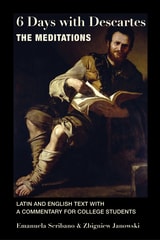
6 Days with Descartes
The Meditations, Latin and English Text with a Commentary for College StudentsRene Descartes
St. Augustine's Press, 2019
This new edition of Descartes’ Meditations by Zbigniew Janowski, wrote extensively on Descartes and 17th c. philosophy, was prepared with the first-year college student in mind. unlike all existing editions in english, which contain bare text of the Meditations, the novelty of this edition is that it includes a short commentary to each meditation, in which the editors help the reader follow Descartes’ steps and arguments.
In addition to their brief commentaries, the author also included short footnotes to the books and articles by contemporary Cartesian specialists who discuss in greater detail specific questions and problems which the text of the Meditations raises. In doing so, the author hopes to familiarize students with authors and titles of major works on Descartes, and with on-going scholarly controversies which this masterpiece of modern thought still inspires
Six Days with Descartes: The Meditations, Latin and English Text with a Commentary for College Students can also serve as a helpful tool for young and less experienced teachers of philosophy.
9/11
The Culture of CommemorationDavid Simpson
University of Chicago Press, 2006
In 9/11, Simpson argues that elements of the conventional culture of mourning and remembrance—grieving the dead, summarizing their lives in obituaries, and erecting monuments in their memory—have been co-opted for political advantage. He also confronts those who labeled the event an “apocalypse,” condemning their exploitation of 9/11 for the defense of torture and war.
In four elegant chapters—two of which expand on essays originally published in the London Review of Books to great acclaim—Simpson analyzes the response to 9/11: the nationally syndicated “Portraits of Grief” obituaries in the New York Times; the debates over the rebuilding of the World Trade Center towers and the memorial design; the representation of American and Iraqi dead after the invasion of March 2003, along with the worldwide circulation of the Abu Ghraib torture photographs; and the urgent and largely ignored critique of homeland rhetoric from the domain of critical theory.
Calling for a sustained cultural and theoretical analysis, 9/11 is the first book of its kind to consider the events of that tragic day with a perspective so firmly grounded in the humanities and so persuasive about the contribution they can make to our understanding of its consequences.
[...After the Media]
News from the Slow-Fading Twentieth CenturySiegfried Zielinski
University of Minnesota Press, 2013
The media are now redundant. In an overview of developments spanning the past seventy years, Siegfried Zielinski’s [ . . . After the Media] discusses how the means of technology-based communication assumed a systemic character and how theory, art, and criticism were operative in this process. Media-explicit thinking is contrasted with media-implicit thought. Points of contact with an arts perspective include a reinterpretation of the artist Nam June Paik and an introduction to the work of Jake and Dinos Chapman. The essay ends with two appeals. In an outline of a precise philology of exact things, Zielinski suggests possibilities of how things could proceed after the media. With a vade mecum against psychopathia medialis in the form of a manifesto, the book advocates for a distinction to be made between online existence and offline being.